


Court’s decision
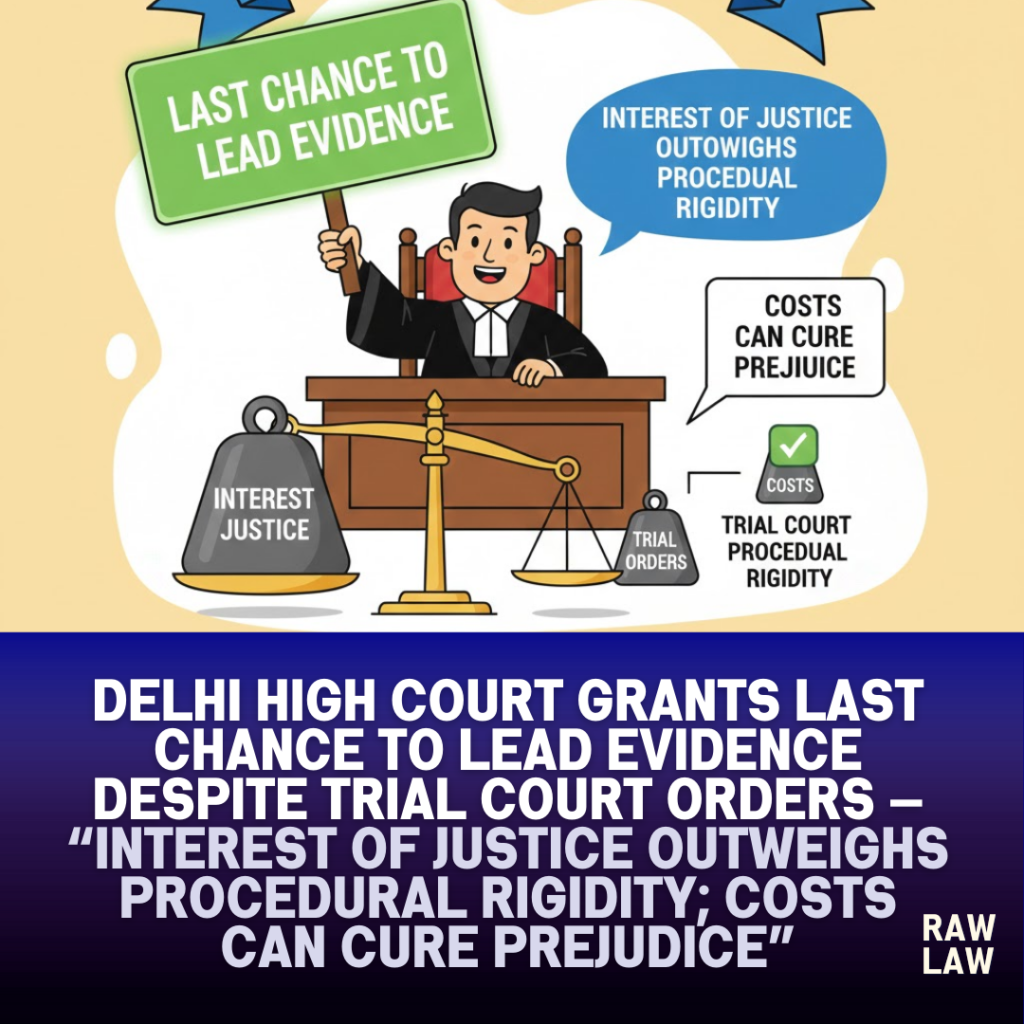
The Delhi High Court partially allowed a petition under Article 227 of the Constitution of India by granting the petitioner one final opportunity to lead her evidence in a pending civil suit, subject to payment of costs of ₹20,000 to the respondents. While declining to interfere with the trial court’s reasoned order rejecting appointment of a local commissioner, the Court held that closure of evidence, in the peculiar facts, could be relaxed in the interest of justice. Emphasising that procedural rules are handmaidens of justice, the Court ruled that any inconvenience to the opposing party could be adequately compensated by costs.
Facts
The petitioner instituted a civil suit before the District Judge, Delhi, seeking reliefs arising out of a private dispute between the parties. During the pendency of the suit, issues were framed in September 2024, and the matter was thereafter fixed for recording of the plaintiff’s evidence.
The petitioner moved an application under Order XXVI Rule 9 read with Section 151 of the Code of Civil Procedure, 1908, seeking appointment of a local commissioner. By an order dated 17 December 2025, the trial court dismissed the application, holding that no sufficient grounds were made out for issuance of a commission. Subsequently, by another order dated 24 December 2025, the trial court closed the evidence of the petitioner on the ground that despite multiple opportunities, the petitioner had failed to lead evidence.
Aggrieved by both orders, the petitioner approached the High Court invoking its supervisory jurisdiction under Article 227, contending that denial of an opportunity to lead evidence would cause grave and irreparable prejudice.
Issues
The principal issue before the High Court was whether, in exercise of supervisory jurisdiction under Article 227, it should interfere with the trial court’s orders rejecting the application for appointment of a local commissioner and closing the petitioner’s evidence. A related issue was whether procedural defaults attributable to illness and logistical constraints during hybrid hearings justified granting one more opportunity to lead evidence, notwithstanding prior orders of closure.
Petitioner’s arguments
The petitioner argued that issues in the suit had been framed in September 2024 and that she was genuinely prevented from leading evidence due to illness and adverse weather conditions. It was submitted that during the relevant period, court proceedings were being conducted in hybrid mode pursuant to a circular issued by the High Court, and practical difficulties arose in coordinating appearances and evidence.
The petitioner contended that the closure of evidence was unduly harsh and would result in serious miscarriage of justice, as she would be deprived of an opportunity to substantiate her case on merits. Stress was laid on the principle that disputes should ordinarily be decided after allowing parties to lead evidence, rather than on technical or procedural defaults. The petitioner urged the Court to adopt a liberal approach and permit one final opportunity to lead evidence.
Respondents’ arguments
The respondents opposed the petition, contending that the petitioner had been afforded sufficient opportunities by the trial court and had failed to avail them. It was argued that the present petition was a dilatory tactic intended to prolong the proceedings and delay adjudication of the suit.
The respondents further submitted that the order dated 17 December 2025 rejecting appointment of a local commissioner was a reasoned order passed in accordance with law, and no interference was warranted. With regard to closure of evidence, it was contended that procedural discipline must be maintained and that repeated indulgence undermines the authority of trial courts and the efficiency of the justice delivery system.
Analysis of the law
The High Court examined the scope of its supervisory jurisdiction under Article 227 of the Constitution of India. It reiterated that while Article 227 does not confer appellate powers, it enables the High Court to ensure that subordinate courts act within the bounds of their jurisdiction and do not cause grave injustice by adopting an unduly rigid or arbitrary approach.
The Court noted that closure of evidence is undoubtedly a serious procedural consequence, as it directly affects a party’s right to prove its case. At the same time, the Court recognised that trial courts are vested with discretion to regulate proceedings and prevent abuse of process. The task before the High Court, therefore, was to strike a balance between procedural discipline and substantive justice.
Precedent analysis
While the order itself was brief, the reasoning is consistent with long-standing judicial principles that procedural rules should not be applied in a manner that defeats substantive rights. Courts have repeatedly held that where denial of an opportunity to lead evidence would result in irreversible prejudice, a pragmatic and justice-oriented approach is warranted, subject to imposition of appropriate costs.
The High Court’s approach also aligns with precedents emphasising that supervisory jurisdiction can be exercised to correct procedural orders that, though technically valid, operate harshly in the given facts. At the same time, the Court reaffirmed that reasoned interlocutory orders, such as rejection of an application for appointment of a local commissioner, do not warrant interference merely because another view is possible.
Court’s reasoning
Applying these principles, the High Court drew a clear distinction between the two impugned orders. With respect to the order dated 17 December 2025 rejecting the application under Order XXVI Rule 9 CPC, the Court found no infirmity. It held that the trial court had passed a reasoned order, and the petitioner failed to demonstrate any jurisdictional error or perversity warranting interference.
However, on the issue of closure of evidence, the Court adopted a more liberal approach. Taking note of the petitioner’s explanation regarding illness, adverse weather conditions, and the prevailing hybrid mode of hearings, the Court held that it would be in the interest of justice to grant one final opportunity to lead evidence. The Court emphasised that denial of such opportunity could result in grave injustice, whereas any inconvenience caused to the respondents could be adequately addressed by imposing costs.
Accordingly, the Court granted one more opportunity to the petitioner to lead her evidence, subject to payment of costs of ₹20,000 to the respondents. It further clarified that the trial court would be at liberty to record the evidence on the date already fixed or on any other convenient date, thereby preserving the trial court’s control over scheduling.
Conclusion
The Delhi High Court disposed of the petition by partially allowing it. While it upheld the trial court’s order rejecting appointment of a local commissioner, it set aside the effect of the order closing the petitioner’s evidence by granting one final opportunity to lead evidence, subject to payment of costs. The Court thus balanced procedural discipline with the overarching goal of delivering substantive justice.
Implications
This decision reinforces the principle that civil litigation should, as far as possible, be decided on merits after affording parties a fair opportunity to present their evidence. It underscores that while trial courts are justified in enforcing procedural timelines, closure of evidence should not be mechanical where exceptional circumstances are shown.
For litigants and practitioners, the ruling serves as a reminder that supervisory jurisdiction under Article 227 can be invoked to prevent irreversible procedural injustice, but such indulgence will ordinarily be coupled with costs to deter laxity and compensate the opposing party. The judgment thus promotes a calibrated approach—firm on discipline, yet flexible in the service of justice.
Case law references
- Supervisory jurisdiction under Article 227 (general principle)
Held: High Courts may intervene to prevent grave procedural injustice without acting as appellate courts.
Applied: Used to grant one final opportunity to lead evidence. - Closure of evidence in civil trials (general principle)
Held: Evidence should not be shut out if denial would cause irreparable prejudice, subject to costs.
Applied: Basis for relaxing closure order.
FAQs
Q1. Can the High Court reopen evidence after a trial court closes it?
Yes. In exceptional cases, the High Court may grant a final opportunity to lead evidence under Article 227 to prevent miscarriage of justice.
Q2. Is rejection of a local commissioner application easily interfered with?
No. Such orders are discretionary and will not be interfered with unless they suffer from perversity or jurisdictional error.
Q3. Can costs compensate the opposite party for delay in civil trials?
Yes. Courts often impose costs while granting additional opportunities to balance fairness and procedural discipline.