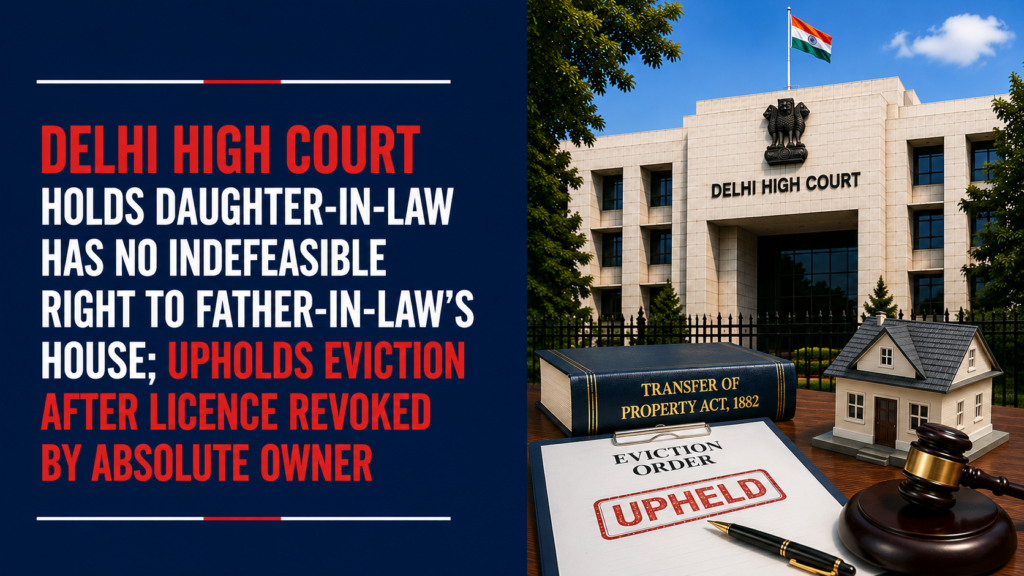
Delhi High Court Holds Daughter-in-Law Has No Indefeasible Right to Father-in-Law’s House; Upholds Eviction After Licence Revoked by Absolute Owner

Daughter-in-Law Has No Indefeasible Right to Continue in Father-in-Law’s Property, Holds Delhi High Court
Facts
The respondent, Sh. Chand Babu, was the owner of House No. 201, Ground Floor, MIG Flats (Metro Apartments), Jahangir Puri, Delhi. After the marriage of his son, Sh. Brij Raj, with Smt. Renu Raj on 28 January 2012, he permitted them to reside in one room of the property out of love and affection.
According to the respondent, from December 2014 onwards, the appellants became hostile, failed to care for him in his old age, and even threatened to dispossess him from his own house. Consequently, he revoked their permission to stay by issuing a legal notice dated 13 July 2015 and filed a suit seeking mandatory injunction directing them to vacate the premises along with damages for unauthorised occupation.
The Trial Court decreed the suit for possession but declined damages. The First Appellate Court affirmed the decree, leading the son and daughter-in-law to file the present Regular Second Appeal before the Delhi High Court.
Issues
- Whether the son and daughter-in-law had any legal right to continue occupying the father’s self-acquired property after permission to reside was withdrawn.
- Whether the daughter-in-law could claim an indefeasible right of residence in the father-in-law’s property as a shared household.
- Whether the son had established co-ownership by alleging financial contribution towards purchase of the property.
- Whether any substantial question of law arose warranting interference under Section 100 CPC.
Appellants’ Arguments
The appellants contended that:
- the daughter-in-law was residing in the property after marriage and therefore shared a domestic relationship with the respondent;
- relying on Prabha Tyagi v. Kamlesh Devi, she possessed a right to reside in the shared household irrespective of ownership;
- the son had contributed ₹2 lakh towards purchase of the property after the respondent assured him that the sale deed would be executed in his favour;
- the Trial Court failed to appreciate their financial contribution and wrongly ignored their defence while decreeing possession.
Respondent’s Arguments
The respondent argued that:
- he was the absolute owner of the suit property, as established by the allotment letter and payment receipts;
- the appellants were merely permissive occupants, whose licence stood terminated by the legal notice dated 13 July 2015;
- the appellants failed to produce any evidence proving contribution towards purchase or any ownership rights;
- the daughter-in-law’s right of residence could not override the respondent’s ownership once the permissive occupation had been lawfully withdrawn.
Analysis of the Law
The Court examined:
- Section 100 of the Code of Civil Procedure, 1908, governing the scope of a Regular Second Appeal;
- principles relating to mandatory injunction;
- the concept of a shared household under the Protection of Women from Domestic Violence Act, 2005;
- the legal status of permissive occupation in another’s property.
The Court reiterated that a Second Appeal lies only where a substantial question of law arises. Pure findings of fact concurrently recorded by the Trial Court and First Appellate Court cannot ordinarily be reopened.
Precedent Analysis
The Court relied upon:
- Prabha Tyagi v. Kamlesh Devi — recognising that a daughter-in-law residing with her husband’s family is in a domestic relationship and may claim residence in a shared household.
- Satish Chander Ahuja v. Sneha Ahuja, (2021) 1 SCC 414 — clarifying that although a daughter-in-law has a right of residence in a shared household, the right is not indefeasible and she may be dispossessed only in accordance with law.
Applying these decisions, the Court held that the appellants had been proceeded against through a lawful civil suit and decree, thereby satisfying the requirement that dispossession occur only in accordance with law.
Court’s Reasoning
The High Court noted that ownership of the property in favour of the respondent stood proved through documentary evidence and was never displaced by any evidence from the appellants.
The son’s assertion that he had contributed ₹2 lakh towards purchase remained a bald allegation because no evidence whatsoever was led in support of that claim.
Regarding the daughter-in-law’s claim, the Court acknowledged that Prabha Tyagi and Satish Chander Ahuja recognise a daughter’s-in-law right to reside in a shared household. However, that right does not create a permanent or indefeasible entitlement to occupy the father-in-law’s self-acquired property.
Since the respondent had revoked the appellants’ permissive occupation and sought their eviction through a duly instituted civil suit, the requirement that dispossession be effected in accordance with law stood fully satisfied.
The Court further held that the appellants merely sought re-appreciation of concurrent findings of fact and failed to demonstrate any substantial question of law under Section 100 CPC.
Conclusion
The Delhi High Court dismissed the Regular Second Appeal and upheld the concurrent judgments of the Trial Court and the First Appellate Court.
The Court held that the appellants had no legal right to continue occupying the respondent’s self-acquired property after the permissive occupation was revoked. It further clarified that although a daughter-in-law may claim residence in a shared household, such right is not absolute and does not override the father’s ownership once eviction is sought through due process of law.
Case Details
Case: Sh. Brij Raj & Anr. v. Sh. Chand Babu
Court: Delhi High Court
Case Number: RSA 185/2024
Judge: Justice Neena Bansal Krishna
Date: 4 August 2026
Result: Regular Second Appeal dismissed. The Delhi High Court upheld the decree directing the son and daughter-in-law to hand over vacant possession of the father’s property, holding that the daughter-in-law’s right to reside in a shared household is not indefeasible and that no substantial question of law arose.