

Court’s decision
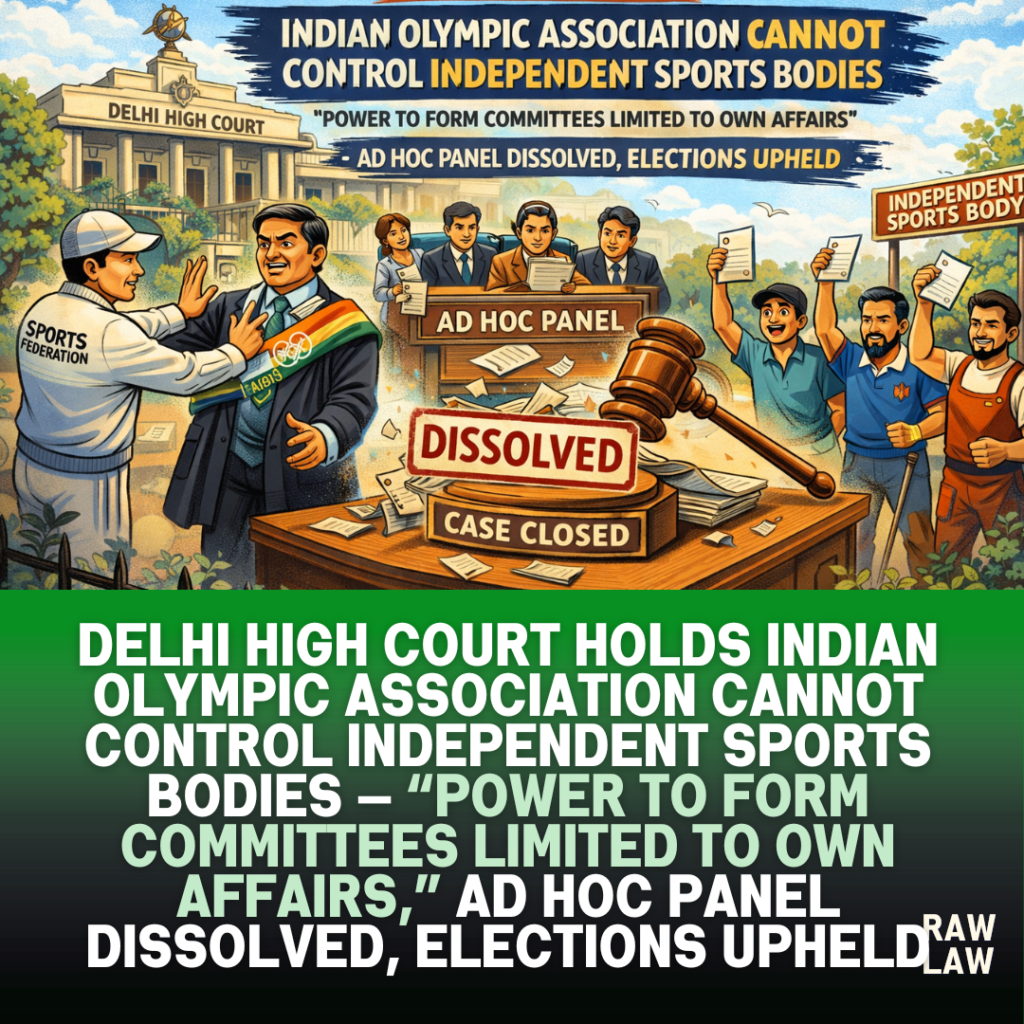
The Delhi High Court dismissed the intra-court appeal and upheld the Single Judge’s ruling that the Indian Olympic Association (IOA) had no authority to appoint an ad hoc committee to manage the affairs of an independent sports body. The Court confirmed that such interference was ultra vires and ordered elections to be conducted, while modifying the judgment to shift the cost of conducting elections to the concerned sports body instead of the IOA.
Facts
The dispute arose when the President of the Indian Olympic Association issued an office order appointing an ad hoc committee to manage the affairs of a sports federation, including athlete selection and conducting elections.
The affected sports body challenged this action before the High Court, arguing that it was an independent society registered under the Karnataka Societies Registration Act and not subject to direct control by the IOA.
The Single Judge quashed the office order, dissolved the ad hoc committee, and directed that elections be conducted under the supervision of a retired judge. The IOA challenged this decision through a Letters Patent Appeal.
Issues
The primary issue was whether the Indian Olympic Association has the authority to appoint an ad hoc committee to manage the affairs of an independent sports federation.
A related issue was whether provisions of the National Sports Governance Act, 2025 and related rules applied to the concerned sports body.
The Court also examined whether the direction to conduct elections was legally sustainable.
Petitioner’s arguments
The appellant contended that its internal rules, particularly Article 17.5, empowered it to constitute committees, including ad hoc bodies, to manage affiliated organizations. It argued that the appointment was justified due to internal disputes and complaints within the sports federation.
The appellant further argued that the Single Judge’s direction to conduct elections violated the National Sports Governance Act, 2025 and the Rules of 2026, which prescribe a statutory framework for sports governance and elections. It was submitted that without compliance with statutory requirements, including establishment of a National Sports Election Panel, elections could not be conducted.
Respondent’s arguments
The respondent argued that it was an independent legal entity registered as a society and that the IOA had no statutory or contractual authority to interfere in its governance.
It was contended that Article 17.5 only allows formation of internal committees of the IOA and cannot be extended to control other entities.
The respondent also argued that the National Sports Governance Act, 2025 did not apply to it, as it was neither recognized as a National Sports Federation nor registered as a National Sports Body under the Act.
Analysis of the law
The Court analyzed the scope of authority of the Indian Olympic Association under its constitution and the statutory framework governing sports bodies.
It emphasized that societies registered under state law are autonomous entities governed by their own memorandum, bye-laws, and rules. External bodies cannot assume control unless expressly authorized by law.
The Court also examined the National Sports Governance Act, 2025 and clarified that its provisions apply only to recognized National Sports Bodies. Entities outside that framework are governed by their own governing documents.
Precedent analysis
The Court relied on earlier decisions affirming the autonomy of registered societies and limiting interference by umbrella organizations.
It also referred to prior rulings holding that sports governance must adhere to statutory recognition frameworks, and that entities not recognized under such frameworks cannot be subjected to those statutory provisions.
The Court reaffirmed principles of administrative law that powers must be exercised strictly within the scope of authority granted.
Court’s reasoning
The Court held that Article 17.5 of the IOA rules was misinterpreted by the appellant. It clarified that the provision permits formation of committees only for internal purposes of the IOA and does not extend to external bodies.
It found that the sports federation was an independent society and not a recognized National Sports Body. Therefore, the provisions of the National Sports Governance Act, 2025 were inapplicable.
The Court rejected the argument that elections could not be conducted due to statutory constraints, noting that such constraints apply only to recognized bodies under the Act.
It further held that the IOA had no legal basis to appoint an ad hoc committee, making the action ultra vires.
However, the Court modified the Single Judge’s order to clarify that the cost of conducting elections should be borne by the concerned sports body and not by the IOA.
Conclusion
The Delhi High Court upheld the dissolution of the ad hoc committee and the direction to conduct elections, while modifying the order on costs. The appeal was disposed of accordingly.
Implications
This judgment reinforces the autonomy of sports bodies registered as independent societies and limits the powers of umbrella organizations like the IOA.
It clarifies the scope of the National Sports Governance Act, 2025, emphasizing that its provisions apply only to recognized entities.
The ruling also underscores that governance disputes in sports bodies must be resolved within their internal frameworks unless statutory intervention is warranted.
For sports governance in India, the decision marks a significant assertion of institutional independence and legal clarity.
Case law references
Bihar Olympic Association v. President Indian Olympic Association
Held that IOA cannot appoint ad hoc committees for independent bodies.
Principles under Societies Registration law
Recognize autonomy of registered societies in managing their internal affairs.
Sports governance jurisprudence
Clarifies applicability of statutory frameworks only to recognized entities.
FAQs
1. Can the Indian Olympic Association appoint ad hoc committees for sports federations?
No. The Court held that IOA’s powers are limited to its own internal affairs and do not extend to independent societies.
2. Does the National Sports Governance Act, 2025 apply to all sports bodies?
No. It applies only to recognized National Sports Bodies under the Act.
3. Who conducts elections in independent sports federations?
Elections are governed by the federation’s own bye-laws unless it is recognized under statutory frameworks.


