


Headnote
Arbitration and Conciliation Act, 1996 – Sections 2(2), 34, 37 – International commercial arbitration – Seat of arbitration – ICC Rules – Governing law versus curial law – Pre-BALCO agreements – Exclusion of Part I – Jurisdiction of Indian courts.
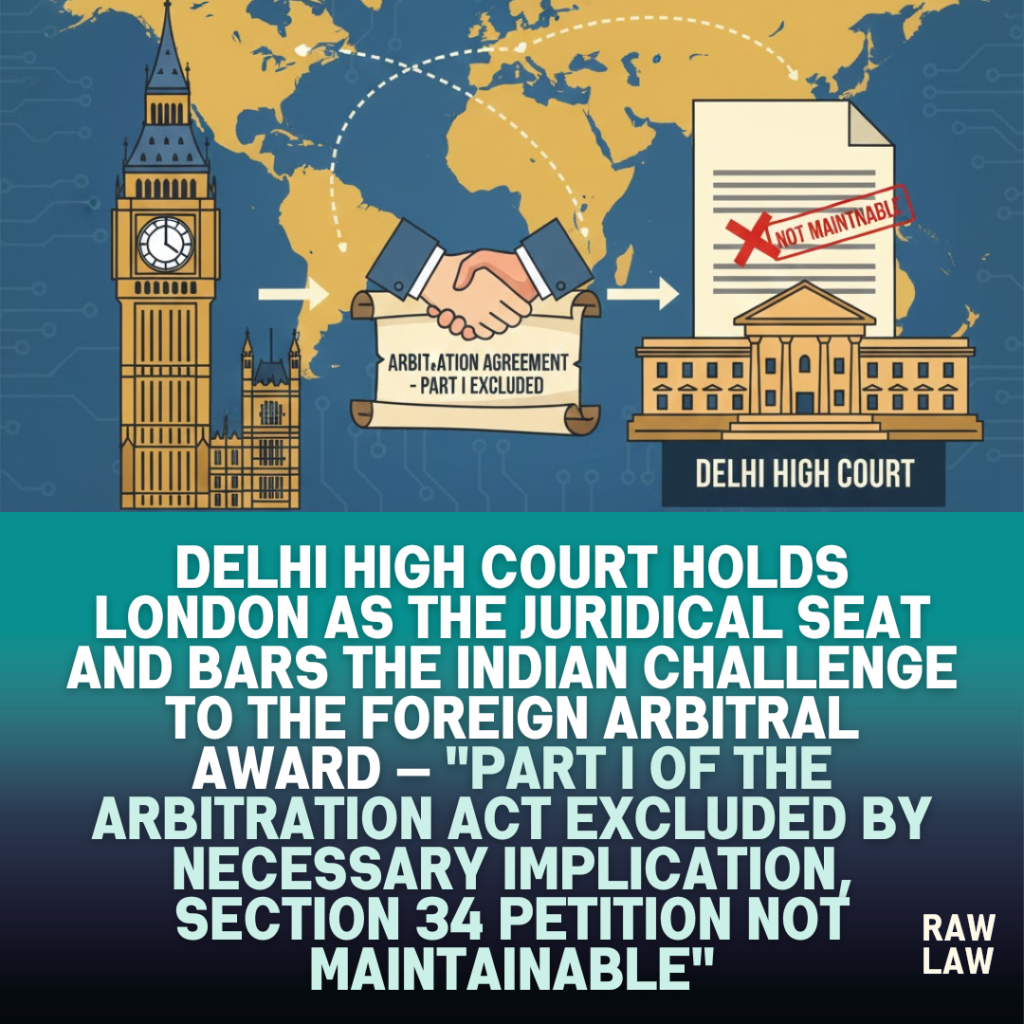
Held, where parties to an international commercial arbitration have expressly designated a foreign seat of arbitration, such designation carries with it the law of the seat as the curial law and necessarily excludes the applicability of Part I of the Arbitration and Conciliation Act, 1996, even in agreements executed prior to the decision in BALCO. The choice of Indian law as the governing law of the substantive contract does not, by itself, confer supervisory jurisdiction on Indian courts when the juridical seat is outside India. Under the post-Reliance Industries and Arif Azim framework, Part I applies only where the seat of arbitration is in India or where no seat can be determined and the arbitration agreement is governed by Indian law. Once London is established as the juridical seat under ICC arbitration clauses, challenges to jurisdiction, interim awards, or final awards lie exclusively before courts of the seat. Consequently, a petition under Section 34 before an Indian court is not maintainable, and dismissal of such challenge on jurisdictional grounds is legally sound.
Court’s decision
The Delhi High Court dismissed an appeal under Section 37 of the Arbitration and Conciliation Act, affirming the Single Judge’s view that Indian courts lacked jurisdiction to entertain a Section 34 challenge against arbitral awards rendered in London-seated ICC arbitrations. The Court held that Part I of the Act stood excluded by necessary implication, and therefore the challenge to the partial and final arbitral awards was not maintainable in India.
Facts
The dispute arose out of contracts executed in connection with the Delhi Airport Metro Express Line project. A special purpose vehicle incorporated in India entered into two agreements with a foreign rolling-stock supplier and its Indian subsidiary: a Rolling Stock Supply Contract and a Maintenance Services Agreement. Both agreements provided for arbitration under the ICC Rules, with London stipulated as the seat or place of arbitration, while Indian law governed the substantive contracts.
Disputes emerged regarding alleged defects in rolling stock and the encashment of a performance bank guarantee. Arbitration was initiated in London, resulting in a partial award on jurisdiction, a separate partial award on costs, and a final award directing refund of the bank guarantee amount. Aggrieved, the Indian party approached the Delhi High Court under Section 34 of the Act. The Single Judge dismissed the petition for want of jurisdiction, leading to the present appeal.
Issues
The central issue before the Division Bench was whether Part I of the Arbitration and Conciliation Act, 1996 applied to the arbitral proceedings and awards, thereby enabling a challenge under Section 34 before Indian courts. Subsidiary issues included determination of the juridical seat of arbitration, the effect of differing arbitration clauses in the two contracts, and the relevance of the governing law being Indian law.
Appellant’s arguments
The appellant argued that the contracts were executed prior to the BALCO decision and were therefore governed by the Bhatia International regime, under which Part I applied unless expressly excluded. It was contended that while the Maintenance Services Agreement expressly excluded Part I, the Supply Contract did not, indicating an intention to retain Indian court jurisdiction. The appellant further relied on the choice of Indian law as the governing law and on the respondent’s earlier invocation of Section 9 jurisdiction before the Delhi High Court to assert that Indian courts retained supervisory control.
Respondents’ arguments
The respondents submitted that London was unequivocally designated as the seat of arbitration under both contracts and that arbitration was conducted under ICC Rules, pointing to a clear intention to exclude Part I. They argued that even under pre-BALCO agreements, Part I stands excluded by necessary implication where the seat is foreign, as clarified in Reliance Industries and Arif Azim. It was also contended that the Section 9 petition related to the bank guarantee and did not confer jurisdiction to entertain a Section 34 challenge to a foreign award.
Analysis of the law
The Court undertook an extensive analysis of the evolution of Indian arbitration jurisprudence, tracing the shift from the Bhatia International doctrine of concurrent jurisdiction to the seat-centric approach affirmed in BALCO. It noted that subsequent decisions, particularly Reliance Industries and Arif Azim, have clarified that even for pre-2012 agreements, Part I is excluded where the seat is outside India or where such exclusion arises by necessary implication.
The Court reiterated that the seat of arbitration determines the curial law and supervisory jurisdiction. The governing law of the substantive contract does not alter this position unless the seat cannot be determined.
Precedent analysis
The Bench relied heavily on BALCO, Reliance Industries Ltd. v. Union of India, Roger Shashoua v. Mukesh Sharma, BGS SGS Soma JV v. NHPC Ltd., and Arif Azim Co. Ltd. v. Micromax Informatics FZE. These authorities were applied to reaffirm that designation of London as the seat, coupled with ICC Rules and absence of contrary indicia, conclusively fixed the juridical seat outside India.
Court’s reasoning
Applying the settled principles, the Court held that both contracts, read harmoniously, evinced a clear intention to seat arbitration in London. The express exclusion of Part I in one agreement reinforced this intention rather than undermining it. The Court rejected the appellant’s reliance on Section 42 and prior Section 9 proceedings, holding that interim relief proceedings do not confer supervisory jurisdiction over the arbitral process or awards.
Conclusion
The appeal was dismissed. The Delhi High Court upheld the dismissal of the Section 34 petition, holding that Indian courts lack jurisdiction to set aside arbitral awards rendered in London-seated ICC arbitrations.
Implications
This judgment strengthens India’s pro-arbitration, seat-centric framework and brings certainty to international commercial arbitration. It underscores that parties choosing a foreign seat cannot later seek Indian court intervention under Part I, thereby reinforcing finality, predictability, and alignment with international arbitration norms.
Case-law references
- Bhatia International v. Bulk Trading S.A. – Concurrent jurisdiction doctrine (now diluted).
- Bharat Aluminium Co. v. Kaiser Aluminium – Territorial, seat-centric approach.
- Reliance Industries Ltd. v. Union of India – Necessary implication exclusion of Part I.
- Arif Azim Co. Ltd. v. Micromax Informatics FZE – Consolidated position on Part I applicability.
- Roger Shashoua v. Mukesh Sharma – Seat determination principle.
FAQs
1. Can Indian courts set aside a foreign-seated arbitral award under Section 34?
No. Where the seat of arbitration is outside India, Part I of the Act is excluded and Section 34 is not maintainable.
2. Does Indian governing law make Indian courts competent?
No. Governing law of the contract does not override the effect of a foreign seat.
3. Do pre-BALCO agreements still allow Indian jurisdiction?
Only if the seat is in India or Part I is not excluded. A foreign seat excludes Part I even in pre-2012 agreements.