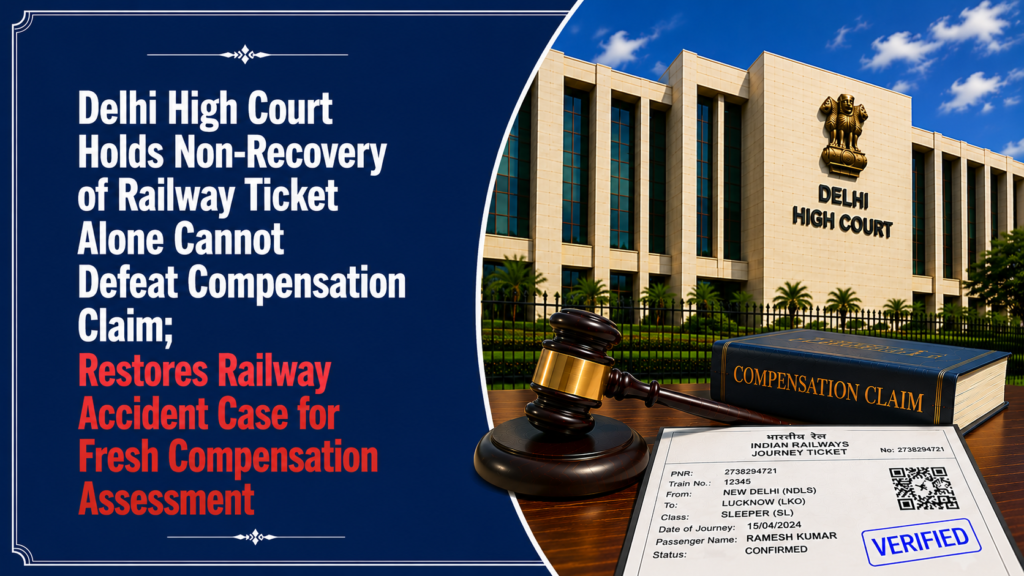
Delhi High Court Holds Non-Recovery of Railway Ticket Alone Cannot Defeat Compensation Claim; Restores Railway Accident Case for Fresh Compensation Assessment

Non-Recovery of Journey Ticket Does Not Prove Ticketless Travel, Rules Delhi High Court
Facts
The appellants challenged the order of the Railway Claims Tribunal dismissing their claim for compensation arising from the death of Abhishek Mishra.
According to the appellants, on 28 April 2022, the deceased purchased a valid journey ticket to travel by Train No. 12558 (Sapt Kranti Superfast Express) from Anand Vihar to Bapudham (Motihari), Bihar. During the journey, near Mundhapanday, ahead of Moradabad, he accidentally fell from the running train due to heavy rush and jostling among passengers, sustained grievous injuries and later succumbed to them in the District Hospital, Moradabad.
The Railway Claims Tribunal dismissed the claim, holding that the deceased had failed to establish that he was a bona fide passenger and that the incident did not amount to an “untoward incident” under the Railways Act, 1989.
Issues
- Whether the deceased was a bona fide passenger travelling with a valid railway ticket.
- Whether non-recovery of the journey ticket justified rejection of the compensation claim.
- Whether the deceased’s fall from the running train constituted an “untoward incident” under the Railways Act, 1989.
- Whether the Railway Claims Tribunal rightly dismissed the compensation claim.
Petitioner’s Arguments
The appellants contended that:
- They had consistently pleaded that the deceased had purchased a valid journey ticket before commencing his journey and that the ticket was lost in the accident.
- AW-2 (the deceased’s brother) specifically deposed that he had accompanied the deceased to Anand Vihar Railway Station, witnessed the purchase of the ticket and saw him board the train.
- The Tribunal wrongly treated the inability to establish the exact source of purchase as proof that the deceased was travelling without a ticket.
- The deceased’s accidental fall from the train stood sufficiently established by the surrounding circumstances.
Respondent’s Arguments
The Union of India argued that:
- No journey ticket was recovered during the jamatalashi (personal search).
- Commercial verification revealed that Gupta Communication, from where the ticket was allegedly purchased, was not an authorised railway ticket vendor.
- No untoward incident had been reported in the railway records.
- The Railway Claims Tribunal had therefore correctly rejected the claim.
Analysis of the Law
The Court examined the provisions governing compensation for untoward incidents under the Railways Act, 1989, particularly the principles relating to bona fide passengers.
The Court reiterated that:
- The claimant’s initial burden is only to place sufficient material showing bona fide travel.
- Once that burden is discharged, the onus shifts to the Railway Administration to establish that the deceased was travelling without lawful authority.
- Mere non-recovery of the ticket or doubts regarding the place of purchase do not, by themselves, establish ticketless travel.
- Once bona fide travel is proved, the Railways must establish that the case falls within one of the statutory exceptions under the proviso to Section 124-A of the Act.
Precedent Analysis
The Court relied upon:
- Union of India v. Rina Devi (2019) 3 SCC 572 — holding that the claimant’s initial burden may be discharged through affidavits and surrounding circumstances and that mere non-recovery of a railway ticket does not negate bona fide travel.
- Lata v. Union of India (2026 SCC OnLine SC 1350) — reaffirming that once the claimant establishes bona fide travel, the burden shifts to the Railways to rebut the claim through cogent evidence.
Court’s Reasoning
The Court held that the appellants had successfully discharged their initial burden.
The claim petition, the affidavit of the deceased’s father (AW-1), and the testimony of AW-2, who accompanied the deceased to the railway station and witnessed the purchase of the ticket and boarding of the train, consistently established that the deceased had commenced his journey with a valid ticket.
The Court found that the Railway Administration produced no affirmative evidence to establish that the deceased was travelling without authority. At best, the commercial verification merely cast doubt on the alleged source of purchase of the ticket. It did not establish that no ticket had ever been purchased.
On the occurrence itself, the Court observed that the DRM Report, DD entries and contemporaneous medical records consistently showed that the deceased was found injured near the railway track after falling from a train.
The absence of information reaching the Guard or Station Master during the journey, or the absence of an eyewitness, could not by itself disprove the occurrence of the accident.
Having held that the deceased was a bona fide passenger, the Court further held that the Railways failed to establish that the case fell within any of the statutory exceptions under the proviso to Section 124-A. Consequently, the accidental fall constituted an “untoward incident” under the Railways Act.
Conclusion
The Delhi High Court held that the deceased was a bona fide passenger and that his accidental fall from the running train constituted an untoward incident under the Railways Act, 1989.
Accordingly, the Court allowed the appeal, set aside the Tribunal’s judgment and remanded the matter to the Railway Claims Tribunal for determination and disbursement of compensation in accordance with law within two months of receipt of the order.
Case Details
Case: Sh. Sanjeet Mishra & Anr. v. Union of India
Court: Delhi High Court
Case Number: FAO 17/2024
Judge: Hon’ble Mr. Justice Manoj Kumar Ohri
Date: 03 August 2026
Result: Delay of 175 days in filing the appeal condoned. Appeal allowed. Tribunal’s judgment set aside; deceased held to be a bona fide passenger and victim of an untoward incident; matter remanded to the Railway Claims Tribunal for assessment and disbursement of compensation.