Delhi High Court Denies Bail to Athar Khan in Delhi Riots UAPA Case, Holds His Role Distinguishable from Co-Accused Granted Bail
Facts
The appeal was filed by Athar Khan under Section 21(4) of the National Investigation Agency Act, 2008 read with Section 483 of the Bharatiya Nagarik Suraksha Sanhita, 2023.
The appeal challenged the order dated 29 January 2026 passed by the Additional Sessions Judge-03, Shahdara, Karkardooma Court, Delhi, rejecting his second regular bail application in Sessions Case No. 163 of 2020 arising from FIR No. 59 of 2020 registered at Police Station Crime Branch, Delhi.
The case relates to the North-East Delhi riots of February 2020, in which 53 persons lost their lives, more than 100 persons were injured, and extensive damage was caused to public and private property.
The FIR was initially registered under Sections 147, 148, 149 and 120B of the IPC. During investigation, several other provisions were added, including offences under the Unlawful Activities (Prevention) Act, 1967, the Arms Act and the Prevention of Damage to Public Property Act.
The prosecution alleged that a deep-rooted criminal conspiracy was hatched by several accused persons, including the appellant, to organise large-scale riots in protest against the Citizenship Amendment Act and the National Register of Citizens.
The appellant was initially examined as a witness, but was later arrested on 2 July 2020 and arrayed as Accused No. 15 in the main chargesheet dated 16 September 2020.
His first bail application was rejected by the Trial Court on 12 October 2022. That order was challenged before the Delhi High Court, but a Co-ordinate Bench rejected the appeal on 2 September 2025.
Several co-accused challenged the High Court’s 2025 judgment before the Supreme Court in Gulfisha Fatima v. State (Govt. of NCT of Delhi). The Supreme Court granted bail to some co-accused but denied bail to others, including Umar Khalid and Sharjeel Imam. The present appellant did not challenge the earlier High Court judgment before the Supreme Court.
After the Supreme Court’s decision in Gulfisha Fatima, the appellant filed a second bail application before the Trial Court, seeking parity with the co-accused who had been granted bail. The Trial Court rejected the application, leading to the present appeal before the Delhi High Court.
Issues
- Whether the appellant was entitled to regular bail on the ground of parity with co-accused persons who were granted bail by the Supreme Court in Gulfisha Fatima.
- Whether the earlier rejection of bail by the Delhi High Court, which was not challenged by the appellant before the Supreme Court, had attained finality against him.
- Whether the allegations and material against the appellant satisfied the embargo under Section 43D(5) of the UAPA.
- Whether prolonged incarceration and delay in trial justified grant of bail despite the seriousness of allegations.
- Whether the appellant’s alleged role was merely that of a local-level facilitator or that of a core conspirator.
Petitioner’s Arguments
The appellant argued that his role was similar to that of co-accused persons who had been granted bail by the Supreme Court in Gulfisha Fatima, particularly co-accused Shadab Ahmad.
He submitted that he was at best a local-level facilitator or executor and had no decision-making power in the alleged conspiracy.
The appellant argued that there were more than 880 witnesses to be examined and that he had already spent around six years in custody. Therefore, continued incarceration would violate his right to speedy trial and personal liberty.
He relied on Syed Iftikhar Andrabi v. National Investigation Agency, Jammu and other recent Supreme Court decisions to argue that prolonged incarceration can justify bail even in UAPA cases.
The appellant also challenged the reliability of the protected witness “Pluto”. He submitted that there were material contradictions and improvements between the witness’s statements under Sections 161 and 164 of the CrPC.
He further argued that his WhatsApp chats, properly read, showed that the plan was only to organise non-violent protests. He submitted that he was not found in possession of weapons, had no direct meeting with Umar Khalid, and no incriminating article was recovered from him.
He also sought parity with co-accused Gulfisha Fatima, arguing that she had a more active role but was granted bail by the Supreme Court.
Respondent’s Arguments
The State opposed the appeal and argued that the appellant’s role was much more serious than that of the co-accused who had been granted bail.
The State relied on the statement of protected witness “Pluto”, who allegedly attributed to the appellant the statement that unless 100-200 people were killed and arson took place at 100-200 places, the issue would not be resolved.
The State also relied on WhatsApp conversations involving the appellant and Ovais Sultan Khan. According to the State, these chats showed that the appellant was advocating violent protests even though others were asking him to keep the protests non-violent.
The State argued that the appellant had already challenged the rejection of his first bail application before the High Court and failed. Since he did not approach the Supreme Court against the High Court’s order dated 2 September 2025, the findings against him had attained finality.
The State submitted that the embargo under Section 43D(5) of the UAPA continued to apply because the accusations against the appellant were prima facie true.
It was further argued that unlike other accused who were granted bail, there was material suggesting that the appellant had encouraged violence leading to deaths. Therefore, he could not claim parity.
Analysis of the Law
The Court examined the principles governing bail under UAPA, especially Section 43D(5), which restricts grant of bail where the Court is of the opinion that the accusations against the accused are prima facie true.
The Court also considered the effect of prolonged incarceration and the right to speedy trial, particularly in light of Supreme Court decisions such as K.A. Najeeb, Syed Iftikhar Andrabi, and Tasleem Ahmed.
The Court noted that although constitutional courts can grant bail in cases of prolonged incarceration, even in special statute cases, this power must be exercised after considering the role of the accused, the gravity of allegations, the likelihood of influencing witnesses, and the possibility of the trial being disrupted.
The Court further considered the general principles of bail laid down in State of U.P. v. Amarmani Tripathi and Prasanta Kumar Sarkar v. Ashis Chatterjee, including prima facie case, nature and gravity of accusation, severity of punishment, risk of absconding, likelihood of repetition, possibility of influencing witnesses, and danger of justice being thwarted.
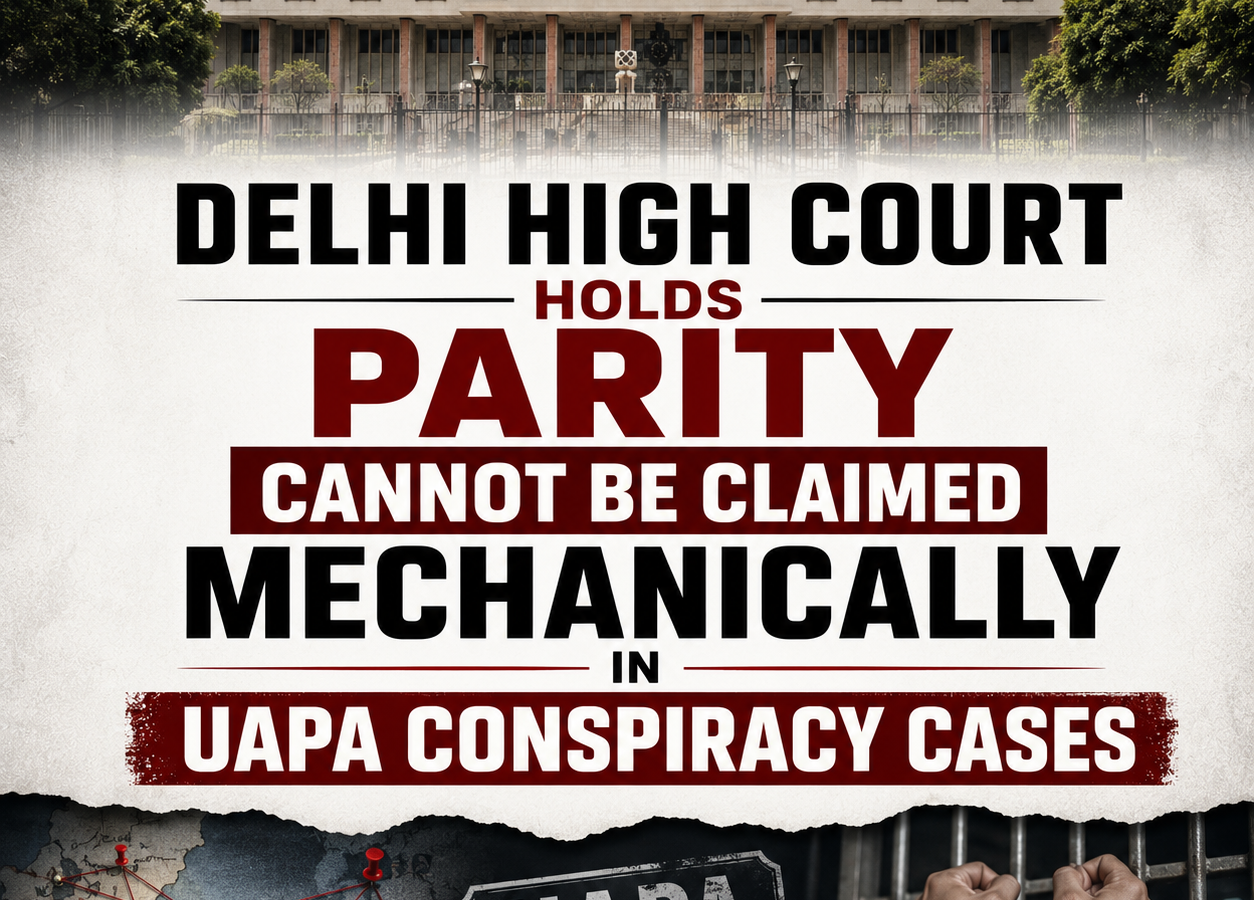
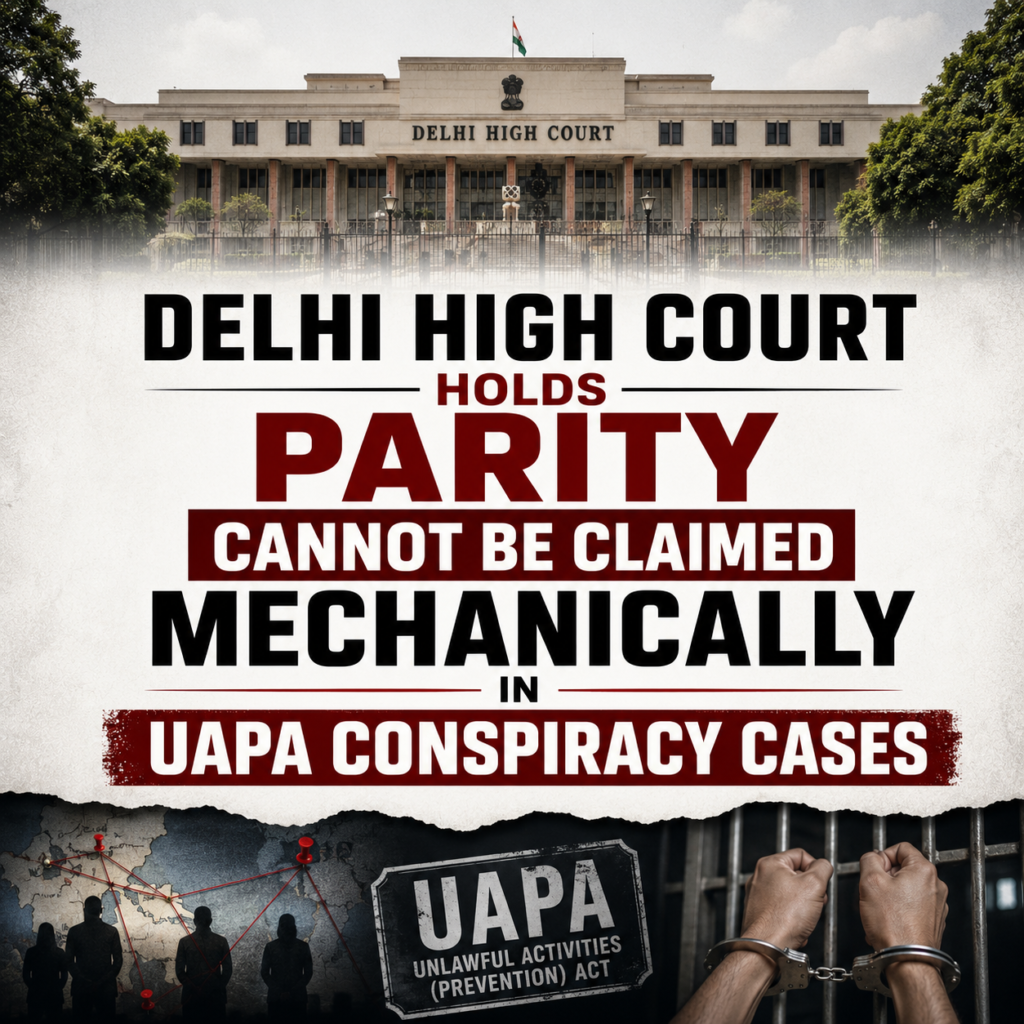
The Court held that parity cannot be applied mechanically. Each accused’s role must be individually assessed, especially in conspiracy cases involving UAPA allegations and mass violence.
Precedent Analysis
The Court discussed Gulfisha Fatima v. State (Govt. of NCT of Delhi) in detail. In that case, the Supreme Court distinguished between core conspirators and field-level operators.
The Supreme Court denied bail to Umar Khalid and Sharjeel Imam, holding that their roles were not episodic but strategic or architectural in the alleged conspiracy. It granted bail to some other accused whose roles were considered operational, derivative or limited.
The appellant relied particularly on the grant of bail to Shadab Ahmad. However, the High Court noted that the Supreme Court found Shadab to be a site-level executor or conduit, without independent command or strategic control. The Court held that the appellant’s role, based on the material before it, was more serious.
The Court also considered the role of Gulfisha Fatima, who was granted bail. However, the Court noted that the Supreme Court treated her role as similar to that of Natasha Narwal and Devangana Kalita, and not as someone having independent command or strategic oversight.
The Court relied on Syed Iftikhar Andrabi, where the Supreme Court emphasised that prolonged incarceration and Article 21 cannot be ignored even under UAPA. However, the Court also noted that after that decision, the issue concerning bail under special statutes and prolonged incarceration was referred to a larger Bench in Tasleem Ahmed v. State Govt. of NCT of Delhi.
The Court further referred to State of Punjab v. Balraj Singh, where the Supreme Court observed that when personal liberty and national security concerns conflict, the interest of justice and national interest must be carefully considered.
Court’s Reasoning
The Court first noted that this was the appellant’s second regular bail application. His first bail rejection had already been upheld by a Co-ordinate Bench of the High Court on 2 September 2025. The appellant did not challenge that decision before the Supreme Court.
Therefore, the Supreme Court in Gulfisha Fatima did not examine the appellant’s individual role. As a result, the appellant could not automatically claim the benefit of findings recorded in favour of other co-accused.
The Court found that the statement of protected witness “Pluto” was extremely serious. The witness allegedly stated that the appellant had spoken of shaking Delhi, causing arson at 100-200 places, and killing 100-200 people before the issue would be resolved.
The Court also found corroboration in WhatsApp messages exchanged with Ovais Sultan Khan. These messages showed that others were asking the appellant not to resort to violence and to keep protests non-violent, but the appellant allegedly persisted with the idea of violent protest.
On this basis, the Court held that the appellant could not be treated as a mere local-level operator. Prima facie, he appeared to be one of the main conspirators who allegedly encouraged violence and deaths during the riots.
The Court rejected the argument of parity with co-accused such as Shadab Ahmad and Gulfisha Fatima. It held that the appellant’s role was distinguishable because the material against him allegedly showed direct exhortation toward violence, deaths and destruction of property.
The Court also held that if released on bail, the appellant could pose a flight risk and may influence protected witnesses whose evidence was yet to be recorded.
The Court clarified that the observations were only for deciding bail and would not influence the Trial Court during trial.
Conclusion
The Delhi High Court dismissed the appeal and upheld the Trial Court’s order rejecting bail to Athar Khan.
The Court held that the appellant’s role was prima facie distinguishable from the co-accused who had been granted bail by the Supreme Court.
It held that the material against the appellant, including the statement of protected witness “Pluto” and WhatsApp chats, prima facie indicated an active role in violent protests, destruction of public and private property, and deaths during the riots.
The Court further held that the embargo under Section 43D(5) of the UAPA applied and that the appellant was not entitled to bail even on ordinary bail principles due to the gravity of allegations, risk of influencing witnesses, and possibility of flight.
The appeal was dismissed, and the order rejecting bail was upheld.
Case Details
Case: Athar Khan v. State of NCT of Delhi
Court: Delhi High Court
Case Number: CRL.A. 137/2026 & CRL.M.A. 9910/2026
Judge: Justice Prathiba M. Singh and Justice Madhu Jain
Date: 07 July 2026
Result: Appeal dismissed; regular bail refused; Trial Court’s bail rejection order upheld.
Read Also: Delhi High Court Says Tenant Cannot Claim Ownership Based on an Oral Sale Agreement