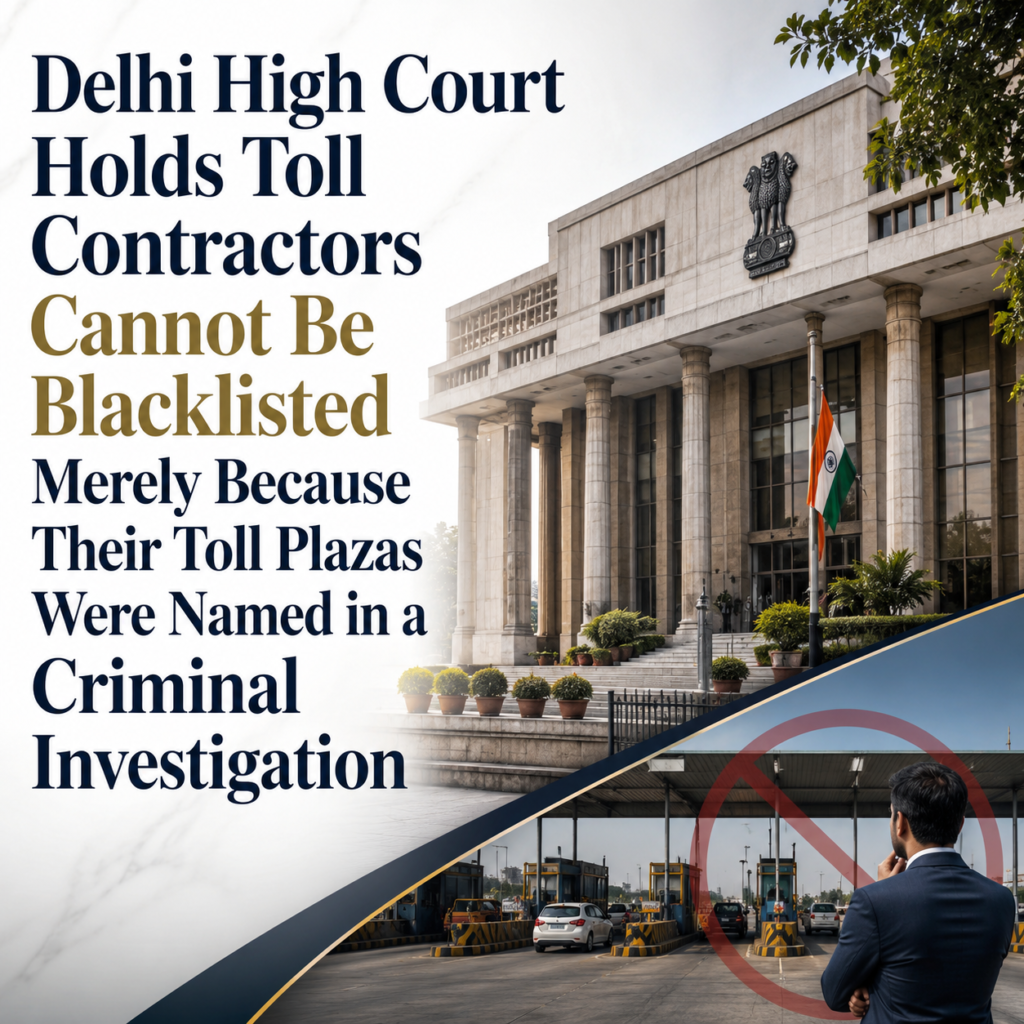
Delhi High Court Holds Toll Contractors Cannot Be Blacklisted Merely Because Their Toll Plazas Were Named in a Criminal Investigation

Delhi High Court Sets Aside NHAI’s One-Year Debarment of Toll Contractors, Holds Blacklisting Cannot Rest on Press Note, Confession and Uncorroborated Cash-Surge Data
Facts
The Delhi High Court decided a batch of writ petitions filed by private contractors/agencies engaged by the National Highways Authority of India for user fee collection at various toll plazas. The petitioners challenged communications issued by NHAI between 18.07.2025 and 18.08.2025 by which they were debarred from participating in future NHAI tenders for one year. In some cases, NHAI also terminated ongoing contracts and sought to encash performance securities furnished by the contractors.
The controversy arose after a raid conducted on 22.01.2025 by the Uttar Pradesh Special Task Force at Shivgulam Toll Plaza, Mirzapur. Three individuals were arrested for allegedly creating, installing and operating parallel/counterfeit software at various NHAI toll plazas to embezzle toll fees from vehicles without FASTag. One accused, Alok Kumar, allegedly identified several toll plazas where such software was installed. Based on the UP STF press note and alleged post-raid increase in cash collection figures, NHAI issued show cause notices and took action against the petitioners.
Earlier, NHAI had issued communications dated 18.03.2025 debarring some petitioners for two years and terminating contracts. Those communications were set aside by the High Court on 28.03.2025 for violation of principles of natural justice, primarily because no personal hearing was granted. NHAI was given liberty to issue fresh show cause notices and pass reasoned orders after hearing. Thereafter, NHAI issued fresh show cause notices on 23.06.2025, granted hearing on 26.06.2025, and again passed orders debarring the petitioners for one year, terminating certain ongoing contracts and seeking encashment of performance securities.
Issues
- Whether NHAI’s decision to debar the petitioners for one year was based on objective material and sufficient evidence.
- Whether reliance on a UP STF press note, confessional statement of an accused, and alleged post-raid cash surge was sufficient to justify blacklisting/debarment.
- Whether the petitioners could be debarred when they were not named as accused in FIR No. 0017/2025, the chargesheet or supplementary chargesheet.
- Whether NHAI’s own inspection reports, which found no parallel software at the petitioners’ toll plazas, undermined the basis of the debarment.
- Whether the High Court should interfere with contract termination and forfeiture of performance guarantees in writ jurisdiction.
Petitioner’s Arguments
The petitioners argued that the impugned action was based on conjectures and surmises. According to them, the primary basis for debarment was only that their toll plazas were mentioned in the UP STF press note, even though neither the petitioners nor their employees were named in the FIR, chargesheet or supplementary chargesheet.
They submitted that no incriminating material, parallel software, illegal POS machine or counterfeit device was recovered from their toll plazas. They further argued that prior to and after the raid, regular inspections were conducted by NHAI officials, system integrators and authority engineers, but no irregularity was ever found. In fact, NHAI’s own inspections had cleared the toll plazas of any use of alternate software.
The petitioners also contended that NHAI has a layered system for supervising toll collection and all toll software is installed and maintained through agencies appointed by NHAI. Therefore, the petitioners could not be held responsible merely on vague allegations.
On the allegation of post-raid surge in cash collection, the petitioners argued that toll collection depends on traffic flow, seasonal changes, regional events, pilgrimage movement, weather, location and infrastructure conditions. They claimed that the alleged surge could be explained by factors such as Maha Kumbh Mela 2025 and regional tourism. They also submitted that cash collection is only a small portion of overall toll revenue, and percentage variations appeared large only because the base value was low.
The petitioners further argued that debarment is equivalent to civil death and could not be imposed without strong evidence, clear application of mind and proportionality.
Respondent’s Arguments
NHAI argued that judicial review of administrative action is limited and interference is warranted only where the decision is arbitrary, perverse or violative of natural justice. It submitted that the petitioners were issued show cause notices, granted personal hearing, and the impugned orders were reasoned administrative decisions.
NHAI relied on the UP STF press note, the statement of the principal accused and the alleged post-raid surge in cash collections. According to NHAI, the accused had named 42 toll plazas, including those operated by the petitioners, where parallel software was allegedly used.
NHAI further argued that the contractors were independently responsible for transparent toll collection and could not shift liability to IHMCL or the system integrator. According to NHAI, the role of the system integrator was limited and it could not physically prevent toll operators from adopting a parallel off-system practice.
NHAI also submitted that the absence of recovery of physical devices or software did not negate misconduct because the alleged parallel system was designed to operate covertly and through mobile devices, capable of being removed or disabled immediately upon risk of detection. NHAI argued that administrative debarment does not require proof equivalent to criminal trial, and reasonable grounds leading to loss of confidence in the contractor’s integrity were sufficient.
Analysis of the Law
The Court held that blacklisting or debarment has serious civil consequences and is often described as civil death for a contractor. Such action is amenable to judicial review under Article 226 on the touchstone of procedural fairness, natural justice, non-arbitrariness, proportionality and Wednesbury reasonableness.
The Court held that even in contractual matters involving the State or its instrumentalities, the decision-making process must be informed by reason and must satisfy Article 14. A public authority cannot debar a contractor merely on suspicion or untested allegations.
The Court further held that debarment must be based on objective satisfaction founded upon sufficient evidence. It cannot rest merely on subjective apprehension, suspicion, or broad reliance on investigative material that does not specifically establish wrongdoing by the concerned contractor.
Precedent Analysis
The Court relied on Kulja Industries Ltd. v. Chief General Manager, Western Telecom Project, BSNL, where the Supreme Court held that State action in contractual matters is subject to judicial review on grounds of fairness, relevance, natural justice, equality and proportionality.
The Court also referred to Diwan Chand Goyal v. National Capital Region Transport Corporation, where the Delhi High Court summarized principles governing blacklisting, including the need for natural justice, reasons, non-arbitrariness and proportionality.
The Court relied on Erusian Equipment & Chemicals Ltd. v. State of West Bengal to emphasize that blacklisting creates civil consequences and requires objective satisfaction. It also relied on A.K.G. Constructions and Developers Pvt. Ltd. v. State of Jharkhand, where the Supreme Court held that blacklisting requires sufficient evidence, clear application of mind and stronger adherence to principles of natural justice.
The Court further referred to Blue Dreamz Advertising (P) Ltd. v. Kolkata Municipal Corporation, where the Supreme Court held that merely giving some reasons is not enough; the reasons must justify blacklisting and the penalty must be proportionate.
Court’s Reasoning
The Court found that the impugned debarment orders were primarily based on the UP STF press note, the alleged confession of one accused, and alleged post-raid surge in cash collection. However, the petitioners and their employees were not arraigned as accused in FIR No. 0017/2025, nor were charges framed against them in the chargesheet or supplementary chargesheet.
The Court noted that apart from the statement of one accused, no parallel or counterfeit software was recovered from the petitioners’ toll plazas during raids, surprise checks or inspections. No direct or corroborative incriminating evidence was found to support NHAI’s hypothesis.
The Court also examined the contractual framework and observed that NHAI had robust monitoring powers, including 24×7 access to video recording systems, authority to inspect registers, receipt books and cash records, and power to conduct surprise checks. NHAI’s own policy circular also required project directors and authority engineers to monitor cash collection and ensure that no parallel software was used.
Importantly, the Court noted that after inspections conducted by NHAI officials themselves, several toll plazas were cleared with findings that no parallel software was installed or used. This weakened NHAI’s case that the petitioners were involved in fraudulent collection.
The Court also found flaws in NHAI’s reliance on post-raid cash collection surge. It noted that in one example, the increase in cash collection was only between approximately ₹905 and ₹2,500, while the corresponding FASTag/ETC increase was between ₹5,000 and ₹8,000. Yet NHAI relied on percentage increase in cash collection to describe the rise as 617% to 1670%, without properly considering the low base value of cash collections.
The Court also noted that a legal opinion dated 15.04.2025 from the Office of Joint Director, Prosecution, District Mirzapur, recorded shortcomings in the investigation, including that recovered goods were not sent to the Forensic Science Laboratory, details of toll plazas and persons involved were not attached, the amount allegedly recovered from each toll plaza was unclear, and the required certificate relating to electronic evidence was not attached.
On this basis, the Court held that the objective standard required for debarment was not met. The debarment orders were therefore unsustainable.
Conclusion
The Delhi High Court set aside the debarment actions passed by NHAI against the petitioners. It held that blacklisting/debarment could not be sustained on the basis of a press note, a single accused’s statement and uncorroborated inferences from cash collection data, especially when the petitioners were not arraigned as accused and no direct incriminating material was recovered.
However, the Court refused to interfere with the termination of contracts and forfeiture of performance guarantees in the writ proceedings. The petitioners were granted liberty to avail appropriate contractual or civil remedies in relation to termination and performance guarantee forfeiture.
Case Details
Case: T Suryanarayana Reddy v. National Highways Authority of India & Connected Matters
Court: Delhi High Court
Case Number: W.P.(C) 10788/2025, W.P.(C) 11106/2025, W.P.(C) 11172/2025, W.P.(C) 11684/2025, W.P.(C) 12044/2025, W.P.(C) 12091/2025, W.P.(C) 12363/2025, W.P.(C) 12780/2025 and W.P.(C) 14768/2025
Judge: Justice Sachin Datta
Date: 03 July 2026
Result: Debarment orders set aside; no interference with contract termination and forfeiture of performance guarantees; petitioners granted liberty to pursue contractual/civil remedies.