

Court’s decision
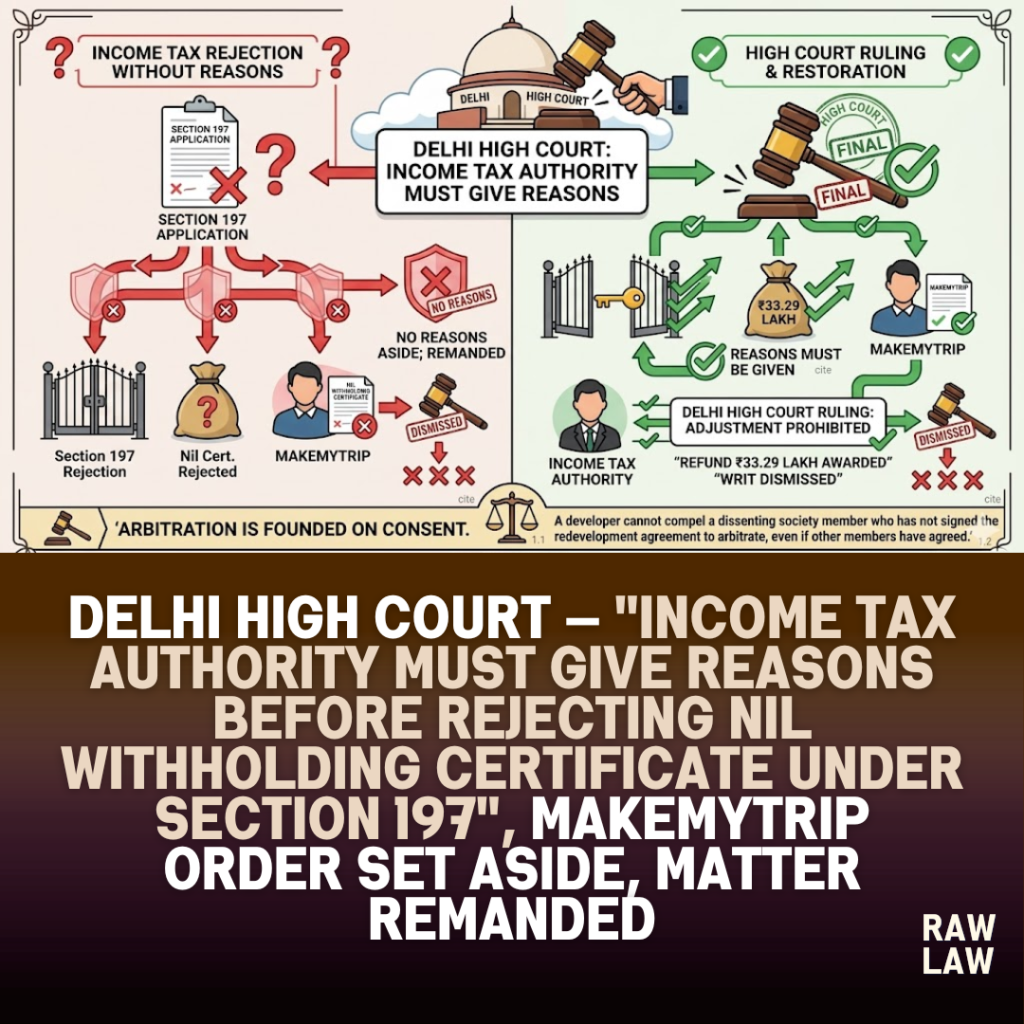
The Delhi High Court set aside an order of the Income Tax Department rejecting MakeMyTrip’s application for a Nil Withholding Certificate under Section 197 of the Income Tax Act. The Court held that the impugned rejection order was non-speaking and failed to consider the mandatory parameters under Rule 28AA of the Income Tax Rules.
A Division Bench comprising Justice V. Kameswar Rao and Justice Vinod Kumar ruled that the tax authority cannot reject an application merely by citing outstanding demand without analysing relevant statutory factors such as estimated tax liability, previous certificates, and financial position. The Court remanded the matter to the Assessing Officer to reconsider the application and pass a reasoned and speaking order within two weeks.
Facts
The petitioner company operates an online travel platform offering airline tickets, hotel bookings and travel packages through its web portal. It has been regularly assessed to tax for several years and had consistently applied for lower or nil withholding tax certificates under Section 197 of the Income Tax Act.
For the financial year 2025–26, the company applied for a Nil Withholding Certificate, or alternatively a certificate permitting deduction of tax at 0.30%, the same rate that had been granted in previous years.
The company contended that it had substantial carried-forward business losses and unabsorbed depreciation, which would result in nil taxable income for the relevant financial year.
The Income Tax Department sought certain clarifications regarding outstanding tax demands appearing against the company’s PAN and TAN numbers.
However, by an order dated 17 July 2025, the Deputy Commissioner of Income Tax rejected the application on the ground that tax demand of ₹23.80 crore was outstanding against the petitioner’s TAN, and no stay had been granted against that demand.
Aggrieved by the rejection order, the company approached the Delhi High Court challenging the denial of the certificate.
Issues
The Delhi High Court examined the following issues:
- Whether the Income Tax Department could reject a Section 197 application solely on the basis of outstanding tax demand.
- Whether the rejection order violated the requirements of Rule 28AA of the Income Tax Rules, which governs issuance of nil or lower TDS certificates.
- Whether the order was arbitrary for failing to provide reasons and proper analysis.
- Whether the Delhi High Court had territorial jurisdiction to hear the petition despite the impugned order being issued from Gurugram.
Petitioner’s arguments
The petitioner argued that the rejection order was arbitrary and violated the statutory framework governing issuance of certificates under Section 197 of the Income Tax Act.
It contended that for several years the Income Tax Department had granted lower withholding certificates, including 0.30% withholding rates for the previous three financial years, despite the same financial circumstances.
The petitioner further submitted that there had been no change in facts, financial position, or tax profile, and therefore the Revenue could not suddenly depart from its earlier consistent position without valid justification.
The company also pointed out that large tax refunds of approximately ₹84 crore were due from the Revenue, which far exceeded the alleged outstanding demand.
It was argued that the impugned order failed to consider the mandatory parameters prescribed under Rule 28AA, including estimated tax liability, past assessments, and financial circumstances.
The petitioner further emphasized that the rejection order consisted of a single line stating that tax demand was pending, which demonstrated complete non-application of mind.
Respondent’s arguments
The Income Tax Department opposed the petition and justified the rejection of the application.
The Revenue argued that significant tax demands existed against the petitioner’s PAN and TAN numbers, including demands arising from orders under Section 201 of the Income Tax Act related to alleged short deduction of tax at source.
According to the Department, the presence of substantial outstanding tax liabilities indicated non-compliance with TDS provisions and therefore adversely affected the petitioner’s eligibility for a lower withholding certificate.
The Revenue also raised a preliminary objection regarding territorial jurisdiction, contending that the order had been issued by the Deputy Commissioner of Income Tax in Gurugram and therefore the Punjab and Haryana High Court had jurisdiction over the dispute.
Additionally, the Department argued that the proceedings under Section 197 are interim and provisional in nature, and past issuance of certificates does not bind the Revenue in subsequent years.
Analysis of the law
The Court examined the statutory framework governing issuance of certificates for lower or nil deduction of tax at source.
Section 197 of the Income Tax Act empowers the Assessing Officer to issue a certificate allowing tax to be deducted at a lower rate or not deducted at all, if justified by the assessee’s estimated tax liability.
Rule 28AA of the Income Tax Rules prescribes the methodology for determining the appropriate withholding rate.
The rule requires the Assessing Officer to consider several parameters, including:
- Estimated tax liability for the relevant financial year
- Tax payable on the basis of completed assessments
- Existing tax liabilities
- Advance tax payments and TDS credits
The Court emphasized that the Assessing Officer is legally obligated to consider these factors before deciding whether to grant or reject a certificate.
Failure to examine these statutory considerations renders the decision arbitrary.
Precedent analysis
The Court relied on previous Delhi High Court judgments interpreting Section 197 and Rule 28AA.
In Manpower Group Services India Pvt. Ltd. v. CIT (TDS), the Court held that orders under Section 197 must be reasoned and cannot arbitrarily determine withholding rates.
Similarly, in Virgin Atlantic Airways Ltd. v. PCIT, the Court held that non-consideration of the parameters specified in Rule 28AA amounts to non-application of mind and makes the order legally unsustainable.
The Court also observed that when the tax authority fails to consider relevant material such as previous certificates and financial records, the resulting decision becomes arbitrary.
Court’s reasoning
The Court found that the rejection order consisted of only a brief statement referring to outstanding demand, without examining the relevant statutory factors.
The Court also noted that the alleged outstanding demand of approximately ₹23.80 crore had subsequently been reduced to ₹14.08 crore through rectification orders, which the authority failed to consider.
Further, the petitioner had asserted that tax refunds exceeding ₹84 crore were due, a factor that could materially affect the assessment of tax liability and revenue risk.
The Court observed that previous certificates had been issued at rates ranging from 0.10% to 4%, yet the impugned order failed to explain why the application was rejected altogether.
The Bench concluded that the order demonstrated non-application of mind and violation of Rule 28AA, as the statutory parameters had not been evaluated.
Conclusion
The Delhi High Court held that the impugned rejection order under Section 197 was unsustainable because it lacked reasoning and failed to consider relevant statutory factors.
Accordingly, the Court set aside the order dated 17 July 2025 and remanded the matter to the Assessing Officer for fresh consideration.
The Court directed the Assessing Officer to reconsider the application and pass a reasoned order within two weeks.
Implications
This judgment reinforces the requirement that administrative decisions in tax matters must be reasoned and comply with statutory guidelines.
The ruling clarifies that the Income Tax Department cannot reject applications under Section 197 merely by citing outstanding demand without analysing the broader financial context and statutory parameters.
The decision also highlights the importance of consistency in tax administration, especially when authorities have adopted a particular approach in earlier years.
For taxpayers, the judgment underscores that arbitrary denial of lower withholding certificates can be challenged in writ jurisdiction when statutory procedures are ignored.
Case Law References
Manpower Group Services India Pvt. Ltd. v. CIT (TDS)
Held that orders under Section 197 must be reasoned and based on Rule 28AA parameters.
Virgin Atlantic Airways Ltd. v. PCIT
The Delhi High Court held that non-consideration of Rule 28AA factors renders orders rejecting lower TDS certificates arbitrary.
Radhasoami Satsang v. CIT
The Supreme Court recognised the importance of consistency in tax administration when facts remain unchanged.
CIT v. Excel Industries Ltd.
The Supreme Court reiterated that consistent treatment should be followed in tax matters unless circumstances change.
FAQs
1. What is a Nil Withholding Certificate under Section 197 of the Income Tax Act?
A Nil Withholding Certificate allows tax to be deducted at zero or a lower rate than the statutory rate when the taxpayer’s estimated tax liability is lower than the standard TDS rate.
2. Can the Income Tax Department reject a Section 197 application because of outstanding tax demand?
Yes, but the authority must evaluate all statutory parameters under Rule 28AA. A rejection cannot be based solely on outstanding demand without proper reasoning.
3. Can courts review orders rejecting lower TDS certificates?
Yes. High Courts can review such orders under Article 226 of the Constitution if the decision is arbitrary, unreasoned, or violates statutory provisions.


