

Court’s decision
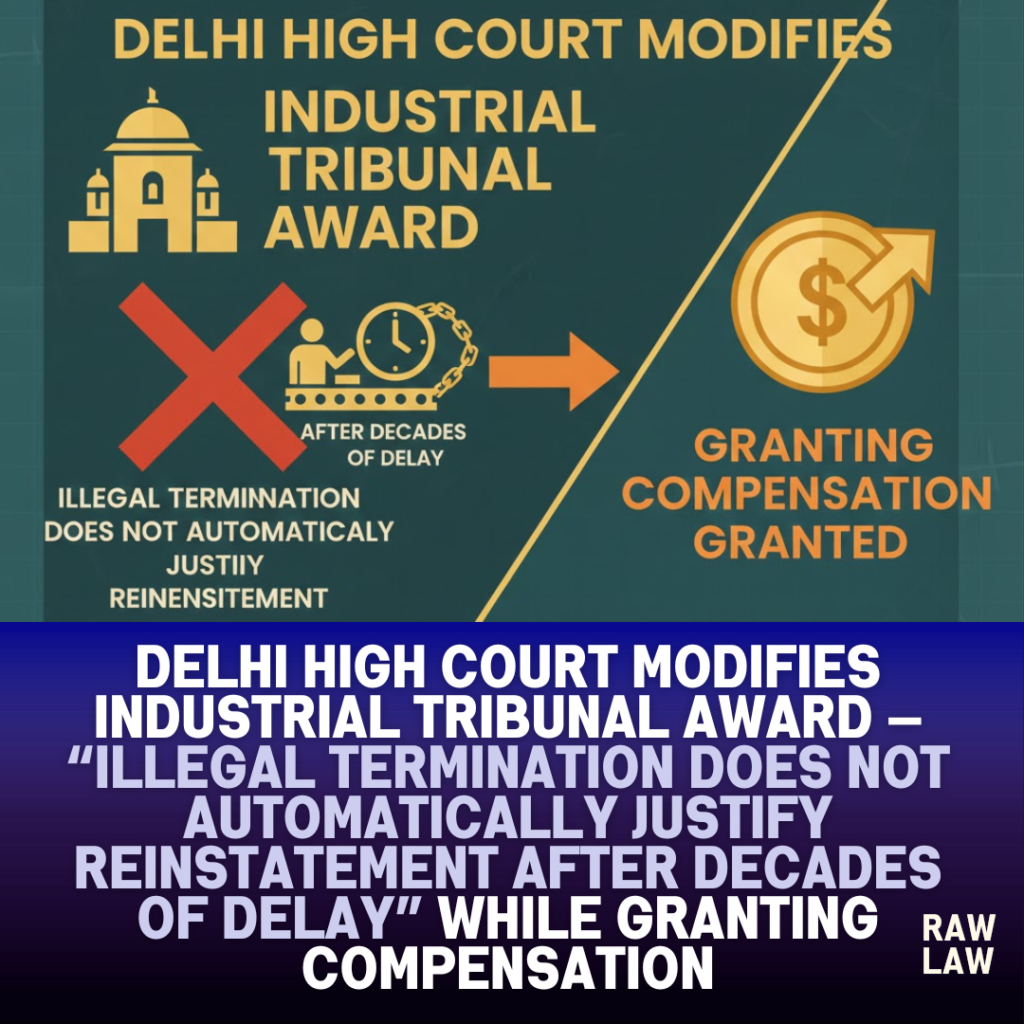
The Delhi High Court partly allowed a writ petition filed by the Development Commissioner challenging an Industrial Tribunal award which had ordered reinstatement and regularisation of a workman terminated in 1987. While affirming that the termination was illegal due to violation of principles of natural justice, the Court held that reinstatement and regularisation after an unexplained delay of over 16 years would be unjust and inequitable. Modifying the award, the Court substituted reinstatement with lump-sum compensation of ₹1,00,000, payable with interest if delayed .
Facts
The dispute arose from the termination of a workman engaged as a Mali under the Development Commissioner. The workman claimed that he had been continuously employed since 1979 and was terminated with effect from 01.08.1987 on allegations of illicit felling and sale of trees. According to the workman, no charge-sheet was served, no domestic inquiry was conducted, and no retrenchment compensation or notice pay was given as mandated under Section 25F of the Industrial Disputes Act, 1947.
The workman further alleged discriminatory treatment, pointing out that two similarly placed co-workers terminated on identical allegations were reinstated by the Labour Court in separate proceedings. Despite this, the workman did not raise an industrial dispute until 2003, asserting ignorance of legal remedies and stating that he had made repeated representations to the management, though no documentary proof of such representations was produced.
The Industrial Tribunal held the termination to be illegal and unjustified, and directed reinstatement with regularisation and consequential benefits from the date of termination. Aggrieved by this award dated 10.11.2006, the management approached the High Court under Articles 226 and 227 of the Constitution.
Issues
The key issues before the High Court were whether the Industrial Tribunal was justified in entertaining a claim raised after an inordinate delay of over 16 years, whether the termination amounted to retrenchment or dismissal for misconduct, and whether reinstatement with regularisation was an appropriate relief in the facts of the case. The Court was also required to determine the proper relief once the termination was found to be illegal.
Petitioner’s arguments
The management contended that the workman was a daily-wage labourer and not a regular Mali, and that his services were terminated following an inquiry which established misconduct involving illicit felling and sale of trees. It was argued that the case was one of termination for misconduct, not retrenchment, and therefore Section 25F of the Industrial Disputes Act had no application. The management further submitted that the claim was hopelessly stale, having been raised after more than 14 years, and that the Tribunal exceeded its jurisdiction in granting reinstatement and regularisation after such delay.
Respondent’s arguments
The workman maintained that no lawful inquiry had been conducted, no charge-sheet or opportunity of hearing was given, and that the so-called inquiry report relied upon by the management did not satisfy the requirements of natural justice. It was argued that in the absence of a valid disciplinary process, the termination amounted to illegal retrenchment. The workman relied on the fact that similarly situated co-workers had been reinstated to claim parity and sought reinstatement with all consequential benefits.
Analysis of the law
The Court analysed the definition of “retrenchment” under Section 2(oo) of the Industrial Disputes Act and reiterated that termination based on misconduct would fall outside its scope only if preceded by a lawful disciplinary inquiry. Where termination is effected without charge-sheet, notice, or opportunity of hearing, it amounts to illegal retrenchment, attracting the rigours of Section 25F.
At the same time, the Court underscored that relief in industrial disputes is discretionary and equitable, and reinstatement is not an automatic consequence of illegal termination, particularly where the workman approaches the forum after an inordinate and unexplained delay.
Precedent analysis
The High Court relied on settled Supreme Court jurisprudence holding that non-compliance with Section 25F renders termination void, but also recognised later decisions where courts have moulded relief by awarding compensation instead of reinstatement in cases involving long delay, laches, or impracticability of restoring the employment relationship. The Court balanced the principle laid down in Mohan Lal v. Management of Bharat Electronics Ltd. with the evolving approach favouring compensation over reinstatement in stale claims.
Court’s reasoning
The Court found that the management failed to establish compliance with principles of natural justice. No charge-sheet or opportunity of defence was shown to have been given to the workman, rendering the termination illegal. On this aspect, the Tribunal’s finding was upheld.
However, the Court took serious note of the inordinate delay of more than 16 years in raising the industrial dispute, for which no cogent explanation or supporting material was furnished. The workman had not produced any proof of representations made during this long interregnum, despite being aware that his co-workers had successfully challenged their termination.
In these circumstances, the Court held that reinstatement and regularisation after such a prolonged lapse of time would be neither just nor reasonable. The ends of justice would be met by awarding monetary compensation in lieu of reinstatement.
Conclusion
Modifying the Industrial Tribunal’s award, the Delhi High Court set aside the directions for reinstatement and regularisation. Instead, the workman was held entitled to compensation of ₹1,00,000, to be paid within three months, failing which interest at 6% per annum would accrue from the date of default. The writ petition was disposed of accordingly .
Implications
This judgment reinforces the principle that illegal termination does not automatically translate into reinstatement, especially when claims are raised after decades of silence. It reflects the judiciary’s pragmatic approach in balancing statutory protections for workmen with considerations of delay, equity, and administrative feasibility. The ruling provides guidance to Labour Courts to carefully tailor reliefs, particularly in stale industrial disputes.
Case law references
- Mohan Lal v. Management of Bharat Electronics Ltd. – Held that termination in violation of Section 25F is void, but relief depends on facts.
- Sachiv, Krishi Upaj Mandi Samiti v. Mahendra Kumar – Distinguished between termination for misconduct and illegal retrenchment.
FAQs
1. Does illegal termination always lead to reinstatement?
No. Courts may award compensation instead of reinstatement, especially in cases involving long delay or laches.
2. What happens if no disciplinary inquiry is conducted before termination?
Such termination is treated as illegal retrenchment, attracting Section 25F of the Industrial Disputes Act.
3. Can Labour Courts grant regularisation after many years of termination?
Courts are cautious and may deny reinstatement or regularisation if the claim is stale or inequitable.


