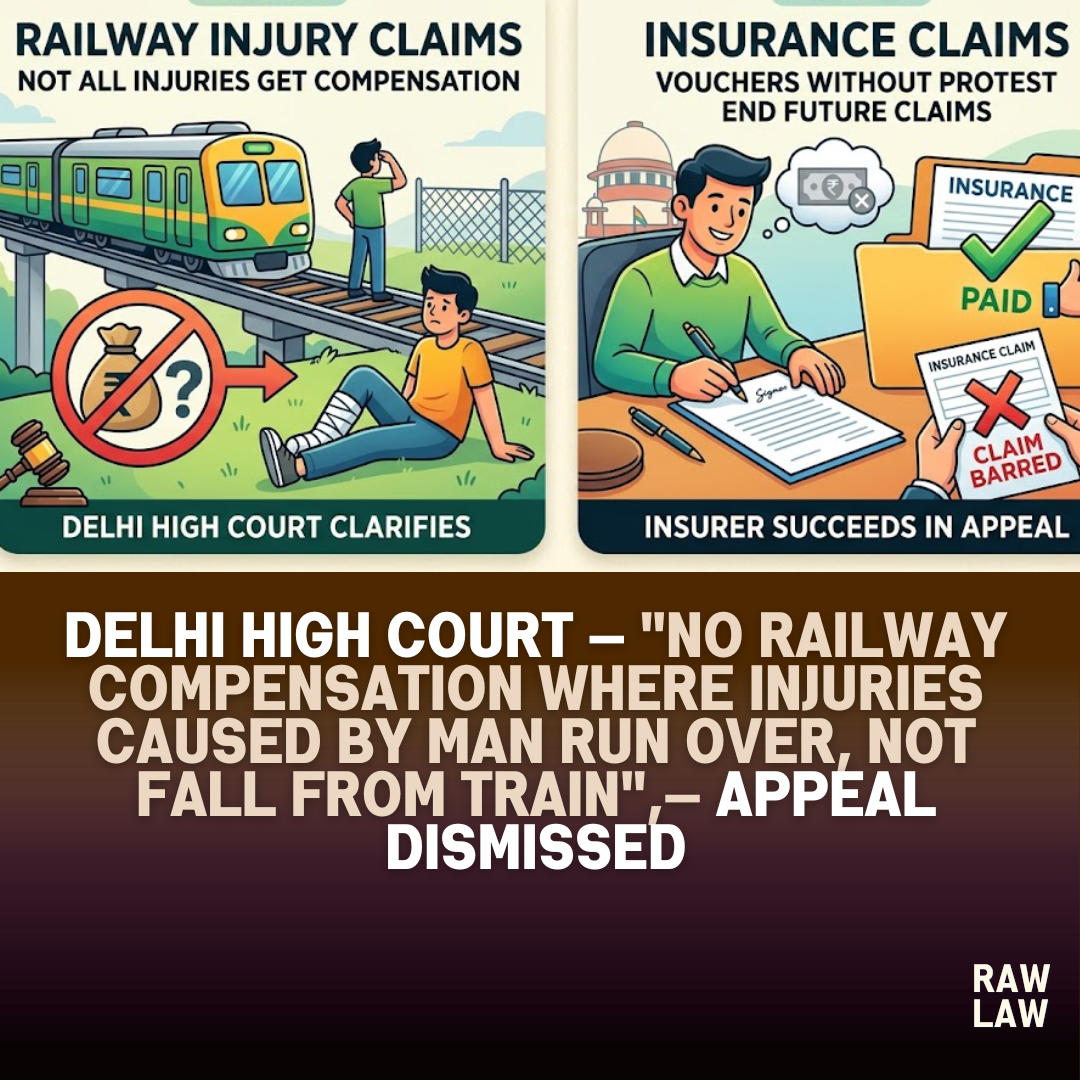
Delhi High Court — “No railway compensation where injuries caused by man run over, not fall from train”,— appeal dismissed

Court’s decision
The High Court considered an appeal challenging the order of the Railway Claims Tribunal which had rejected the claimant’s compensation application.
While the Court condoned a delay of 200 days in filing the appeal, it ultimately dismissed the appeal on merits.
The Court held that the Tribunal had correctly relied on the testimony of railway officials and contemporaneous railway records, which indicated that the incident occurred when the claimant came onto the railway track and was run over by the train.
Since the accident did not qualify as an untoward railway incident under the statutory framework, the claimant was not entitled to compensation.
Facts
The appellant claimed that on 11 March 2024 he boarded the Unchahar Express after purchasing a ticket from Panipat to Delhi.
According to him, the train was overcrowded and he accidentally fell from the moving train due to heavy rush.
The fall allegedly resulted in grievous injuries, including amputation of both legs.
Based on these claims, the appellant filed an application before the Railway Claims Tribunal seeking compensation for injuries suffered in an untoward railway accident.
However, the Tribunal dismissed the claim after examining the evidence and concluding that the accident had not occurred due to an accidental fall from the train.
Issues
The High Court examined the following issues:
- Whether the appellant had established that he was a bona fide passenger at the time of the incident.
- Whether the injuries were caused by an accidental fall from the train, qualifying as an untoward incident.
- Whether the Tribunal had erred in relying on railway records and witness testimony to reject the claim.
Petitioner’s arguments
The appellant argued that the Tribunal wrongly rejected his claim by relying on the Divisional Railway Manager (DRM) report and testimony of railway officials.
It was contended that the appellant’s own testimony should have been given greater weight.
The appellant further submitted that non-recovery of the journey ticket during jamatalashi should not automatically disqualify a claimant from being considered a bona fide passenger.
Reliance was placed on the Supreme Court’s decision in Union of India v. Rina Devi, which held that a claimant can discharge the initial burden of proving bona fide travel through an affidavit, after which the burden shifts to the Railways to rebut the claim.
Respondent’s arguments
The Railways opposed the appeal and supported the Tribunal’s findings.
It argued that no ticket was recovered from the claimant during jamatalashi and no independent witness confirmed his version of events.
The Railways relied heavily on the testimony of the Assistant Loco Pilot, who stated that he saw a person come onto the railway track and lie down in front of the train.
Despite sounding the horn and applying brakes, the train ran over the individual.
This account was corroborated by official railway records, including the Loco Pilot Notebook entry and station records, which recorded the incident as “MRO” (man run over).
Analysis of the law
The Court examined the statutory scheme governing compensation for railway accidents.
Under railway accident compensation law, compensation is payable only when injuries result from an “untoward incident,” such as accidental fall from a train.
However, incidents such as suicide, self-inflicted injury, or run-over accidents on tracks do not fall within this statutory category.
The Court reiterated that although courts must adopt a liberal approach in such claims due to the beneficial nature of the legislation, compensation cannot be granted where the factual circumstances do not meet the statutory requirements.
Precedent analysis
The Court relied on the Supreme Court’s decision in Union of India v. Rina Devi (2019).
In that case, the Supreme Court held that the claimant bears the initial burden of establishing that he was a bona fide passenger.
Once that burden is discharged, the onus shifts to the Railways to rebut the claim.
The Court also referred to Rajni v. Union of India, where the Supreme Court reiterated that the claimant must first establish lawful travel before claiming compensation.
Court’s reasoning
The High Court found that the Tribunal had relied on credible and consistent evidence.
The testimony of the Assistant Loco Pilot clearly stated that the individual came onto the track and lay down in front of the train.
This version was recorded immediately after the incident in the Loco Pilot Notebook and other railway records.
Such contemporaneous records made during the course of official duties carry significant evidentiary value.
The Court also noted that the appellant failed to rebut this testimony during cross-examination or produce independent evidence supporting his claim.
Even assuming that the appellant had purchased a ticket, the Court held that the nature of the accident itself did not qualify as an untoward railway incident.
Conclusion
The Delhi High Court concluded that the Tribunal’s findings were supported by reliable evidence and correct application of the law.
Since the accident was established to be a man run over case rather than an accidental fall from a train, the statutory conditions for compensation were not satisfied.
Accordingly, the Court dismissed the appeal and upheld the Tribunal’s decision denying compensation.
Implications
This judgment clarifies the evidentiary threshold in railway accident compensation claims.
While courts adopt a liberal approach to protect victims of genuine railway accidents, claimants must still establish that the injury resulted from a legally recognised untoward incident.
The decision also highlights the importance of contemporaneous railway records and testimony of train crew, which courts may treat as strong evidence when determining the nature of an accident.
Case Law References
- Union of India v. Rina Devi (2019) 3 SCC 572
Held that the claimant must first establish bona fide travel before the burden shifts to the Railways. - Rajni v. Union of India (2025)
Reaffirmed that the initial burden of proving lawful travel lies on the claimant in railway accident claims.
FAQs
1. What qualifies as an “untoward incident” under railway accident law?
An untoward incident includes events like accidental fall from a train. Incidents such as suicide or being run over on the tracks generally do not qualify.
2. Is compensation available if a person is run over by a train?
Generally no, unless the claimant can prove that the injury resulted from an untoward incident connected with lawful train travel.
3. Is a railway ticket necessary to claim compensation?
While recovery of a ticket strengthens the claim, courts may accept other evidence to prove bona fide travel. However, the claimant must still establish that the accident qualifies as an untoward incident.