

Court’s decision
The Delhi High Court overturned the trial court’s order dated 22 November 2024 which had dismissed the plaintiff’s suit for recovery of money.
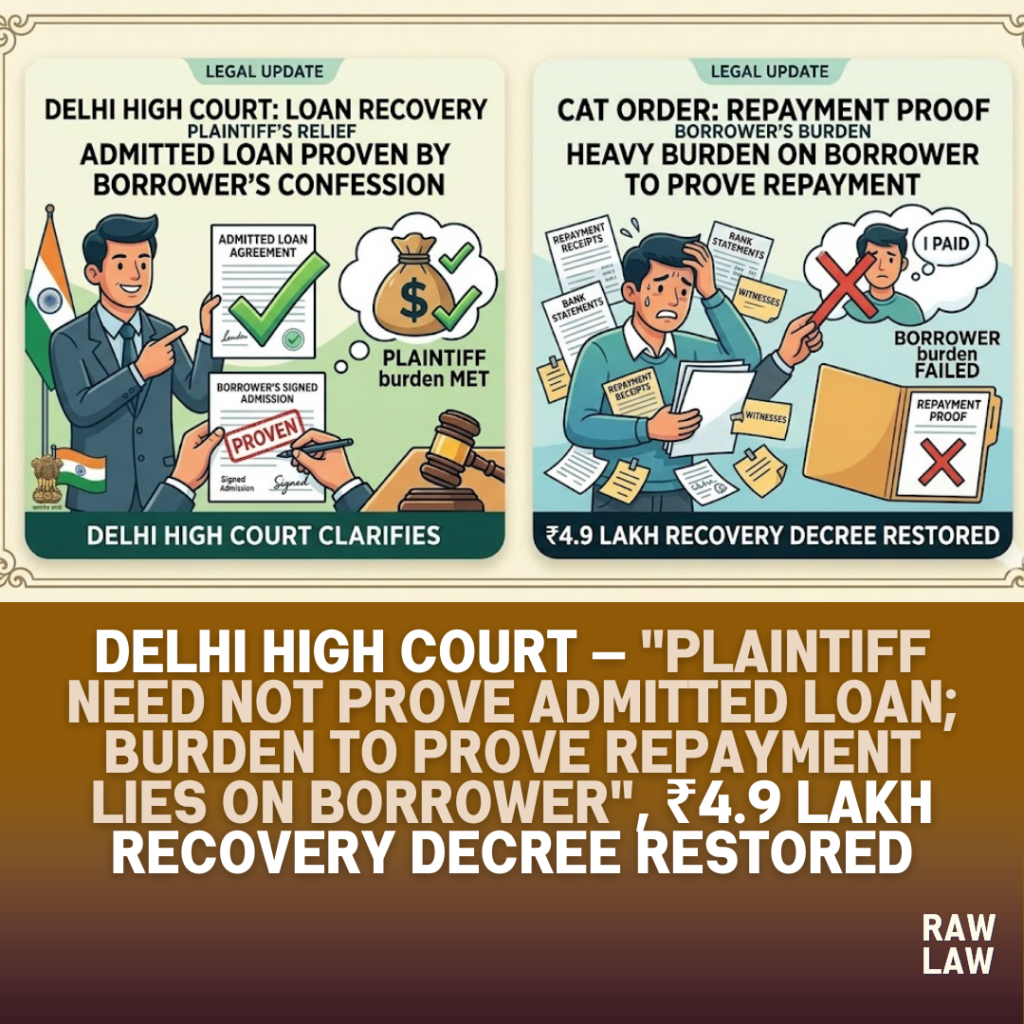
The Court held that once the defendant admitted the loan transaction and execution of a written undertaking acknowledging receipt of ₹7 lakh, the plaintiff was not required to independently prove that fact.
Since the defendant failed to produce credible evidence demonstrating repayment of the loan, the High Court concluded that the trial court erred in dismissing the suit.
The Court therefore decreed recovery of ₹4,90,000 with interest at 6% per annum from the date of filing of the suit until realization, along with costs.
Facts
The dispute arose from a financial transaction between two individuals in Delhi.
The plaintiff claimed that in May 2017 he advanced ₹7 lakh in cash to the defendant, repayable within two to three months. The defendant executed a handwritten undertaking dated 2 June 2017 acknowledging receipt of the loan on the letterhead of his proprietorship business.
According to the plaintiff, the defendant later made partial repayments totaling ₹4 lakh:
- ₹2,00,000 on 2 September 2018
- ₹1,50,000 on 7 January 2019
- ₹50,000 on 8 February 2020
After these payments, the plaintiff alleged that ₹3 lakh remained outstanding, on which interest was calculated at 12% per annum.
A legal notice demanding payment was issued in August 2020, but the defendant failed to clear the dues.
The plaintiff therefore filed a suit seeking recovery of ₹4,90,000 (principal ₹3 lakh plus interest ₹1.9 lakh).
Issues
The Delhi High Court examined the following legal questions:
- Whether the plaintiff was required to prove the loan despite the defendant admitting it.
- Whether the defendant successfully proved repayment of the loan.
- Whether the trial court was justified in dismissing the suit for want of evidence.
- Whether the plaintiff was entitled to recovery of the outstanding loan amount with interest.
Petitioner’s arguments
The plaintiff argued that the trial court had failed to appreciate the legal consequences of the defendant’s admission.
Since the defendant had acknowledged receiving ₹7 lakh and executing the written undertaking, the plaintiff contended that the loan transaction stood established under Section 58 of the Evidence Act, which provides that admitted facts need not be proved.
According to the plaintiff, the trial court incorrectly focused on the absence of additional evidence from the plaintiff, even though the primary dispute concerned whether the defendant had repaid the loan.
The plaintiff also relied on Section 103 of the Evidence Act, arguing that the burden of proving repayment lay on the defendant because he was asserting that the liability had been discharged.
Respondent’s arguments
The defendant claimed that he had repaid the entire loan amount in July 2017 in cash.
He argued that due to friendly relations with the plaintiff, no receipt was obtained at the time of repayment.
The defendant denied making the partial payments alleged by the plaintiff and maintained that the entire loan had been settled earlier.
In support of his defence, the defendant examined himself as a witness and also produced his wife as a witness.
However, the defendant failed to appear in the High Court proceedings and the appeal proceeded ex parte.
Analysis of the law
The Court examined the legal principles governing burden of proof and admissions under the Indian Evidence Act.
Under Section 58, facts admitted by a party do not require further proof. Therefore, once the defendant admitted receiving the loan, the plaintiff was relieved of the obligation to prove that fact through additional evidence.
The Court also considered Section 103 of the Evidence Act, which provides that the burden of proving a particular fact lies on the person who asserts it.
In the present case, since the defendant claimed that the loan had already been repaid, it was his responsibility to prove the alleged repayment.
Precedent analysis
Although the judgment primarily applied statutory provisions of the Evidence Act, it relied on established principles concerning burden of proof.
Courts have consistently held that once a financial transaction is admitted, the borrower must establish repayment if such a defence is raised.
The Court also reiterated that vague oral assertions without documentary support are generally insufficient to prove repayment of large financial transactions.
Court’s reasoning
The Court carefully examined the testimony of the defendant and his wife.
During cross-examination, the defendant admitted receiving the loan and issuing the written undertaking acknowledging the debt.
However, he claimed that the entire amount was returned in cash in July 2017 without any documentation.
The Court found this explanation implausible because:
- No receipt or document acknowledged repayment.
- The defendant could not recall the exact date of repayment.
- He failed to explain the source of funds used to repay such a large amount.
The Court also found inconsistencies in the testimony of the defendant’s wife. She stated that she had handed over cash to her husband but admitted she did not count the money and did not know the denominations.
These contradictions significantly weakened the defence.
The Court therefore concluded that the defendant had failed to prove repayment of the loan.
Conclusion
The Delhi High Court held that the trial court erred in dismissing the suit despite the defendant admitting receipt of the loan.
Since the defendant failed to discharge the burden of proving repayment, the plaintiff was entitled to recovery of the outstanding amount.
The High Court accordingly allowed the appeal, set aside the trial court’s judgment, and decreed recovery of ₹4,90,000 along with interest and costs in favour of the plaintiff.
Implications
This judgment reinforces the importance of admissions and burden of proof in civil litigation.
The ruling clarifies that once a defendant admits receiving a loan, the plaintiff is not required to prove that fact again.
The decision also highlights that courts will closely scrutinize defences based on unsubstantiated claims of cash repayment, particularly in large financial transactions.
For litigants in money recovery suits, the judgment underscores the evidentiary significance of written acknowledgments and the risks associated with undocumented cash dealings.
Case Law References
- Section 58, Indian Evidence Act, 1872
Facts admitted by parties do not require further proof in civil proceedings. - Section 103, Indian Evidence Act, 1872
The burden of proving a particular fact lies on the person asserting its existence.
FAQs
1. Does a plaintiff need to prove a loan if the borrower admits receiving it?
No. Under Section 58 of the Indian Evidence Act, admitted facts do not require proof. Once the borrower admits receiving the loan, the burden shifts to the borrower to prove repayment.
2. Who must prove repayment of a loan in court?
The borrower must prove repayment if they claim that the loan has already been discharged.
3. Can a loan repayment defence succeed without documentary evidence?
It is difficult. Courts generally require credible evidence or documentation to prove repayment, especially for large financial transactions.


