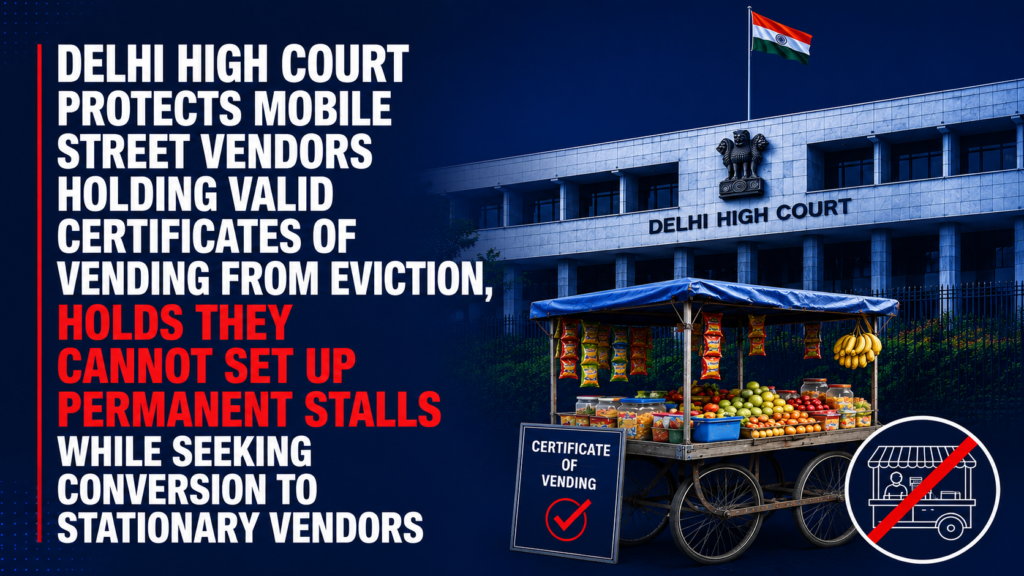
Delhi High Court Protects Mobile Street Vendors Holding Valid Certificates of Vending from Eviction, Holds They Cannot Set Up Permanent Stalls While Seeking Conversion to Stationary Vendors

Street Vendors with Valid Certificates Cannot Be Disturbed if They Follow Vending Rules: Delhi High Court
Facts
The petition was filed by four street vendors—Ramprakash, Arjun Singh, Karunesh Kumar and Chander Pal—who carried on vending activities in Kamla Nagar, Jawahar Nagar, Maurice Nagar and Bungalow Road, Delhi. Each petitioner possessed a provisional Certificate of Vending (COV) issued under the Street Vendors framework and sought protection from interference in carrying on their trade.
During an earlier hearing, the Court directed the petitioners to place their Certificates of Vending and photographs of their vending sites on record. The Municipal Corporation of Delhi (MCD) also produced photographs depicting the manner in which the petitioners were carrying on vending activities. The Court examined both the COVs and the photographs before deciding the matter.
The Certificates of Vending categorised all four petitioners under the “Others” category and contained standard conditions requiring vendors to adhere to designated vending zones and timings, avoid obstructing pedestrians or vehicular movement, refrain from constructing permanent or temporary structures, maintain hygiene, avoid illegal activities, and comply with the Delhi Street Vendors (Protection of Livelihood and Regulation of Street Vending) Scheme, 2019.
The petitioners also informed the Court that some of them had already submitted representations seeking conversion of their status from mobile vendors to stationary vendors. In an earlier writ petition, the High Court had directed the MCD to decide those representations. However, the decision was still pending.
Issues
- Whether the petitioners holding provisional Certificates of Vending were entitled to protection against interference in carrying on their vending activities.
- Whether the petitioners could claim a right to operate as stationary vendors despite being issued Certificates of Vending as mobile vendors.
- Whether the MCD could disturb the petitioners’ vending activities pending consideration of their representations for conversion to stationary vending status.
Petitioners’ Arguments
The petitioners submitted that they were authorised vendors holding valid Certificates of Vending and were entitled to carry on their livelihood peacefully without obstruction from the authorities.
They further contended that representations seeking conversion from mobile vending to stationary vending had already been submitted before the MCD pursuant to earlier directions of the High Court. Until those representations were decided, they sought protection against any interference with their vending activities.
Respondents’ Arguments
The MCD relied upon the Certificates of Vending and the photographs placed on record to demonstrate the nature of the petitioners’ vending activities.
It pointed out that the petitioners had been issued Certificates only as mobile vendors, not as stationary vendors. The MCD also highlighted the conditions attached to the Certificates, particularly those prohibiting permanent or temporary constructions, obstruction of public movement, and violations of the Street Vendors Scheme.
The MCD also informed the Court that the Town Vending Committee (TVC) was in the process of being constituted and elections were expected to be held in August 2026, after which issues relating to stationary vending would be considered.
Analysis of the Law
The Court examined the legal effect of the Certificates of Vending issued to the petitioners. It held that the Certificates expressly categorised them as mobile vendors, and therefore they could not claim rights inconsistent with the conditions governing such certificates.
The Court relied upon the express terms of the Certificates, which required vendors to:
- follow the designated vending zone and timings;
- avoid obstructing pedestrians and vehicles;
- refrain from constructing permanent or temporary structures;
- maintain cleanliness and hygiene;
- avoid unauthorised activities; and
- comply with the Delhi Street Vendors (Protection of Livelihood and Regulation of Street Vending) Scheme, 2019.
The photographs produced by both sides confirmed that the petitioners were operating as mobile vendors. Accordingly, until their applications for conversion were decided by the Town Vending Committee, they could not insist upon being treated as stationary vendors.
At the same time, the Court recognised that holders of valid Certificates of Vending were entitled to continue their livelihood so long as they complied with the statutory conditions governing their certificates. Since the TVC was yet to be constituted, the Court considered it appropriate to protect the petitioners from unnecessary interference while preserving the authority of the TVC to take a final decision.
Precedent Analysis
Ramprakash & Ors. v. GNCTD (W.P.(C) 9813/2025)
The Court referred to its earlier order dated 11 September 2025, whereby the MCD had been directed to decide the petitioners’ representations seeking conversion from mobile vending status to stationary vending status within the prescribed period.
The earlier order did not confer any right to stationary vending. It merely required the competent authority to consider and decide the pending representations in accordance with law. The present Bench relied on that order to direct that, once constituted, the Town Vending Committee should consider the pending representations within three months.
Court’s Reasoning
The Court observed that the Certificates of Vending, read together with the photographs placed on record, clearly established that the petitioners were authorised only as mobile vendors. Consequently, they were obliged to comply with all conditions attached to those certificates.
While recognising the petitioners’ right to continue earning their livelihood, the Court balanced that right with the need to regulate public spaces. It therefore directed that the petitioners:
- may continue vending peacefully in accordance with their Certificates;
- shall not erect permanent or temporary structures;
- shall maintain cleanliness around their vending sites;
- shall not sell food items or use gas cylinders;
- shall not extend their vending area beyond permissible limits.
Subject to compliance with these conditions, the Court directed that their vending activities should not be disturbed by the authorities.
Regarding their request for conversion to stationary vending status, the Court held that the issue fell within the jurisdiction of the Town Vending Committee. After its constitution, the TVC was directed to decide the pending representations within three months.
The Court further clarified that its order created no vested right in favour of the petitioners and would remain subject to the final vending plan to be prepared by the Town Vending Committee.
Conclusion
The Delhi High Court disposed of the writ petition by permitting the petitioners to continue vending peacefully under their existing provisional Certificates of Vending, subject to strict compliance with the conditions governing mobile vendors.
The Court restrained the authorities from disturbing their vending activities so long as those conditions were observed, directed the Town Vending Committee to decide the petitioners’ request for conversion to stationary vending within three months after its constitution, and clarified that no permanent or vested rights would arise from the interim protection granted.
Case Details
Case: Ramprakash & Ors. v. Government of NCT of Delhi & Ors.
Court: High Court of Delhi
Case No.: W.P.(C) 5899/2026 with CM APPL. 28944/2026
Bench: Justice Prathiba M. Singh and Justice Vikas Mahajan
Date of Decision: 23 July 2026
Relevant Law: Street Vendors (Protection of Livelihood and Regulation of Street Vending) Act, 2014; Delhi Street Vendors (Protection of Livelihood and Regulation of Street Vending) Scheme, 2019
Result: Writ petition disposed of; petitioners permitted to continue vending as mobile vendors subject to conditions; conversion to stationary vending left for decision by the Town Vending Committee after its constitution.