Delhi High Court quashes AIIMS rejection of DM Critical Care Medicine candidature—”1095 days residency can be cumulative across institutions, merit cannot be defeated by technicalities”

Court’s decision
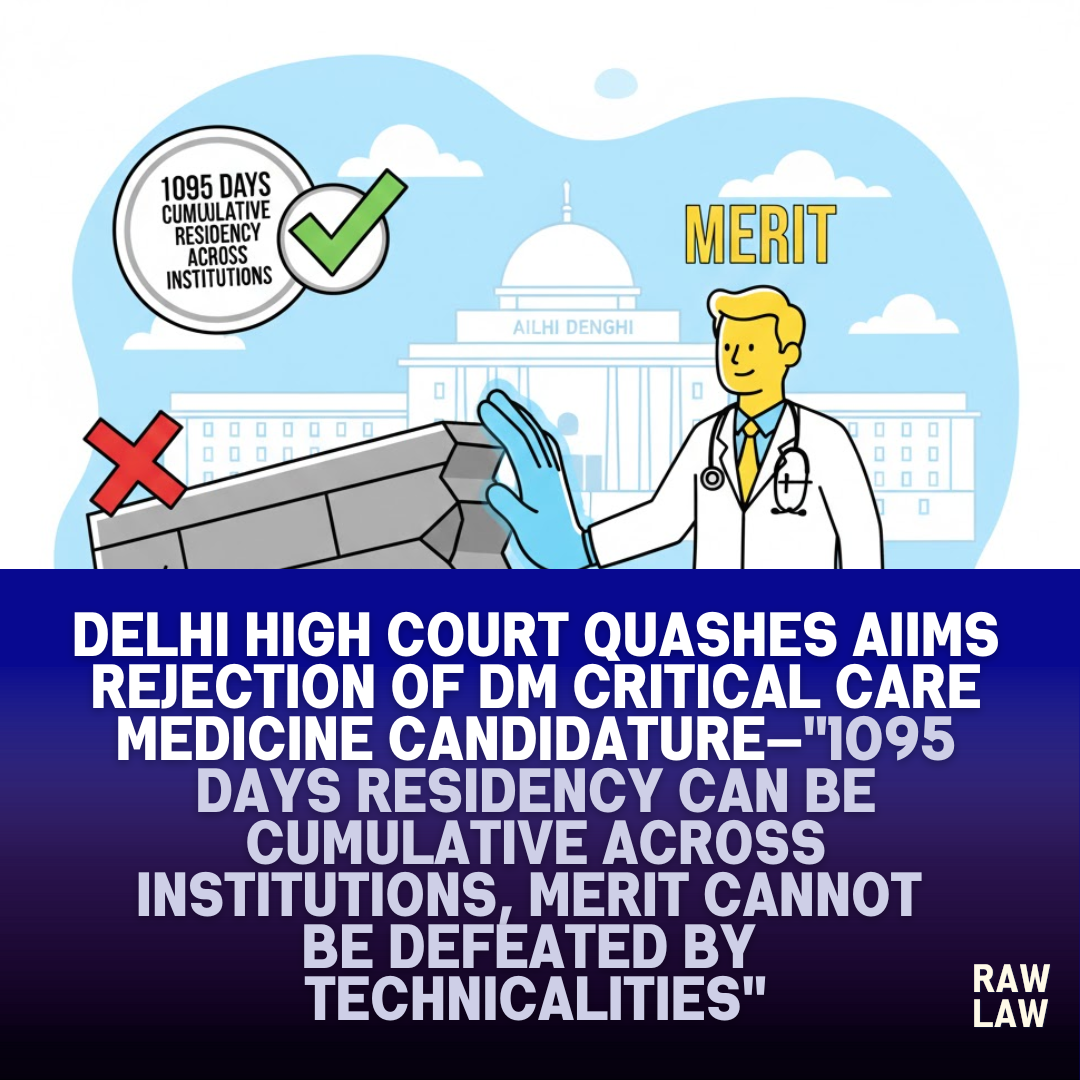
The Delhi High Court set aside the decision of an Institute of National Importance cancelling a doctor’s candidature for the DM Critical Care Medicine programme, holding that the mandatory requirement of three years (1095 days) of postgraduate residency can be satisfied cumulatively across multiple recognised institutions. The Court ruled that neither the prospectus nor the governing medical education regulations mandate completion of residency from a single institute. Declaring the rejection arbitrary and contrary to the plain language of eligibility conditions, the Court allowed the writ petition and directed restoration of the petitioner’s candidature.
Court’s decision
The Court allowed the writ petition and quashed the rejection letter dated 02 January 2026 cancelling the petitioner’s candidature for admission to the DM Critical Care Medicine programme. It held that the interpretation adopted by the respondent institute imposed an unwritten eligibility condition by requiring residency training to be from a single institution. Such an interpretation, the Court found, was impermissible, arbitrary, and violative of Article 14. The Court concluded that once the petitioner had completed 1095 days of residency training in the same discipline from recognised institutions, the eligibility requirement stood fulfilled.
Facts
The petitioner appeared in the Institute of National Importance Super-Specialty Entrance Examination for the January 2026 session and secured a high All India Rank. He had completed his MD in Anaesthesiology after undergoing postgraduate residency training across three recognised medical colleges due to counselling reshuffles during the COVID-19 pandemic. His residency comprised 15 days at one institute, 54 days at another, and 1026 days at his final institution, cumulatively exceeding 1095 days.
Despite being issued an admit card, participating in counselling, and being included in the final merit list, the petitioner’s candidature was cancelled at the final stage on the ground that his residency experience was fragmented across institutions. This rejection was issued without prior notice or opportunity of hearing, leading to the present writ petition.
Issues
The primary issue before the Court was whether the requirement of completing three years or 1095 days of postgraduate residency, as prescribed under the prospectus and medical education regulations, must necessarily be fulfilled in a single institution. Ancillary issues included the scope of judicial review in academic matters, whether an institute could add eligibility conditions not expressly stated in the prospectus, and whether rejection of candidature at the final stage violated principles of fairness, legitimate expectation, and equality.
Petitioner’s arguments
The petitioner contended that neither the prospectus nor the Post Graduate Medical Education Regulations, 2023, stipulate that the residency period must be continuous or from a single institution. It was argued that his transitions between institutions were entirely through authorised counselling and were necessitated by extraordinary circumstances arising from the COVID-19 pandemic. The petitioner emphasised that all institutions were recognised and that the concerned university had issued a valid certificate confirming completion of more than 1095 days of residency.
It was further submitted that the rejection violated principles of natural justice as it was issued without notice or hearing, and that the respondent institute was estopped from raising eligibility objections at the final stage after permitting participation throughout the selection process. Reliance was placed on the doctrine of legitimate expectation and equality under Article 14.
Respondent’s arguments
The respondent institute argued that it retained discretion under the prospectus to decide questions of eligibility and that allowing cumulative residency across institutions would dilute academic standards. It was contended that super-specialty medical courses are skill-based and require continuous training in a single institutional environment to ensure uniform competence. The respondent further urged judicial restraint, submitting that courts should not interfere in academic policy matters decided by expert bodies. It was also argued that the certificate issued by the university could not bind the institute if it did not align with the institute’s understanding of eligibility norms.
Analysis of the law
The Court reiterated the settled principle that while courts ordinarily exercise restraint in academic matters, they retain the power of judicial review where decisions are arbitrary, unreasonable, or contrary to law. Analysing Clause 4.3.2 of the prospectus alongside Regulation 2.1 of the PGME Regulations, 2023, the Court found that both merely require completion of three years or 1095 days of training and are silent on the requirement of a single institution.
The Court held that eligibility conditions must be explicit and cannot be supplemented by implication. Introducing an unstated requirement amounted to adding words to the prospectus, which is impermissible. Once the regulatory framework recognises cumulative completion and the awarding university has certified compliance, the respondent institute could not reinterpret eligibility to the detriment of a candidate.
Precedent analysis
The Court examined earlier decisions emphasising judicial restraint in academic matters but distinguished them on facts. It held that precedents discouraging interference apply where eligibility criteria are clear and uniformly applied. In the present case, the ambiguity arose from the respondent’s attempt to read an implied restriction into a clear eligibility clause. The Court also relied on prior rulings underscoring that merit cannot be sacrificed to technical or procedural interpretations, especially when candidates are allowed to complete the selection process without objection.
Court’s reasoning
The Court noted that the respondent institute had multiple opportunities to flag the alleged deficiency, including at the stage of issuing the admit card, publishing the list of ineligible candidates, and during counselling, but failed to do so. Raising the objection only at the final stage was held to be unfair and arbitrary.
It further observed that the petitioner’s training was not shortened or diluted; rather, he had completed the full statutory duration of residency in the same discipline. The Court rejected the argument that cumulative residency would undermine standards, holding that such policy considerations must be expressly incorporated in regulations or prospectus, not enforced retrospectively through interpretation.
Conclusion
The Delhi High Court held that the petitioner satisfied the eligibility requirement of 1095 days of postgraduate residency and that the rejection of his candidature was unsustainable. The impugned rejection letter was quashed, and the writ petition was allowed. The Court reaffirmed that academic merit and fairness must prevail over hyper-technical interpretations and that institutes of national importance must act transparently and consistently in high-stakes selection processes.
Implications
This judgment has significant implications for medical admissions across India. It clarifies that, unless expressly barred, cumulative residency across recognised institutions satisfies eligibility requirements for super-specialty courses. The ruling strengthens protection for candidates affected by counselling reshuffles and extraordinary disruptions such as the pandemic. It also sends a clear message that premier institutions cannot introduce implicit eligibility barriers at advanced stages of selection, thereby reinforcing transparency, meritocracy, and equality in medical education.
Case law reference
- Judicial restraint in academic matters: Courts generally defer to expert bodies but will intervene where decisions are arbitrary or contrary to express rules.
- Clarity of eligibility conditions: Eligibility criteria must be explicit; unstated requirements cannot be enforced through interpretation.
- Application in present case: These principles were applied to hold that cumulative completion of 1095 days of residency across institutions satisfies the prospectus requirement.
FAQs
Q1. Can postgraduate medical residency be counted cumulatively from different institutions?
Yes. Unless expressly prohibited by regulations or the prospectus, residency periods completed across recognised institutions can be counted cumulatively.
Q2. Can AIIMS or similar institutes add eligibility conditions not stated in the prospectus?
No. Institutes cannot introduce implicit or unwritten eligibility requirements beyond what is clearly stated.
Q3. Can candidature be cancelled at the final stage of counselling?
Courts have held that raising eligibility objections at the final stage, after allowing full participation, may be arbitrary and violative of fairness.