Delhi High Court quashes cross-FIRs in extended family dispute involving obscene content and assault — “Continuation would serve no useful purpose” — Proceedings set aside after settlement

Court’s decision
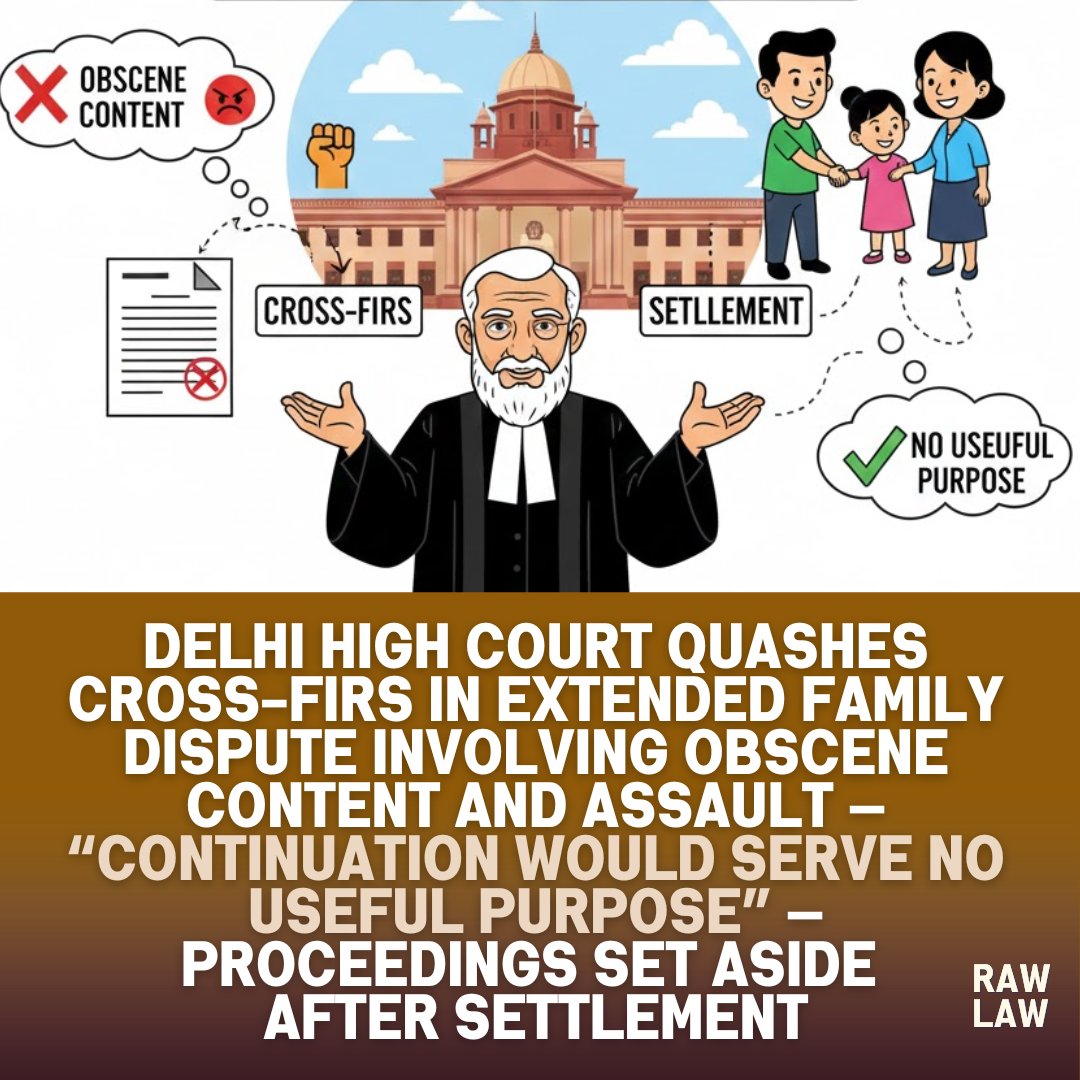
The Delhi High Court quashed two cross-FIRs arising from a volatile panchayat meeting between members of an extended family, holding that the dispute was overwhelmingly personal and had been amicably resolved. Exercising inherent powers under Section 528 of the Bharatiya Nagarik Suraksha Sanhita, 2023, the Court set aside proceedings relating to alleged circulation of obscene material and alleged attempt to culpably harm.
The Court found that the compromise was voluntary, genuine, and executed within months of the incident, and that continuation of criminal proceedings would disturb family harmony rather than secure justice. The bail applications arising from the FIRs were rendered infructuous.
Facts
The case arose from two interconnected FIRs between two branches of the same extended family bound by multiple matrimonial alliances. The first FIR alleged circulation of objectionable and intimate photographs of a woman in WhatsApp groups and their display during a panchayat meeting held on 25 April 2025. The offences invoked included Section 79 of the Bharatiya Nyaya Sanhita and Section 67 of the Information Technology Act.
The second FIR stemmed from the same panchayat meeting. It alleged that tempers flared during discussions over family disputes and escalated into a physical altercation. The complainant alleged that he was struck on the head with stones, resulting in a laceration requiring stitches. The prosecution invoked Sections 109, 110 and 3(5) of the Bharatiya Nyaya Sanhita, corresponding to serious assault provisions.
During proceedings before the High Court, the parties executed two separate Memoranda of Understanding dated 28 July 2025, affirming a voluntary and comprehensive settlement.
Issues
The principal legal issue was whether the High Court should exercise its inherent jurisdiction to quash criminal proceedings involving non-compoundable offences, including allegations analogous to attempt to murder and dissemination of obscene material, on the basis of a private compromise.
The Court was required to examine whether the offences, though serious in nature, were rooted in personal and familial discord rather than societal criminality, and whether the possibility of conviction was remote in light of the settlement.
Petitioners’ arguments
The petitioners submitted that both FIRs arose from the same panchayat meeting convened to resolve inter se matrimonial and family tensions. It was contended that the allegations were the product of heightened emotions during a family confrontation. They emphasized that the parties had resolved all disputes through written Memoranda of Understanding and that affidavits of no objection had been filed by the complainants. It was argued that continuation of prosecution would undermine fragile familial harmony, particularly where marriages between the families continued to subsist. The petitioners urged the Court to apply settled principles permitting quashing of criminal proceedings in cases overwhelmingly civil or personal in character.
Respondent’s arguments
The State, while placing the factual record before the Court, highlighted that one complainant had suffered a head injury requiring stitches and that provisions corresponding to attempt to murder had been invoked. It was suggested that offences involving physical assault and alleged circulation of obscene material must be treated with seriousness. However, the complainants personally appeared before the Court, affirmed the settlement, and unequivocally expressed their unwillingness to pursue criminal proceedings. The respondents confirmed that the compromise had been entered into voluntarily and without coercion.
Analysis of the law
The Court relied upon established jurisprudence governing the quashing of criminal proceedings under inherent powers. The seminal decision in Gian Singh v. State of Punjab recognized that even non-compoundable offences may be quashed where continuation would amount to abuse of process and where the dispute bears predominantly private character.
The Court further examined Narinder Singh v. State of Punjab, which laid down structured guidelines for quashing proceedings involving serious offences including Section 307 IPC. The Supreme Court clarified that mere invocation of serious penal provisions does not automatically bar quashing; courts must evaluate the nature of injuries, likelihood of conviction, and stage of proceedings.
The decisions in State of Madhya Pradesh v. Laxmi Narayan and Naushey Ali v. State of Uttar Pradesh reaffirmed these principles, permitting quashing in appropriate factual settings where the dispute is personal and settlement genuine.
Precedent analysis
In Gian Singh, the Supreme Court emphasized that offences predominantly arising from matrimonial or family disputes may be quashed where the victim and offender have amicably resolved their disputes. The High Court invoked this reasoning to classify the present matter as fundamentally familial.
Narinder Singh introduced the principle that courts must examine whether Section 307 or equivalent serious provisions were invoked mechanically or whether evidence suggested a strong possibility of conviction. In the present case, the Court observed that the altercation was sudden, involved no firearm or sharp-edged weapon, and arose in the heat of a family meeting.
Laxmi Narayan reiterated caution in quashing serious offences but permitted such relief where justice so demanded. Naushey Ali demonstrated the application of these principles in quashing attempt to murder charges upon settlement. The High Court applied these precedents to conclude that this case warranted intervention.
Court’s reasoning
The Court emphasized the intricate matrimonial ties binding the parties and the fact that the cross-FIRs emerged from the same panchayat meeting intended to resolve family differences. The second FIR was a direct consequence of tensions arising during discussions over the first FIR.
While acknowledging that the complainant in the assault case suffered a grievous head injury, the Court noted his categorical statement that the injury had no lasting consequences and that he did not wish to pursue the matter further.
The Court found the settlement to be voluntary, executed within months of the incidents, and supported by affidavits of no objection. The possibility of conviction was assessed as remote and bleak, particularly in light of the complainants’ stance.
In these circumstances, continuation of criminal proceedings would not advance justice but instead prolong hostility within the family structure.
Conclusion
The Delhi High Court allowed the petitions and quashed FIR No. 300/2025 registered at Police Station Shahbad Dairy and FIR No. 204/2025 registered at Police Station Paschim Vihar, along with all consequential proceedings.
The parties were directed to remain bound by the terms of their settlement. The pending bail applications were disposed of as infructuous.
The ruling reinforces the principle that criminal law should not be wielded as a tool to perpetuate family vendettas where genuine reconciliation has been achieved.
Implications
This judgment strengthens the jurisprudence permitting quashing of cross-FIRs arising from family and matrimonial disputes, even where serious allegations such as dissemination of obscene material or attempt to murder are invoked.
It underscores that courts must distinguish between crimes affecting society at large and those emerging from personal discord. The decision promotes restorative justice and family harmony while preserving judicial caution in serious criminal matters.
The ruling will likely serve as persuasive authority in cases involving digital dissemination allegations intertwined with personal disputes, particularly under the Bharatiya Nyaya Sanhita and Information Technology Act.
Case law references
- Gian Singh v. State of Punjab (2012)
Held that non-compoundable offences may be quashed where disputes are predominantly personal and settlement serves the ends of justice. - Narinder Singh v. State of Punjab (2014)
Laid down structured guidelines for quashing proceedings involving serious offences including attempt to murder. - State of Madhya Pradesh v. Laxmi Narayan (2019)
Reaffirmed cautious but flexible exercise of inherent powers in serious criminal cases. - Naushey Ali v. State of Uttar Pradesh (2025)
Applied compromise principles to quash prosecution under attempt to murder provisions.
FAQs
1. Can cross-FIRs in family disputes be quashed after settlement?
Yes. High Courts can quash cross-FIRs if the dispute is overwhelmingly personal, the settlement is voluntary, and continuation would not serve the ends of justice.
2. Can serious offences like attempt to murder be quashed?
Courts may quash such offences after careful scrutiny if evidence suggests a remote likelihood of conviction and the dispute is personal rather than societal.
3. Does settlement automatically lead to quashing?
No. Courts assess the nature of the offence, evidence, stage of proceedings, and genuineness of compromise before exercising inherent powers.