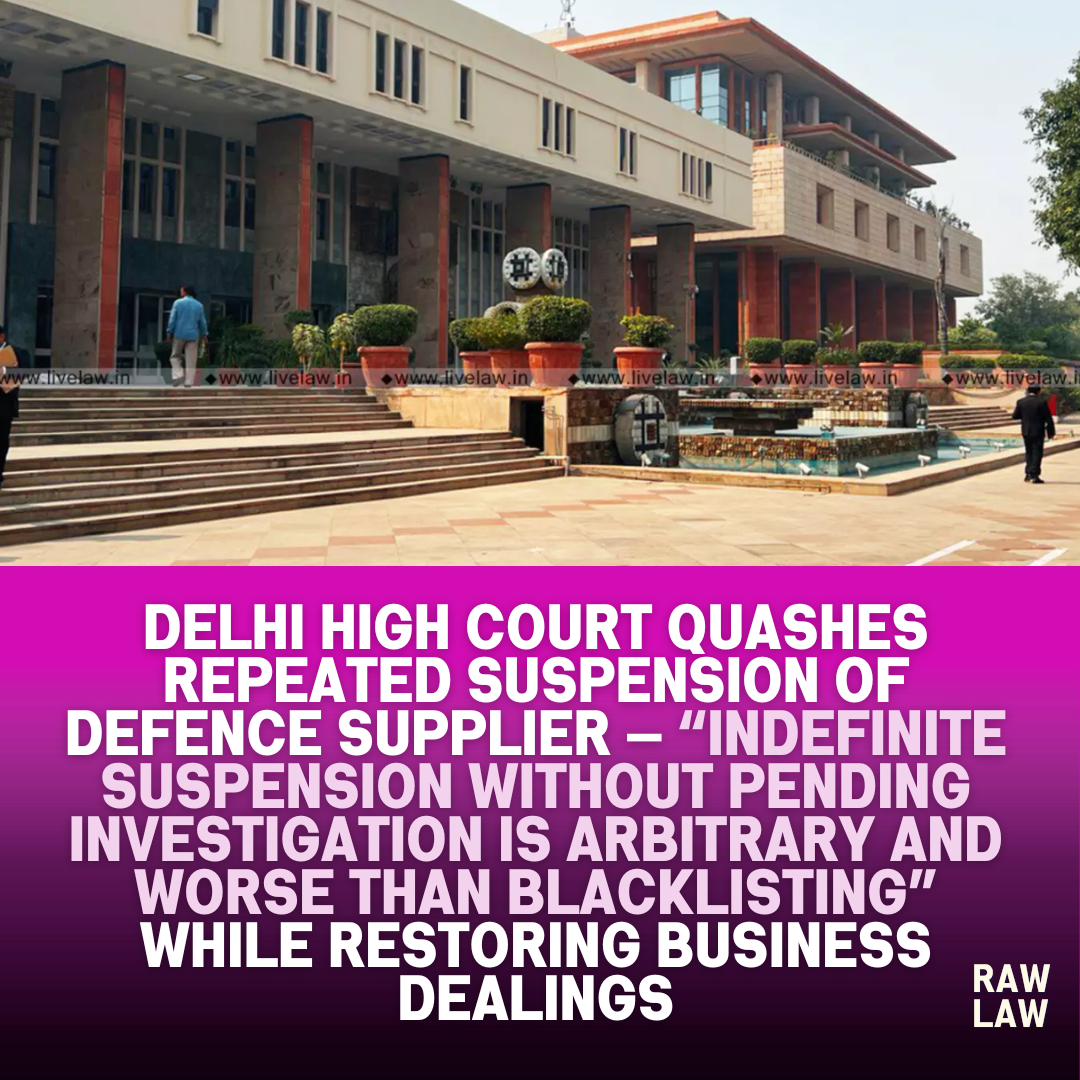
Delhi High Court quashes repeated suspension of defence supplier — “Indefinite suspension without pending investigation is arbitrary and worse than blacklisting” while restoring business dealings

Court’s decision
The Delhi High Court allowed a writ petition filed by an engineering equipment supplier against the Ministry of Defence, setting aside an order that extended the suspension of its business dealings with the Government of India. The Court held that continued suspension based solely on decade-old FIRs against a deceased shareholder, with no pending investigation or enquiry, is legally unsustainable. It ruled that suspension under the Ministry of Defence Guidelines is an interim and urgent measure, not a tool for indefinite exclusion, and that mechanical extensions without fresh material violate principles of natural justice and non-arbitrariness .
Facts
The petitioner company is engaged in supplying engineering equipment to the Government of India and the Indian Army. Its business dealings were initially suspended in August 2020 under the Ministry of Defence Guidelines for Penalties in Business Dealings, on the ground that two FIRs registered by the Central Bureau of Investigation in 2012 were allegedly not disclosed under the Pre-Contract Integrity Pact submitted by the company during earlier tenders.
Both FIRs related to allegations against a former majority shareholder of the petitioner company. In one FIR, a closure report was filed by the CBI in August 2014 and remains pending acceptance by the trial court. In the second FIR, a charge sheet was filed only against a retired senior Army officer, and the shareholder concerned was not arraigned as an accused. The said shareholder passed away in March 2016.
Despite these developments, the Ministry of Defence repeatedly extended the suspension every six months from 2020 onwards, without issuing a show cause notice or granting a personal hearing. The petitioner challenged these extensions, leading to an earlier judgment of the High Court in September 2023 directing issuance of a show cause notice, consideration of relevant material including the death of the shareholder, and passing of a reasoned order after hearing.
Pursuant to these directions, a show cause notice was issued in January 2024, followed by a personal hearing. However, by order dated 26 February 2024, the Ministry again extended the suspension for a further six months or until further orders. This order was challenged in the present writ petition.
Issues
The principal issues before the High Court were whether suspension of business dealings could be continued under the Ministry of Defence Guidelines when there was no pending criminal investigation or enquiry against the company, whether FIRs against a deceased former shareholder could justify ongoing suspension, and whether repeated extensions of suspension amounted to impermissible indefinite banning in the guise of an interim measure.
Petitioners’ arguments
The petitioner contended that the entire basis of suspension rested on FIRs registered more than a decade ago against a person who had since passed away, and in which the company itself was neither named nor accused. It was argued that after the death of the shareholder and filing of a closure report in one FIR and exclusion of his name in the charge sheet in the other, there was no pending enquiry or investigation, which is a mandatory precondition for invoking the suspension power under paragraph D.2 of the Guidelines.
It was further argued that the impugned order completely ignored binding findings in the earlier judgment of the High Court, which had categorically held that there was no ongoing investigation. The petitioner submitted that the show cause notice and the impugned order were mechanical reiterations of past allegations, without addressing the petitioner’s detailed reply or the effect of subsequent developments. Continued suspension for over five years, it was argued, effectively amounted to blacklisting without following the safeguards prescribed for banning.
Respondent’s arguments
The Union of India defended the impugned order, submitting that the suspension was extended after issuance of a show cause notice, consideration of the petitioner’s reply, and grant of a personal hearing, in compliance with earlier judicial directions. It was argued that paragraph D.2 of the Guidelines empowered the competent authority to suspend business dealings when criminal cases were registered, and that suspension could be extended periodically subject to approval.
The respondent also contended that under the Guidelines, the total period of suspension could extend up to the maximum permissible period for banning, which could be as long as ten years.
Analysis of the law
The Court examined the structure of the Ministry of Defence Guidelines and emphasised that suspension is not an independent penalty, but an urgent, interim measure preceding a final decision on banning. It reiterated that powers under paragraph D.2 can be exercised only when there is an initiation or pendency of criminal investigation or enquiry against the entity itself. Once such investigation ceases to exist, the foundation for suspension disappears.
The Court also relied on settled criminal jurisprudence that prosecution cannot continue against a deceased person and that presumption of innocence does not vanish upon death. FIRs against a deceased shareholder, without any material implicating the company, could not justify continued adverse action.
Precedent analysis
The Court relied heavily on its earlier judgment in the petitioner’s own case from September 2023, as well as Division Bench decisions such as Defsys Solutions Private Limited v. Union of India, which held that mere registration of an FIR or investigation against a promoter or former director cannot automatically justify suspension of a company’s business dealings. The Court also drew support from Supreme Court authority cautioning against mechanical issuance of show cause notices and pre-determined outcomes in blacklisting and suspension cases.
Court’s reasoning
The High Court found that the impugned order failed on multiple counts. First, it ignored the undisputed factual position that there was no pending investigation against the petitioner company. Second, it failed to consider the legal consequence of the death of the shareholder, despite this aspect being expressly highlighted by the Court in earlier proceedings.
Third, the impugned order was found to be non-speaking and mechanical, merely reproducing the contents of the show cause notice without dealing with the petitioner’s reply or recording independent reasons. The Court observed that repeated extensions of suspension every six months, without moving towards either banning or revocation, resulted in a perpetual state of exclusion, which the law does not permit.
The Court also rejected the argument that suspension could continue up to ten years, holding that such an interpretation would render the safeguards in the Guidelines meaningless and unconstitutional. It reiterated that prolonged suspension can be even more damaging than blacklisting, especially in defence contracts where the Government is the sole customer .
Conclusion
The Delhi High Court held that the impugned order dated 26 February 2024 extending the suspension was unsustainable in law and accordingly set it aside. The writ petition was allowed, and all pending applications were disposed of. The effect of the judgment was restoration of the petitioner’s business dealings with the Government of India, subject to law.
Implications
This judgment is a significant reaffirmation of judicial control over executive discretion in defence procurement. It clarifies that indefinite suspension without a live investigation is impermissible, and that authorities must either proceed to banning by following due process or revoke suspension. The ruling strengthens protections against arbitrary exclusion of companies from government contracts and underscores that suspension cannot be used as a punitive measure in perpetuity.
Case law references
- U. Subhadramma v. State of Andhra Pradesh – Held that criminal proceedings cannot continue against a deceased accused and presumption of innocence survives.
- Defsys Solutions Private Limited v. Union of India – Ruled that FIRs or investigations against individuals cannot automatically justify suspension of a company.
- Kulja Industries Limited v. Chief General Manager, BSNL – Held that blacklisting or exclusion must be proportionate, reasoned, and time-bound.
- M/s Techno Prints v. Chhattisgarh Textbook Corporation – Warned against mechanical show cause notices and pre-determined administrative decisions.
FAQs
1. Can the Government indefinitely suspend a company’s business dealings?
No. Suspension is an interim measure and cannot be continued indefinitely without a pending enquiry or final decision on banning.
2. Can FIRs against a deceased shareholder justify suspension of a company?
No. FIRs against a deceased individual, without material implicating the company, cannot sustain suspension.
3. Is a reasoned order mandatory for extending suspension?
Yes. Authorities must pass a speaking, reasoned order after considering replies and relevant developments.