

Court’s decision
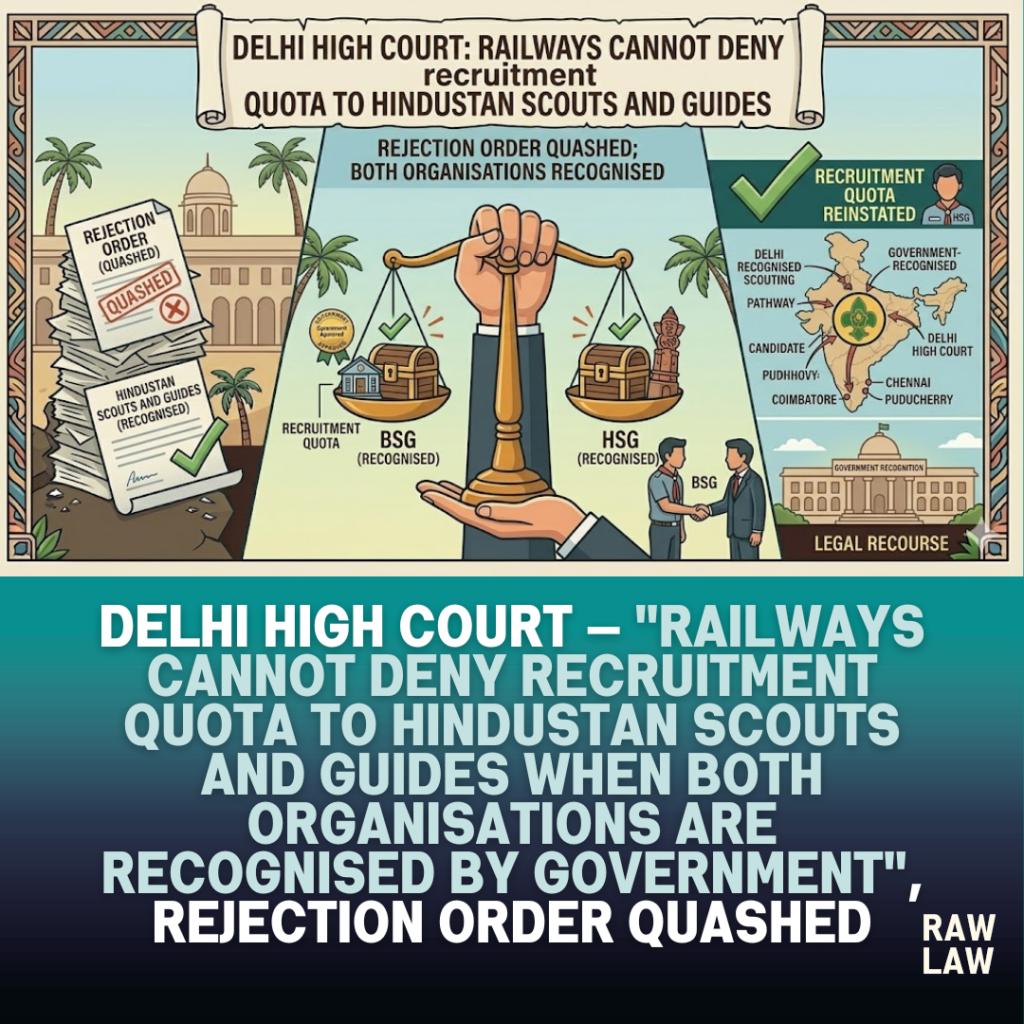
The Delhi High Court allowed a writ petition filed by the Hindustan Scouts and Guides Association challenging the Ministry of Railways’ refusal to grant it parity with Bharat Scouts and Guides in the recruitment quota available for scouts and guides. The Court held that denying the benefit of the Scouts and Guides quota to members of the petitioner organisation was arbitrary and violative of Article 14 of the Constitution.
Justice Mini Pushkarna ruled that both organisations perform similar functions and are recognised by the Ministry of Youth Affairs and Sports. Consequently, limiting the recruitment quota only to Bharat Scouts and Guides lacked any intelligible differentia. The Court quashed the Railway Board’s rejection order dated 25 November 2022 and directed the Railways to extend the recruitment quota benefit to the petitioner association as well.
Facts
The dispute arose when the Hindustan Scouts and Guides Association approached the Ministry of Railways seeking parity with Bharat Scouts and Guides in relation to recruitment under the Scouts and Guides quota in railway employment. The Railways had a long-standing policy under various Master Circulars allowing recruitment of eligible candidates under a special cultural-cum-scouts and guides quota.
However, the Railway policy effectively recognised only Bharat Scouts and Guides for this quota. Members of the petitioner organisation were not eligible to apply under the quota even though they were engaged in similar scouting activities.
Earlier, the petitioners had filed a writ petition seeking consideration of their representation for parity. The High Court directed the Railways to decide their representation through a speaking order. In response, the Railways passed a speaking order dated 25 November 2022 rejecting the request.
The rejection was based on several grounds, including the fact that Bharat Scouts and Guides was affiliated with the World Organization of the Scout Movement (WOSM), whereas the petitioner organisation was not.
Aggrieved by this rejection, the Hindustan Scouts and Guides Association filed the present writ petition seeking quashing of the order and extension of recruitment quota benefits to its members as well.
Issues
The Delhi High Court examined the following legal issues:
- Whether Hindustan Scouts and Guides Association was similarly placed with Bharat Scouts and Guides in relation to scouting activities.
- Whether restricting the railway recruitment quota only to members of Bharat Scouts and Guides amounted to arbitrary discrimination.
- Whether lack of affiliation with international scouting bodies could justify denial of recruitment benefits.
- Whether the Railway Board’s speaking order rejecting parity violated the equality principle under Article 14 of the Constitution.
Petitioner’s arguments
The petitioner association argued that it performs the same functions as Bharat Scouts and Guides and carries out nationwide scouting and guiding activities focusing on youth development, community service and leadership training.
It was submitted that the organisation is recognised by the Ministry of Youth Affairs and Sports, which is the nodal authority responsible for promoting scouting and guiding in India. In fact, the Ministry had clarified through official communication that both organisations—Bharat Scouts and Guides and Hindustan Scouts and Guides—are recognised and receive government financial assistance for their activities.
The petitioners contended that despite this recognition, the Railways had arbitrarily restricted the recruitment quota to only one organisation. This discrimination placed the members of the petitioner organisation at a disadvantage even though they were similarly engaged in scouting activities.
The petitioners emphasised that they were not seeking removal of Bharat Scouts and Guides from the quota. Instead, they sought equal opportunity for their members to participate in recruitment under the Scouts and Guides quota.
Respondent’s arguments
The Union of India and the Ministry of Railways opposed the petition. They argued that historically, the Railways had been associated only with Bharat Scouts and Guides, and therefore the quota was limited to that organisation.
The Railways also relied on the international recognition enjoyed by Bharat Scouts and Guides through its membership in the World Organization of the Scout Movement and the World Association of Girl Guides and Girl Scouts.
According to the respondents, since WOSM recognises only one scouting organisation per sovereign nation, the petitioner association could not claim parity unless it became part of that international framework.
The Railways also argued that extending recognition to multiple scouting organisations could create administrative difficulties and lead to future demands from other organisations.
Analysis of the law
The Court examined the constitutional guarantee of equality under Article 14 and the well-established doctrine that similarly placed persons must be treated alike.
The Court reiterated that the State may classify persons or entities for policy purposes, but such classification must satisfy the twin test of:
- An intelligible differentia distinguishing the groups, and
- A rational nexus with the objective sought to be achieved.
Applying this principle, the Court found that both organisations performed similar functions related to scouting and youth development.
The Court also noted that both organisations had been recognised by the Ministry of Youth Affairs and Sports, which is the competent authority responsible for promoting scouting activities in India.
In such circumstances, excluding the petitioner organisation from the recruitment quota lacked any reasonable justification.
Precedent analysis
The Court relied on several Supreme Court precedents interpreting the equality clause.
In Amita v. Union of India, the Supreme Court emphasised that Article 14 prohibits discrimination between persons who are similarly situated.
Similarly, in Prem Chand Somchand Shah v. Union of India, the Supreme Court held that equality requires that all persons similarly placed must be treated alike unless a valid classification exists.
The Court also referred to State of West Bengal v. Anwar Ali Sarkar, which established that classification must be based on intelligible differentia and must bear a rational nexus with the objective of the law.
Applying these principles, the Delhi High Court concluded that no such intelligible differentia existed in the present case.
Court’s reasoning
The Court carefully examined the activities and recognition status of both organisations. It observed that both groups conduct similar scouting activities such as community service programmes, outdoor training, leadership development and national-level events.
It further noted that the Ministry of Youth Affairs and Sports had formally recognised both organisations and even provided financial assistance to them for conducting scouting programmes.
The Court rejected the Railways’ reliance on international affiliation with WOSM as a justification for differential treatment. It held that WOSM is a private international organisation and its internal rules cannot determine government policy in India.
The Court also observed that the railway recruitment quota is based on merit-based selection through written tests and evaluation criteria. Therefore, extending eligibility to members of the petitioner organisation would merely increase competition without compromising recruitment standards.
Finally, the Court rejected the argument of financial or administrative constraints, holding that such reasons cannot justify discrimination when similarly placed entities are treated differently.
Conclusion
The Delhi High Court held that the Railway Board’s rejection of parity to Hindustan Scouts and Guides Association was arbitrary and unconstitutional.
The Court quashed the speaking order dated 25 November 2022 and directed the Ministry of Railways to extend the recruitment quota benefits available to Bharat Scouts and Guides to the petitioner association as well.
Accordingly, the writ petition was allowed.
Implications
This judgment significantly reinforces the constitutional principle of equality in public employment policies.
The ruling clarifies that government departments cannot arbitrarily recognise only one organisation for recruitment benefits when another organisation performing identical functions is officially recognised by the government.
The decision also emphasises that international affiliations of private bodies cannot determine access to government schemes or recruitment policies.
More broadly, the judgment strengthens judicial scrutiny of government policies that create artificial distinctions between similarly placed organisations.
Case Law References
Amita v. Union of India (2005)
The Supreme Court held that Article 14 guarantees equality before law and prohibits discrimination among persons in similar circumstances.
Prem Chand Somchand Shah v. Union of India (1991)
The Court ruled that equality ensures that similarly placed individuals receive equal treatment unless valid classification exists.
State of West Bengal v. Anwar Ali Sarkar (1952)
The Supreme Court established the test of reasonable classification requiring intelligible differentia and rational nexus.
Confederation of Ex-Servicemen Associations v. Union of India (2006)
The Court reiterated the two-pronged test for permissible classification under Article 14.
FAQs
1. Can government recruitment quotas be limited to a single organisation?
No. If multiple organisations perform similar functions and are recognised by the government, limiting a recruitment quota to only one organisation may violate Article 14 of the Constitution.
2. Is international affiliation necessary for recognition of scouting organisations in India?
The Delhi High Court clarified that affiliation with international bodies like WOSM is not a mandatory requirement if the organisation is recognised by the Ministry of Youth Affairs and Sports.
3. What is the Scouts and Guides quota in railway recruitment?
The Railways maintain a special cultural-cum-scouts and guides quota allowing eligible scouts and guides to apply for certain railway posts, subject to merit-based selection criteria.


