

Court’s decision
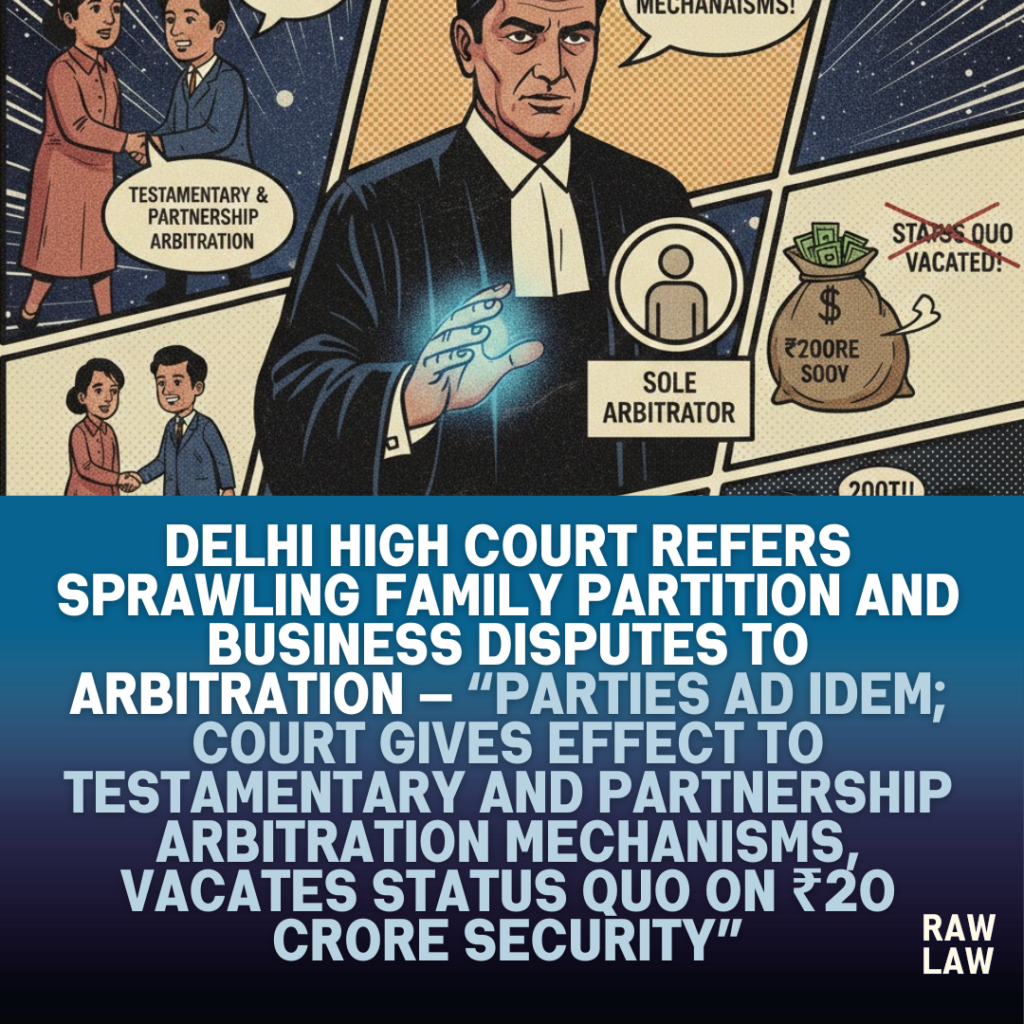
The Delhi High Court disposed of a comprehensive civil suit involving partition, declaration, dissolution of partnership firms, rendition of accounts and injunctions by referring all inter se disputes between family members to arbitration, holding that the parties were unequivocally ad idem on adopting an arbitral mechanism. The Court ruled that where testamentary directions, partnership deeds, and subsequent conduct converge towards arbitration, courts must make that intention workable — “duty of the court is to give effect to parties’ intent”; sole arbitrator appointed, interim status quo vacated subject to ₹20 crore security.
Court’s decision
Justice Mini Pushkarna, with consent of all parties, appointed a former Chief Justice of a High Court as sole arbitrator to adjudicate disputes arising out of a family will, multiple partnership deeds, Hindu Undivided Family issues, and property partition claims. The Court held that even disputes lacking a formal arbitration clause could be validly referred to arbitration by consent, preserved all objections for the arbitral tribunal, and vacated the earlier status quo order on immovable properties upon furnishing substantial security.
Facts
The suit was instituted by the plaintiff, son of defendant no. 1, seeking partition, declaration, dissolution of partnership firms, rendition of accounts, and mandatory and permanent injunctions in respect of extensive movable and immovable assets detailed across multiple schedules. The disputes stemmed from family-owned businesses and properties, including interests connected with a footwear manufacturing enterprise, as well as assets claimed through inheritance.
A key factual backdrop was the Will dated 10 November 1998 executed by the plaintiff’s grandfather, under which the estate was bequeathed to the plaintiff, certain defendants, and the testator’s wife. Crucially, the Will contained an internal dispute resolution mechanism entrusting named family elders with authority to resolve disputes, with their decision binding on all beneficiaries. Earlier, by order dated 06 May 2019, parties had expressly stated before the Court that there was no dispute as to the validity of the Will.
Issues
The principal issue before the High Court was whether the entire spectrum of disputes — including those arising from the Will, multiple partnership deeds, Hindu Undivided Family arrangements, and partition of properties — could be referred to arbitration. A connected issue was whether the Court could, with consent of parties, refer even non-contractual disputes to arbitration and vacate subsisting interim orders upon securing parties’ interests.
Plaintiff’s arguments
The plaintiff accepted reference of all disputes to arbitration and reiterated the earlier statement that the Will was not under challenge. It was submitted that arbitration would provide a comprehensive, efficient, and confidential mechanism to resolve complex interlinked disputes spanning properties, partnership firms, accounts, and family arrangements. The plaintiff did not oppose appointment of a sole arbitrator and agreed that all issues, including arbitrability and merits, be left open for adjudication before the arbitral forum.
Defendants’ arguments
The contesting defendants also consented to arbitration, relying on arbitration clauses contained in successive partnership deeds, particularly the clause in the partnership deed dated 08 September 2003 governing disputes relating to firm affairs. It was argued that even testamentary disputes were envisaged to be resolved through a non-judicial mechanism under the Will itself.
However, the defendants sought vacation of the interim status quo order on properties, submitting that the business entities were viable, ongoing concerns and that continuation of restrictive interim orders would impede operations. They offered to secure the plaintiff’s interests by furnishing substantial security to the satisfaction of the arbitrator.
Analysis of the law
The Court examined the legal permissibility of consensual reference to arbitration beyond the confines of a formal arbitration agreement. Relying on authoritative Supreme Court precedent, the Court reiterated that arbitration agreements can be inferred from conduct, correspondence, and clear consensus ad idem, and that courts must adopt a common-sense, non-technical approach to give effect to parties’ intention to arbitrate.
The Court emphasised that even where certain disputes do not strictly fall within an arbitration clause, parties are free to consensually submit them to arbitration, and courts should facilitate such resolution provided it is within the bounds of law.
Precedent analysis
The Court relied on the Supreme Court’s decision in Mahanagar Telephone Nigam Limited v. Canara Bank, which held that arbitration agreements can arise from conduct and that courts must make arbitration clauses workable rather than defeat them on technicalities. The judgment also drew from Enercon (India) Ltd. v. Enercon GmbH, underscoring that commercial and dispute resolution clauses must be interpreted to advance, not frustrate, parties’ agreed mechanism.
These precedents were applied to conclude that the parties’ express consent and prior statements before court constituted a valid basis for reference of all disputes to arbitration.
Court’s reasoning
The Court found that there was complete consensus among parties to resolve all disputes through arbitration. It noted that the Will itself contemplated a binding dispute resolution process, partnership deeds contained arbitration clauses, and parties had repeatedly affirmed their intention to arbitrate.
Given this unanimity, the Court held there was no impediment to referring all disputes — contractual and otherwise — to a single arbitral forum. To balance equities, the Court vacated the earlier interim order directing status quo on properties but safeguarded the plaintiff’s interests by directing the defendants to deposit security of ₹20 crore before the arbitrator. All questions relating to arbitrability, jurisdiction, and merits were expressly left open.
Conclusion
The Delhi High Court referred all inter se disputes between the parties to arbitration, appointed a sole arbitrator, and disposed of the suit along with all pending applications. The earlier interim status quo order was vacated subject to deposit of ₹20 crore as security. The Court clarified that its order did not express any opinion on merits and that the arbitral tribunal would adjudicate all issues independently.
Implications
This decision reinforces the judiciary’s strong pro-arbitration stance, particularly in complex family and business disputes. It clarifies that with clear consent, even testamentary, partnership, and partition disputes can be consolidated and resolved through arbitration. The ruling also illustrates how courts can balance commercial functionality and protection of parties’ interests by vacating restrictive interim orders against robust security, thereby promoting efficient dispute resolution without prejudicing substantive rights.
Case law references
- Mahanagar Telephone Nigam Limited v. Canara Bank: Arbitration agreement can be inferred from conduct; courts must make arbitration workable. Applied to justify consensual reference.
- Enercon (India) Ltd. v. Enercon GmbH: Common-sense interpretation of arbitration clauses to give effect to parties’ intent. Relied upon for interpretative approach.
- Section 7, Arbitration and Conciliation Act: Arbitration agreement may arise from written communications and consensus. Applied to validate reference.
FAQs
1. Can disputes without an arbitration clause be referred to arbitration?
Yes. If parties give clear and informed consent, courts can refer even non-contractual disputes to arbitration.
2. Can testamentary or family partition disputes be arbitrated?
Yes, where parties consent and no statutory bar applies, such disputes can be resolved through arbitration.
3. Why did the Court vacate the status quo order on properties?
Because arbitration was agreed upon and defendants furnished ₹20 crore security to protect the plaintiff’s interests.


