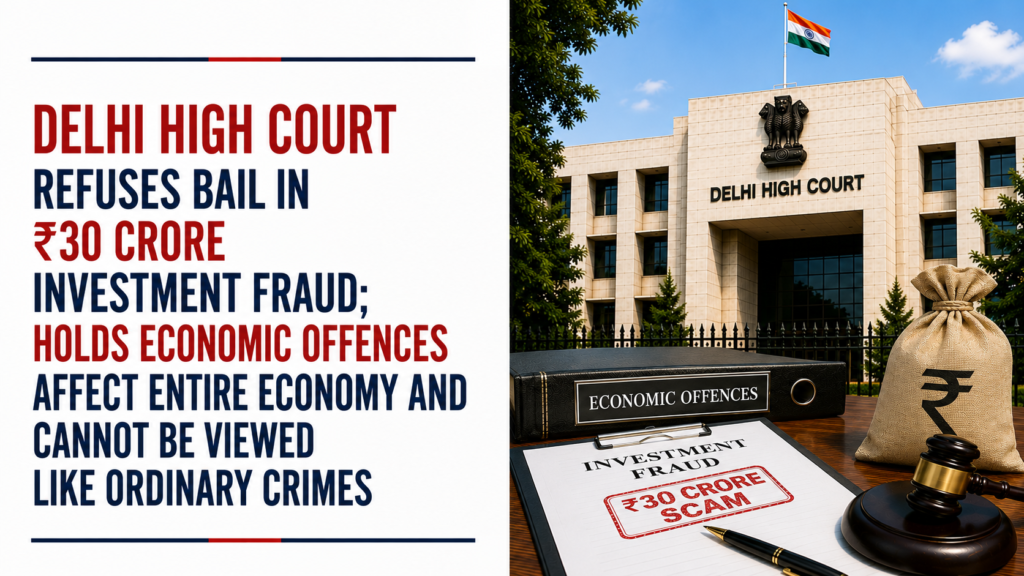
Delhi High Court Refuses Bail in ₹30 Crore Investment Fraud; Holds Economic Offences Affect Entire Economy and Cannot Be Viewed Like Ordinary Crimes

Economic Offences Causing Massive Public Loss Cannot Be Treated Like Ordinary Crimes, Holds Delhi High Court
Facts
The petitioner, Ravinder Singh Sidhu, sought regular bail in FIR No. 267/2018 registered by the Economic Offences Wing (EOW), Delhi, for offences under Sections 406, 420, 120B, 467, 468 and 471 IPC.
The prosecution alleged that, as Managing Director of certain companies, the petitioner and his associates induced investors across several States to invest in schemes promising high returns, plots or flats upon maturity. Investors were allegedly misled into believing that the companies were authorised by SEBI to mobilise public funds and were registered as NBFCs with the RBI, though no such approvals existed.
According to the prosecution, the alleged fraud involved 159 complaints, 56 FIRs across different States, and an estimated cheated amount exceeding ₹30 crore. Pursuant to a Supreme Court judgment dated 19 May 2025, the FIRs were merged State-wise by treating the earliest FIR in each State as the lead FIR.
Issues
- Whether the petitioner was entitled to regular bail considering the gravity and magnitude of the alleged economic offences.
- Whether prolonged incarceration since 2020 justified grant of bail despite the seriousness of the allegations.
- Whether the pendency of trial outweighed the public interest involved in a large-scale financial fraud.
Petitioner’s Arguments
The petitioner argued that:
- he had remained in judicial custody since 2020;
- despite prolonged incarceration, the trial had not commenced;
- several High Courts in other States had already granted him regular bail in connected cases;
- continued detention was therefore unwarranted.
Respondent’s Arguments
The State opposed bail, contending that:
- the petitioner was allegedly the principal architect of a massive multi-State cheating and forgery operation involving over 159 victims;
- the cheated amount exceeded ₹30 crore;
- offences alleged carried punishment extending up to life imprisonment;
- seven co-accused remained proclaimed offenders and continued to evade arrest;
- SEBI had directed the petitioner and his companies to wind up the investment schemes and refund investors, but those directions were ignored;
- the charge sheet had already been filed and the matter was listed for consideration of charge before the Trial Court.
Analysis of the Law
The Court considered:
- the principles governing grant of regular bail;
- the seriousness of economic offences affecting numerous investors;
- the effect of the punishment prescribed for the alleged offences;
- the stage of the criminal proceedings, including filing of the charge sheet.
The Court emphasised that large-scale economic offences involving public investments stand on a different footing from ordinary criminal cases because they undermine public confidence and adversely affect the national economy.
Precedent Analysis
The judgment primarily rested upon the factual circumstances of the case rather than an elaborate discussion of reported precedents.
The Court, however, took note of the Supreme Court’s judgment dated 19 May 2025 in W.P. (Crl.) No. 394/2024, whereby multiple FIRs arising across different States were directed to be merged State-wise by treating the earliest FIR in each State as the lead FIR and the remaining FIRs as statements under Section 161 CrPC.
Court’s Reasoning
The High Court observed that the petitioner allegedly orchestrated fraudulent investment schemes by promising investors either allotment of plots/flats or attractive financial returns while falsely representing regulatory approvals.
The Court noted that SEBI had directed the petitioner and his companies as early as 8 December 2014 to wind up the collective investment schemes and refund investors within three months, but the petitioner failed to comply despite dismissal of his appeal.
The Court further observed that:
- the alleged fraud affected 159 investors across several States;
- more than ₹30 crore of public money was involved;
- seven co-accused continued to evade arrest as proclaimed offenders;
- the petitioner offered no explanation regarding refund of investors’ money or any concrete proposal to compensate victims.
While acknowledging that courts deciding bail applications cannot function as recovery forums, the Court held that releasing the petitioner in such circumstances would send a wrong message to society, suggesting that persons accused of large-scale financial fraud could retain enormous unlawful gains after spending only a few years in custody.
Although the petitioner had remained incarcerated since 2020, the Court found that the gravity, magnitude and societal impact of the alleged offences outweighed the plea based on prolonged custody, particularly when charges were yet to be framed and the offences carried punishment extending to life imprisonment.
Conclusion
The Delhi High Court dismissed the bail application.
The Court held that the allegations disclosed a large-scale economic fraud affecting numerous investors and the broader economy, making the case unsuitable for grant of regular bail. It concluded that the gravity of the offences, the enormous financial loss, the non-compliance with SEBI’s refund directions, the absconding co-accused and the absence of any explanation regarding return of investors’ money outweighed the petitioner’s plea based on prolonged incarceration.
Case Details
Case: Ravinder Singh Sidhu v. State (NCT of Delhi)
Court: Delhi High Court
Case Number: Bail Application No. 1712/2026
Judge: Justice Girish Kathpalia
Date: 4 August 2026
Result: Bail application dismissed. The Delhi High Court refused regular bail, holding that the alleged ₹30 crore multi-State investment fraud involving 159 victims and 56 FIRs constituted a grave economic offence whose societal and economic impact outweighed the petitioner’s plea based on prolonged custody.