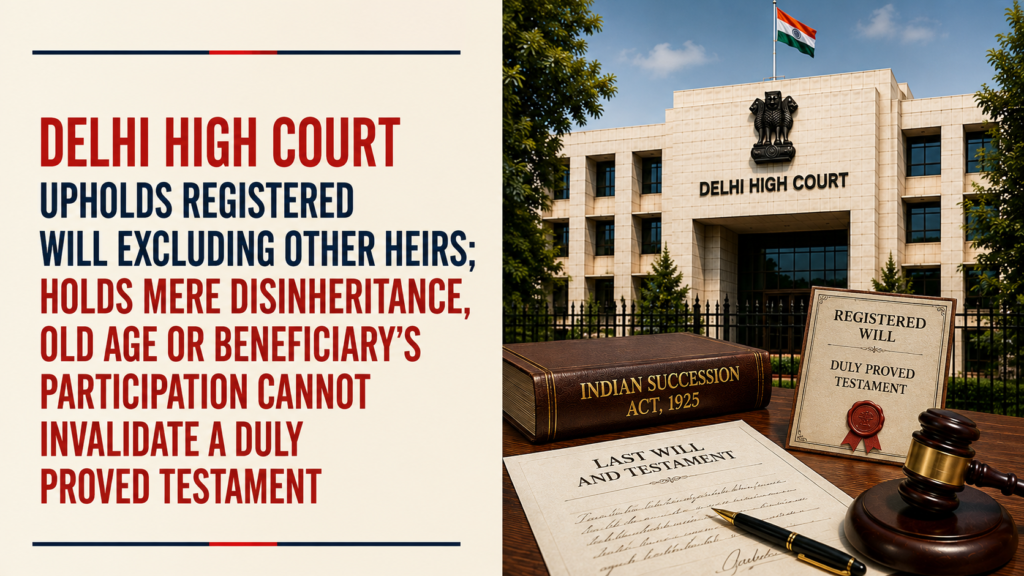
Delhi High Court Upholds Registered Will Excluding Other Heirs; Holds Mere Disinheritance, Old Age or Beneficiary’s Participation Cannot Invalidate a Duly Proved Testament

Probate Granted as Objectors Failed to Prove Testator Lacked Sound Mind, Rules Delhi High Court
Facts
Late Sh. Nathu Singh executed a registered Will dated 13 December 2005, registered on 28 December 2005, bequeathing his movable and immovable properties, including land at Karkardooma, exclusively in favour of his son Prem Chand, while specifically excluding his remaining children.
After Nathu Singh’s death on 20 January 2008, Prem Chand filed a probate petition under Section 276 of the Indian Succession Act, 1925. The Additional District Judge granted probate and Letters of Administration after finding that the Will had been duly executed and proved.
The appellants, Kailash Chand and Jagdish Prasad, challenged the probate before the Delhi High Court, alleging that the Will was forged, surrounded by suspicious circumstances, executed when the testator lacked testamentary capacity, and that the properties had already been orally partitioned during the father’s lifetime.
Issues
- Whether the Will was duly executed and attested in accordance with Section 63 of the Indian Succession Act and Section 68 of the Evidence Act.
- Whether the testator possessed a sound disposing mind while executing the Will.
- Whether the Will was surrounded by suspicious circumstances warranting its rejection.
- Whether the appellants established a prior oral partition of the family properties.
- Whether the probate granted by the Trial Court required interference in appeal.
Appellants’ Arguments
The appellants contended that:
- the Will unnaturally excluded all other legal heirs without assigning valid reasons;
- Prem Chand, being the sole beneficiary, actively participated in preparing and registering the Will, creating suspicion;
- the testator suffered from cancer, cataract, and advanced age, rendering him incapable of executing a valid Will;
- inclusion of the already-acquired Karkardooma land cast doubt on the document’s authenticity;
- an oral family partition had already taken place during the father’s lifetime, leaving nothing to be bequeathed by Will;
- registration alone could not cure suspicious circumstances surrounding the testament.
Respondents’ Arguments
Prem Chand argued that:
- the Will was executed voluntarily by the testator in a sound disposing state of mind;
- both attesting witnesses, including the drafting advocate, proved its execution in accordance with law;
- the Will was duly registered before the Sub-Registrar and official records corroborated its execution;
- no medical evidence established lack of testamentary capacity;
- the alleged oral partition remained completely unproved;
- exclusion of some legal heirs did not invalidate a testament under settled law.
Analysis of the Law
The Court examined:
- Section 63 of the Indian Succession Act, 1925;
- Section 68 of the Indian Evidence Act, 1872;
- principles governing testamentary capacity;
- the law relating to suspicious circumstances surrounding execution of Wills;
- the limited jurisdiction of probate courts, which concerns only the genuineness of the Will and not disputes regarding title to the properties.
The Court reiterated that a valid Will requires proof of execution and attestation through at least one attesting witness. Once these statutory requirements are satisfied, the propounder must also satisfactorily explain any genuine suspicious circumstances relied upon by the objectors.
Precedent Analysis
The Court relied upon several Supreme Court decisions, including:
- Sridevi v. Jayaraja Shetty (2005) 2 SCC 784 — old age or illness alone does not negate testamentary capacity.
- Kavita Kanwar v. Pamela Mehta — beneficiary’s participation in execution is only one circumstance and does not by itself invalidate a Will.
- P.P.K. Gopalan Nambiar v. P.P.K. Balakrishnan Nambiar — only genuine suspicious circumstances require explanation.
- Rabindra Nath Mukherjee v. Panchanan Banerjee and Uma Devi Nambiar v. T.C. Sidhan — exclusion of natural heirs by itself is not suspicious.
- Mahesh Kumar v. Vinod Kumar — entire estate may validly be bequeathed to one child who cared for the parents.
- Sameer Kapoor v. State — probate proceedings determine only the genuineness of the Will and not title to the properties.
- Kale v. Deputy Director of Consolidation — oral family partitions are legally permissible but must be proved by cogent evidence.
Court’s Reasoning
The High Court found that the Will had been proved strictly in accordance with Section 63 of the Indian Succession Act and Section 68 of the Evidence Act through the evidence of both attesting witnesses and the drafting advocate.
The Court rejected the challenge based on the testator’s alleged illness because:
- no medical records or doctor’s testimony established incapacity on the date of execution;
- evidence showed the testator continued running his business until shortly before his death;
- cataract surgery occurred only after execution of the Will;
- the attesting witnesses consistently testified that the testator understood the contents of the Will.
The Court further held that:
- mere participation of the beneficiary in execution or registration did not establish undue influence;
- exclusion of other heirs did not constitute a suspicious circumstance, especially where the evidence explained that Prem Chand had cared for the testator and the deceased had consciously decided to leave the estate to him;
- inclusion of acquired property in the Will did not affect its validity because probate proceedings concern the authenticity of the Will rather than title to individual properties;
- the alleged oral partition remained unsupported by any documentary evidence or reliable testimony.
Finding no suspicious circumstances and no infirmity in the Trial Court’s appreciation of evidence, the High Court affirmed the grant of probate.
Conclusion
The Delhi High Court dismissed the appeal and upheld the probate granted in favour of Prem Chand.
The Court held that the registered Will had been duly executed and proved, the testator possessed the requisite testamentary capacity, the alleged suspicious circumstances stood satisfactorily explained, and the plea of prior oral partition was wholly unsubstantiated. It reiterated that mere exclusion of natural heirs, advanced age, illness or participation of the beneficiary does not invalidate an otherwise genuine Will.
Case Details
Case: Kailash Chand & Anr. v. Prem Chand & Ors.
Court: Delhi High Court
Case Number: RFA 73/2025
Judge: Justice Neena Bansal Krishna
Date: 4 August 2026
Result: Appeal dismissed. The Delhi High Court affirmed the judgment granting probate of the registered Will dated 13 December 2005, holding that it was duly executed, free from suspicious circumstances, and that the appellants failed to establish either lack of testamentary capacity or any prior oral partition.