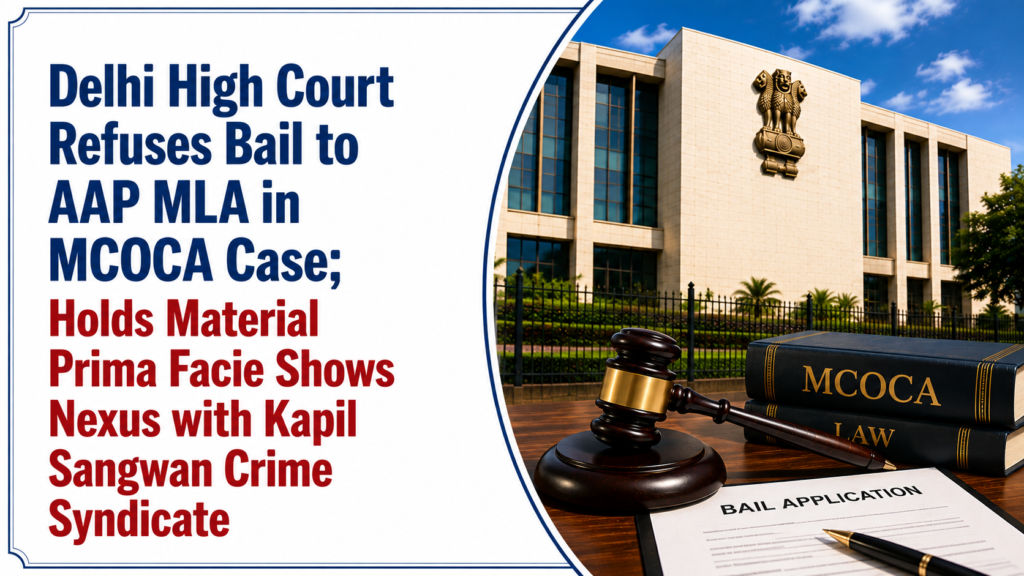
Delhi High Court Refuses Bail to AAP MLA in MCOCA Case; Holds Material Prima Facie Shows Nexus with Kapil Sangwan Crime Syndicate

MCOCA Applies to Syndicate Activities, Not Individual Charge Sheets Alone, Holds Delhi High Court While Rejecting Bail
Facts
The appellant, Naresh Balyan, a two-time MLA from Uttam Nagar, challenged the Trial Court’s order refusing him bail in FIR No. 165/2024 registered by the Crime Branch under Sections 3 and 4 of the Maharashtra Control of Organised Crime Act, 1999 (MCOCA) as extended to Delhi.
The prosecution alleged that gangster Kapil Sangwan @ Nandu headed an organised crime syndicate engaged in extortion, murder, land grabbing and intimidation across Delhi-NCR. Following approval under Section 23 of MCOCA, a fresh FIR was registered against the syndicate.
The appellant was initially arrested in another extortion case and, upon securing bail therein, was immediately arrested in the present MCOCA case. After filing of the main and supplementary charge-sheets, the Trial Court rejected his bail applications, leading to the present appeal under Section 12 of MCOCA.
Issues
- Whether the threshold requirements for invoking MCOCA were prima facie satisfied.
- Whether MCOCA could be invoked against the appellant despite earlier charge-sheets not naming him individually.
- Whether registration of a separate MCOCA FIR amounted to double jeopardy.
- Whether the material collected during investigation satisfied the twin conditions under Section 21(4) of MCOCA for grant of bail.
Petitioner’s Arguments
The appellant contended that:
- MCOCA had been invoked mechanically without any fresh continuing unlawful activity attributable to him.
- More than one prior charge-sheet against the appellant himself was absent, making invocation of MCOCA illegal.
- He had been falsely implicated for political reasons to prevent him from contesting another Assembly election.
- The alleged audio recordings were unauthenticated and unreliable.
- Confessional statements of co-accused had been retracted and could not constitute substantive evidence.
- Statements of protected witnesses lacked probative value.
- He himself had previously lodged complaints against Kapil Sangwan and had even been granted police protection, making it improbable that he was a member of the same syndicate.
- His properties had been lawfully acquired and did not represent proceeds of crime.
- Continued incarceration violated his constitutional right to a speedy trial.
Respondent’s Arguments
The State argued that:
- The appellant was an active member and facilitator of the organised crime syndicate headed by Kapil Sangwan.
- His role included identifying extortion targets, facilitating illegal property transactions and assisting in investment of extorted money.
- MCOCA examines the continuing unlawful activities of the syndicate, not merely the criminal history of an individual accused.
- Fresh registration of an FIR under MCOCA did not amount to double jeopardy.
- Confessional statements, protected witness statements, forensic evidence, technical analysis, financial records and audio recordings collectively established the appellant’s nexus with the syndicate.
- The appellant failed to satisfy the twin conditions under Section 21(4) of MCOCA for grant of bail.
Analysis of the Law
The Court examined:
- Sections 2, 3, 4, 21 and 23 of the Maharashtra Control of Organised Crime Act, 1999.
- The statutory definitions of continuing unlawful activity, organised crime, and organised crime syndicate.
- The stringent bail restrictions contained in Section 21(4) MCOCA.
The Court reiterated that:
- At the bail stage, a detailed appreciation of evidence is neither necessary nor permissible.
- The Court must undertake only a prima facie assessment to determine whether invocation of MCOCA is justified.
- Bail under MCOCA can be granted only if the Court is satisfied that there are reasonable grounds for believing that the accused is not guilty and is not likely to commit any offence while on bail.
- MCOCA is a special legislation enacted to combat organised criminal syndicates whose activities cannot effectively be addressed under ordinary criminal law.
Precedent Analysis
The Court relied upon several decisions, including:
- Ranjitsing Brahmajeetsing Sharma v. State of Maharashtra — explaining the standard for considering bail under Section 21(4) MCOCA.
- State of Maharashtra v. Bharat Shantilal Shah — upholding the constitutional validity of the definitions contained in MCOCA.
- Kavitha Lankesh v. State of Karnataka and Zakir Abdul Mirajkar v. State of Maharashtra — holding that the requirement of multiple charge-sheets relates to the activities of the organised crime syndicate and not to each individual accused.
- Sachin Bansilal Ghaiwal v. State of Maharashtra — recognising that facilitators and abettors may also constitute members of an organised crime syndicate and that the prosecution may register a separate MCOCA FIR.
- Abhishek v. State of Maharashtra — holding that while MCOCA must be construed strictly, interpretation should not defeat the legislative object of combating organised crime.
Court’s Reasoning
The Court rejected the appellant’s challenge to the invocation of MCOCA.
It held that the statutory requirement of multiple prior charge-sheets is syndicate-centric, not individual-centric. Therefore, the prosecution was not required to establish that the appellant himself had been charge-sheeted in multiple earlier cases; it was sufficient that the organised crime syndicate satisfied the statutory requirements.
The Court also rejected the plea of double jeopardy, observing that the investigating agency is legally entitled either to invoke MCOCA in an existing FIR or register a separate FIR after obtaining statutory approval.
On the evidentiary material, the Court found prima facie substance in:
- confessional statements of co-accused;
- statements of protected witnesses;
- audio recordings allegedly revealing conversations between the appellant and Kapil Sangwan;
- forensic voice comparison reports;
- technical connectivity through internet protocol records;
- allegations relating to extortion, land grabbing and disputed property transactions; and
- financial material concerning alleged investment of proceeds of crime.
Although the appellant relied upon earlier complaints allegedly made by him against Kapil Sangwan, the Court held that those complaints did not negate the other incriminating material collected during investigation and their evidentiary value would be determined during trial.
The Court further observed that long incarceration alone could not justify bail in serious organised crime prosecutions governed by the stringent statutory conditions under MCOCA.
Conclusion
The Delhi High Court held that the prosecution had placed sufficient prima facie material to justify invocation of MCOCA and to demonstrate the appellant’s alleged nexus with the organised crime syndicate headed by Kapil Sangwan.
Finding that the statutory twin conditions under Section 21(4) MCOCA were not satisfied, the Court upheld the Trial Court’s order refusing bail and dismissed the appeal, while clarifying that its observations were only tentative and would not influence the trial on merits.
Case Details
Case: Shri Naresh Balyan v. State of NCT of Delhi
Court: Delhi High Court
Case Number: Criminal Appeal No. 1676/2025
Judge: Hon’ble Mr. Justice Manoj Jain
Date: 03 August 2026
Result: Appeal dismissed. Bail under Section 12 of MCOCA refused; Court held that the threshold requirements for invocation of MCOCA were prima facie satisfied and the appellant failed to meet the twin conditions under Section 21(4) of MCOCA.