

HEADNOTE
Shakuntala Devi @ Shakun Rana v. Sudha Singh & Ors.
Court: High Court of Delhi
Bench: Hon’ble Ms. Justice Neena Bansal Krishna
Date of Judgment: January 20, 2026
Case Number: CRL.M.C. 3484/2018
Laws Involved:
Sections 420, 467, 468, 471 read with Section 120B IPC; Sections 200, 482 CrPC; Article 227, Constitution of India
Keywords: Forged Will, summoning order, parallel civil and criminal proceedings, Section 482 CrPC, property dispute
Summary
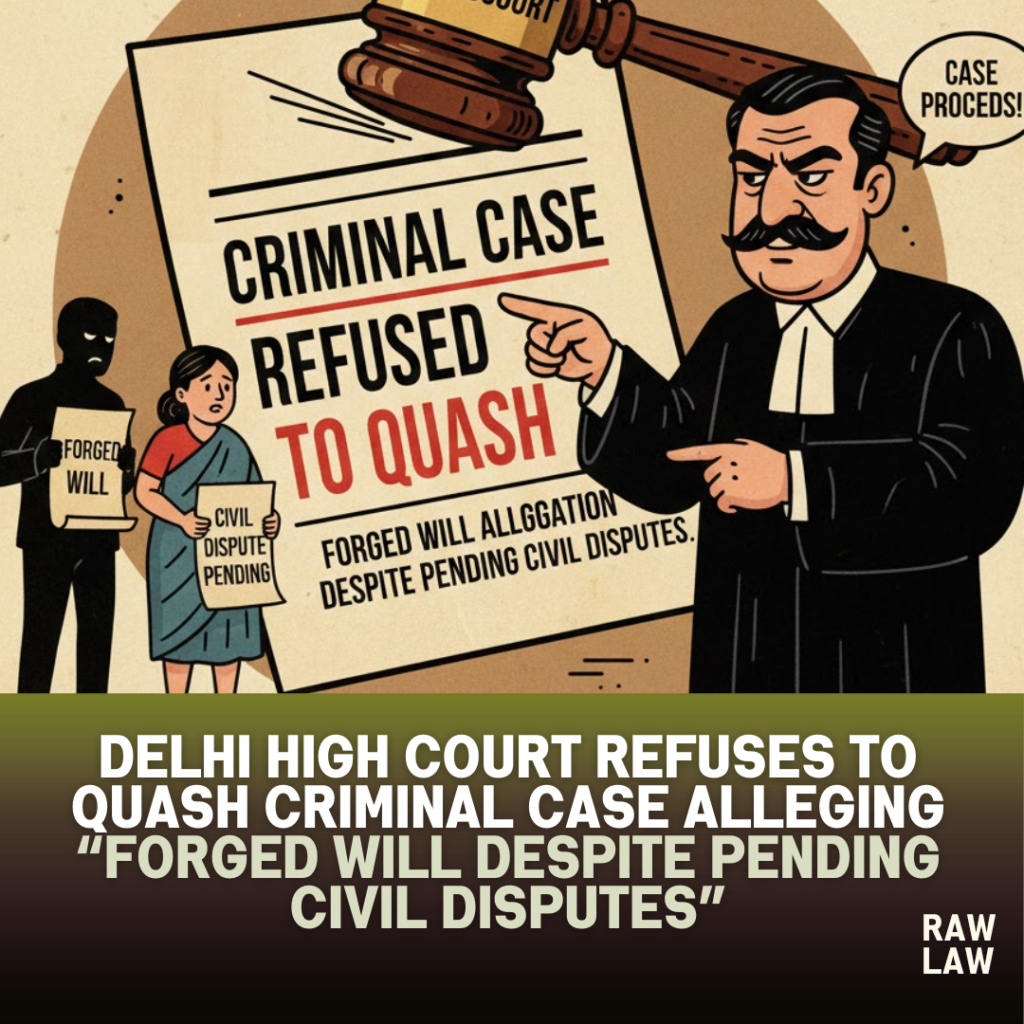
The Delhi High Court dismissed a petition seeking quashing of criminal proceedings arising out of allegations of forging a Will to claim property after the death of its alleged executant. Upholding concurrent orders of the Magistrate and the Revisional Court, the Court held that the pendency of civil, revenue, or probate proceedings does not bar criminal prosecution where allegations of forgery, cheating, and conspiracy are prima facie disclosed. Justice Neena Bansal Krishna ruled that at the stage of summoning, the court is only required to assess whether sufficient grounds exist to proceed and not to adjudicate on the defence or the genuineness of documents. The Court emphasised that forgery and use of forged documents constitute independent criminal offences, distinct from civil disputes over validity or title, and refused to exercise inherent or supervisory jurisdiction to stifle prosecution at the threshold.
Court’s decision
The Delhi High Court dismissed the petition filed under Article 227 of the Constitution read with Section 482 CrPC, refusing to quash the summoning order passed against the petitioner for offences of cheating, forgery, and criminal conspiracy. The Court upheld the orders of the Magistrate and the Revisional Court, holding that the criminal proceedings were maintainable and disclosed a prima facie case warranting trial.
Facts
Following the death of Anil Rana in 2011, his widow and minor son inherited his properties, which were duly mutated in their favour. Several years later, the petitioner, mother of the deceased, sought mutation of the same property on the basis of a Will allegedly executed in 2008 but registered only in 2014. The complainants alleged that the Will was forged and fabricated, having never been disclosed during earlier mutation or service benefit proceedings. A criminal complaint was filed alleging offences of cheating, forgery, and conspiracy, pursuant to which the Magistrate summoned the petitioner and co-accused.
Issues
The principal issue before the High Court was whether criminal proceedings alleging forgery and cheating could be quashed at the threshold on the ground that civil and revenue proceedings regarding the validity of the Will were already pending between the parties.
Petitioner’s arguments
The petitioner contended that the dispute was purely civil in nature and revolved around the genuineness of the Will, which was already subject matter of civil and revenue proceedings. It was argued that allowing criminal prosecution would amount to abuse of process. Reliance was placed on precedents suggesting that criminal proceedings should not continue when the validity of a Will is sub judice before civil courts.
Respondents’ arguments
The complainants opposed the petition, asserting that the Will surfaced for the first time years after the death of the executant and after mutation orders had attained finality. It was argued that prima facie material, including expert opinion and discrepancies in notarisation and identification, clearly disclosed criminal offences. The respondents submitted that civil remedies do not eclipse criminal liability for acts of forgery and cheating.
Analysis of the law
The Court analysed settled jurisprudence on the permissibility of parallel civil and criminal proceedings. It reiterated that civil and criminal liabilities operate in distinct spheres, with different standards of proof and objectives. While civil courts examine validity on a balance of probabilities, criminal courts assess whether offences involving mens rea are prima facie disclosed. Forgery and use of forged documents, the Court held, are not mere civil wrongs but independent criminal offences.
Precedent analysis
The Court examined earlier Supreme Court decisions, including Sardool Singh v. Nasib Kaur, and distinguished them in light of later authoritative rulings such as Kamaladevi Agarwal, Iqbal Singh Marwah, Syed Askari Hadi Ali Augustine Imam, and Neeharika Infrastructure. Relying on recent decisions, the Court reaffirmed that pendency of civil or probate proceedings is not a ground to quash criminal prosecution where allegations disclose cognizable offences.
Court’s reasoning
Justice Neena Bansal Krishna held that at the stage of summoning, the Magistrate is only required to determine whether there is sufficient ground to proceed, not whether the prosecution will ultimately succeed. The Court noted that the Magistrate relied on multiple factors, including expert handwriting opinion, discrepancies in notarisation records, and the delayed surfacing of the Will. Evaluating the defence or testing evidentiary reliability at this stage was held to be impermissible.
Conclusion
The High Court concluded that the criminal complaint disclosed a prima facie case of cheating, forgery, and conspiracy. The existence of parallel civil or revenue proceedings did not justify quashing of the criminal case. Accordingly, the petition was dismissed.
Implications
This judgment reinforces the principle that allegations of forgery and fabrication of documents cannot be neutralised merely by initiating civil litigation. It serves as a clear reminder that criminal courts must be allowed to examine allegations of mens rea-driven offences independently, and that inherent jurisdiction should not be used to prematurely terminate prosecutions.
Case law references
- Sardool Singh v. Nasib Kaur – Civil proceedings on Will do not automatically bar criminal prosecution; distinguished.
- Kamaladevi Agarwal v. State of West Bengal – Parallel civil and criminal proceedings permissible. Applied.
- Iqbal Singh Marwah v. Meenakshi Marwah – Forgery constitutes an independent criminal offence. Relied upon.
- Neeharika Infrastructure v. State of Maharashtra – Quashing at threshold to be exercised sparingly. Followed.
FAQs
1. Can criminal proceedings continue despite pending civil suits over a Will?
Yes. Civil and criminal proceedings operate independently, and criminal prosecution can continue if offences are prima facie disclosed.
2. What is the scope of court scrutiny at the summoning stage?
The court only examines whether sufficient grounds exist to proceed, not the merits or defence of the accused.
3. Does forgery of a Will amount to a criminal offence?
Yes. Forgery and use of forged documents attract independent criminal liability under the IPC.
Also Read: Delhi High Court upholds injunction against use of “POWER FLEX”, protects Bata’s “POWER” trademark


