HEADNOTE
Mithun Kumar & Ors. v. State (NCT of Delhi) & Anr.
Court: Delhi High Court
Jurisdiction: Criminal Writ Jurisdiction
Bench: Justice Neena Bansal Krishna
Date of Judgment: December 15, 2025
Citation: W.P.(CRL) 3410/2024 (Delhi High Court)
Laws / Sections Involved:
Bharatiya Nyaya Sanhita, 2023 – Sections 74, 76, 79, 115(2), 3(5);
Bharatiya Nagarik Suraksha Sanhita, 2023 – Sections 35(3), 180, 183, 528;
Article 226 of the Constitution of India
Keywords: FIR quashing, outraging modesty, BNS offences, one-day delay FIR, interested witnesses, criminal writ jurisdiction
Summary
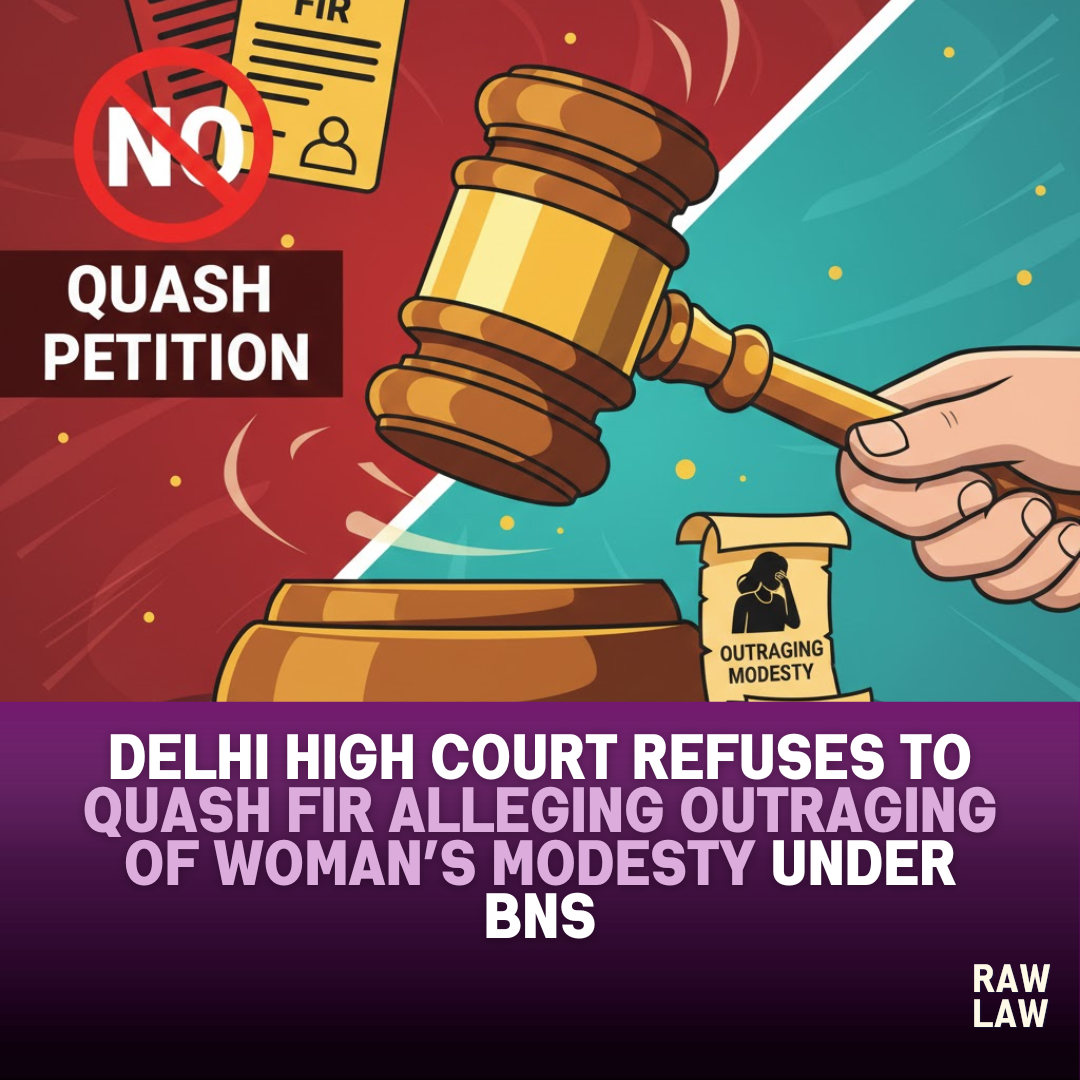
The Delhi High Court dismissed a criminal writ petition seeking quashing of an FIR registered for offences under the Bharatiya Nyaya Sanhita, including outraging the modesty of a woman. The Court held that the complaint disclosed specific and detailed allegations of sexual harassment, assault, and use of offensive language, supported by medical evidence and victim statements recorded during investigation. Rejecting arguments of mala fides, delay of one day in registration of FIR, absence of independent witnesses, and lack of CCTV footage, the Court ruled that these issues pertain to appreciation of evidence and must be tested at trial. Applying settled principles governing quashing jurisdiction, the Court held that none of the grounds satisfied the stringent thresholds for interference and declined to short-circuit the criminal process.
Court’s decision
The Delhi High Court dismissed W.P.(CRL) 3410/2024 along with all pending applications, holding that no case for quashing of FIR was made out. The Court ruled that the allegations, taken at face value, clearly disclosed cognisable offences under the Bharatiya Nyaya Sanhita and that the matter was already pending before the trial court at the stage of framing of charges.
Facts
The petitioners comprised two married couples residing in Trilokpuri, East Delhi, along with a relative. Respondent No.2 lodged FIR No. 0361/2024 alleging continuous harassment over one year, culminating in an incident on 14 October 2024 where the petitioners allegedly abused her in sexist language, assaulted her and her sister, tore her clothes, and touched her inappropriately. The FIR was registered the following day at PS Mayur Vihar Phase I. During investigation, the complainant’s torn kurta was seized, medical examinations were conducted, and statements under the BNSS were recorded. A chargesheet was subsequently filed.
Issues
Whether the FIR and consequential proceedings deserved to be quashed under Article 226 of the Constitution and Section 528 BNSS on the grounds of mala fides, delay in registration, absence of intention to outrage modesty, and lack of independent corroboration.
Petitioners’ arguments
The petitioners argued that the complaint was vague and malicious, lacking the essential intention required for offences relating to outraging modesty. They relied on State of Punjab v. Major Singh to contend that culpable intent was missing. It was further argued that a one-day delay in lodging the FIR cast serious doubt on the prosecution case, that some petitioners were not present at the spot, and that the case rested only on interested witnesses without CCTV footage or recovery of weapons.
Respondents’ arguments
The State and the complainant opposed the petition, submitting that the complaint contained specific and detailed allegations, supported by medical evidence and consistent statements recorded during investigation. It was argued that the FIR was promptly followed by medical examination and seizure of torn clothing, and that the truthfulness of allegations could not be examined in writ jurisdiction.
Analysis of the law
The Court reiterated the settled principles governing quashing of FIRs, particularly the restrictive parameters laid down in State of Haryana v. Bhajan Lal. It emphasised that at the quashing stage, courts must assume the allegations to be true and should not embark upon appreciation of evidence or adjudication of disputed facts.
Precedent analysis
The Court referred to State of Punjab v. Major Singh to note that intention or knowledge to outrage a woman’s modesty is context-specific and must be inferred from conduct and circumstances. It also relied on Bhajan Lal to underline that extraordinary jurisdiction cannot be exercised where allegations disclose a prima facie offence and investigation has culminated in a chargesheet.
Court’s reasoning
Justice Neena Bansal Krishna noted that the complaint described the incident in detail, including abusive conduct, physical assault, and tearing of clothes, which prima facie satisfied the ingredients of the alleged offences. The Court held that a one-day delay in FIR was inconsequential, especially when medical examinations were conducted on the date of incident. It further observed that absence of independent witnesses or CCTV footage does not undermine prosecution at the threshold, as family members are natural witnesses in such incidents.
Conclusion
The High Court concluded that none of the grounds raised by the petitioners warranted interference. All contentions were held to be matters for trial, and the writ petition was dismissed.
Implications
This judgment reinforces the narrow scope of FIR quashing jurisdiction, particularly in cases involving allegations of sexual harassment and outraging of modesty. It affirms that courts will be slow to interdict criminal proceedings where the complaint is detailed, supported by medical evidence, and investigation has progressed to the stage of charges.
Case law references
• State of Haryana v. Bhajan Lal (1992 Supp (1) SCC 335)
Holding: FIR can be quashed only in rare cases where allegations do not disclose any offence.
Application: Applied to reject quashing at the threshold.
• State of Punjab v. Major Singh (AIR 1967 SC 63)
Holding: Intention to outrage modesty must be inferred from conduct and circumstances.
Application: Used to assess prima facie sufficiency of allegations.
FAQs
Q1. Can a one-day delay in lodging FIR justify quashing?
No. Minor delay, especially when supported by medical evidence, is not a ground for quashing.
Q2. Can FIR be quashed due to absence of independent witnesses?
No. Family members are natural witnesses and their credibility is tested at trial.
Q3. Will courts examine truthfulness of allegations at quashing stage?
No. Truthfulness and credibility are matters for trial, not writ jurisdiction.
Also Read: Bombay High Court restores eviction under Section 24 MRC Act, slams perverse revisional order