
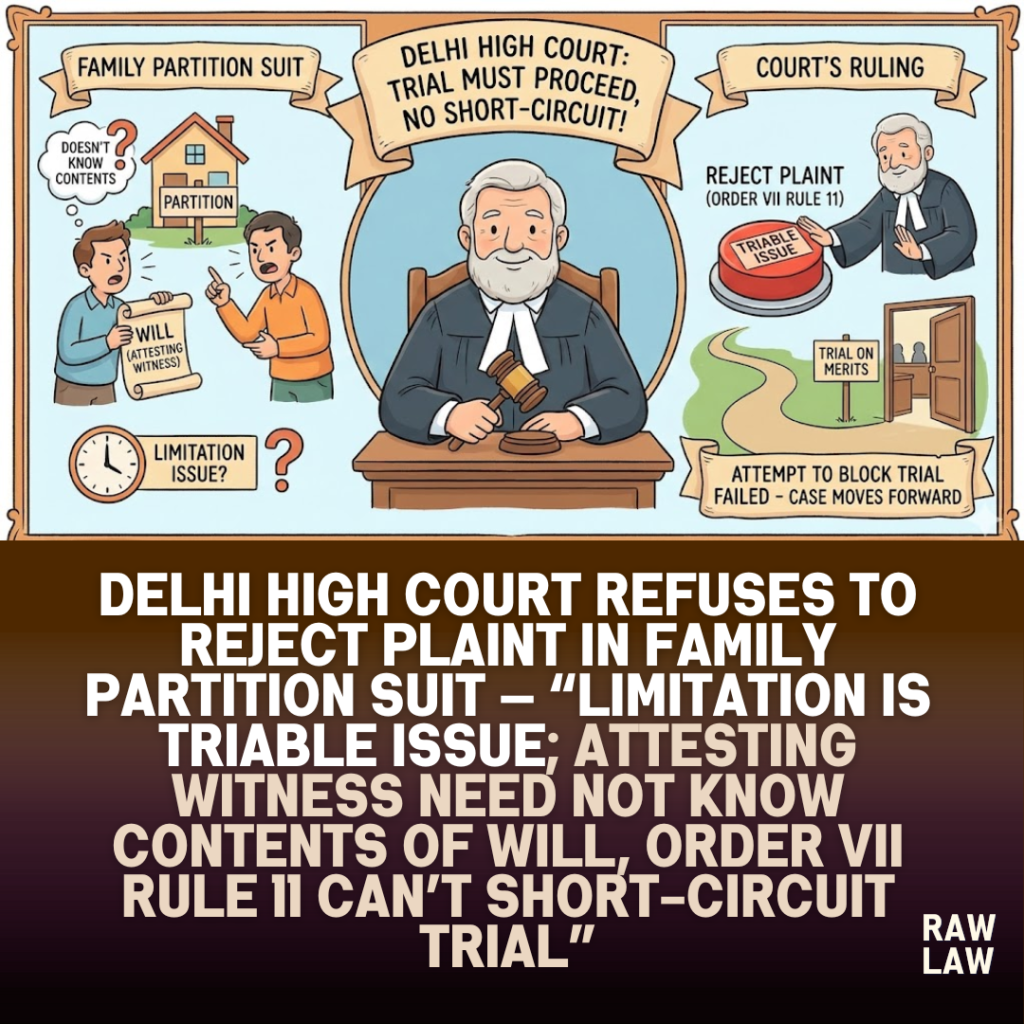

Court’s decision
The Delhi High Court dismissed an application seeking rejection of a plaint in a high-stakes family partition and inheritance dispute, holding that questions of limitation and knowledge of an allegedly fraudulent will are mixed questions of law and fact that must be tried. The Court ruled that merely being an attesting witness to a will does not imply knowledge of its contents, and that Order VII Rule 11 cannot be used to pre-judge disputed facts or convert the court into a fact-finding forum under Order X — “rejection of plaint is a drastic power, not to be exercised on contested narratives”; application rejected, suit to proceed.
Court’s decision
Justice Subramonium Prasad dismissed the defendant’s application under Order VII Rule 11 read with Order X Rule 2 of the Code of Civil Procedure, refusing to throw out the suit at the threshold on the ground of limitation. The Court held that the plaintiff’s plea of discovering the impugned 2008 will only much later could not be disbelieved at the preliminary stage, and that the veracity of such claims must be tested during trial through evidence and cross-examination.
Facts
The suit was instituted by the plaintiff, daughter of defendant no.1 and late Smt. Barfo Devi, seeking partition, possession, permanent injunction and rendition of accounts in respect of eight valuable immovable properties situated in Delhi, Haryana and Sonipat. The properties included large residential plots, commercial premises in Pitampura and Rohini, and extensive agricultural land in Haryana.
According to the plaint, familial relations remained cordial until July 2008, when defendant no.1 allegedly took the plaintiff and late Smt. Barfo Devi to the Sub-Registrar’s office under the pretext of executing a simple power of attorney. The documents were allegedly pre-prepared, concealed, and signed in good faith. Over the years, defendants allegedly refused to show these documents, raising suspicion.
In 2017, late Smt. Barfo Devi executed a registered will expressly revoking all earlier testamentary dispositions and declaring that all her properties, except one flat purchased by the plaintiff, should devolve equally upon all her children. She passed away in May 2019. The plaintiff claimed that only in September 2019 did she discover that the concealed 2008 document was in fact a will allegedly procured through fraud, prompting institution of the suit.
Issues
The principal issue before the Court was whether the plaint, as amended, was liable to be rejected at the threshold as being barred by limitation. Subsidiary issues included whether the plaintiff’s alleged role as an attesting witness to the 2008 will conclusively proved her knowledge of its contents, and whether the Court could invoke Order X Rule 2 to examine the plaintiff and test the truthfulness of her pleadings at the pre-trial stage.
Defendant’s arguments
The defendant contended that the suit was ex facie barred by limitation since the plaintiff admittedly visited the Sub-Registrar’s office in July 2008, signed the will as an attesting witness, and even photographed the document. It was argued that the plaintiff could not plausibly claim ignorance of the will’s contents for over a decade.
The defendant further argued that the amended plaint contained contradictory pleadings regarding the date of knowledge of the will, amounting to clever drafting designed to create an illusory cause of action. Invoking Order X Rule 2, it was submitted that the Court should examine the plaintiff to expose abuse of process and reject the plaint at the threshold.
Plaintiff’s arguments
The plaintiff opposed the application, asserting that the will was never shown to her and that mere presence at the Sub-Registrar’s office or attestation did not establish knowledge of contents. It was submitted that defendants deliberately concealed the document and refused disclosure for years.
The plaintiff argued that limitation depends on the date of knowledge of fraud, which is a factual issue requiring trial. Reliance was placed on settled law that at the stage of Order VII Rule 11, the plaint must be taken at face value, and disputed facts cannot be adjudicated or tested through preliminary examination.
Analysis of the law
The Court revisited settled jurisprudence on Order VII Rule 11, reiterating that rejection of a plaint is a drastic power to be exercised sparingly. At this stage, only the averments in the plaint are relevant; defences raised in the written statement are wholly irrelevant.
On limitation, the Court emphasised that where a plaintiff pleads discovery of fraud or knowledge of essential facts at a later point in time, such a plea must ordinarily be accepted at the threshold and tested only at trial. Limitation, in such cases, becomes a mixed question of law and fact.
The Court also clarified the limited scope of Order X Rule 2, holding that it is meant to seek clarification of pleadings, not to assess veracity or conduct a substitute for cross-examination.
Precedent analysis
Relying on Popat and Kotecha Property, Saleem Bhai, and T. Arivandandam, the Court reiterated that clever drafting alone cannot justify rejection unless the plaint is manifestly vexatious on a meaningful reading. The Court further relied on Salim D. Agboatwala and Chhotanben, which hold that the date of knowledge in fraud-based claims raises a triable issue and cannot be decided under Order VII Rule 11.
Importantly, the Court invoked Ganesan v. Kalanjiam to hold that under Section 63(c) of the Indian Succession Act, an attesting witness is only required to witness the testator’s signature and need not know the contents of the will.
Court’s reasoning
The Court found that the plaintiff’s assertion that the 2008 will was concealed and its contents unknown to her could not be disbelieved without evidence. Whether the will was shown to the plaintiff, whether fraud was practised, and when the plaintiff acquired knowledge were all matters requiring trial.
The Court rejected the attempt to invoke Order X Rule 2 to examine the plaintiff, holding that such an exercise would improperly substitute cross-examination and convert the Court into a fact-finding authority at the pre-issue stage.
The Court further held that the mere fact that the plaintiff was an attesting witness did not lead to a legal presumption that she knew the contents of the will, and therefore could not be used to non-suit her at the threshold.
Conclusion
The Delhi High Court dismissed the application seeking rejection of the plaint and directed that the suit proceed in accordance with law. The Court held that the plea of limitation raised by the defendant was not suitable for determination under Order VII Rule 11 and must be decided after evidence is led at trial.
Implications
This ruling reinforces judicial caution against premature dismissal of civil suits involving allegations of fraud, inheritance disputes, and concealed documents. It clarifies that attestation of a will does not automatically imply knowledge of its contents, a principle with significant implications in family property litigation. The judgment also draws firm boundaries on the use of Order X Rule 2, ensuring that trial courts do not short-circuit adjudication by converting preliminary scrutiny into a mini-trial.
Case law references
- Popat and Kotecha Property v. State Bank of India Staff Association: Scope of Order VII Rule 11; plaint to be read as a whole. Applied to refuse rejection.
- Salim D. Agboatwala v. Shamalji Oddhavji Thakkar: Date of knowledge in fraud cases is triable; relied upon.
- Ganesan v. Kalanjiam: Attesting witness need not know contents of will; applied decisively.
- T. Arivandandam v. T.V. Satyapal: Illusory cause of action doctrine; distinguished on facts.
FAQs
1. Can a plaint be rejected on limitation at the threshold?
Only if the bar is apparent on the face of the plaint. Where limitation depends on disputed facts, it must be tried.
2. Does attesting a will mean the witness knows its contents?
No. Law requires only witnessing the testator’s signature, not knowledge of contents.
3. Can courts examine parties under Order X Rule 2 to test truthfulness?
No. Order X is for clarification of pleadings, not to assess veracity or replace cross-examination.


