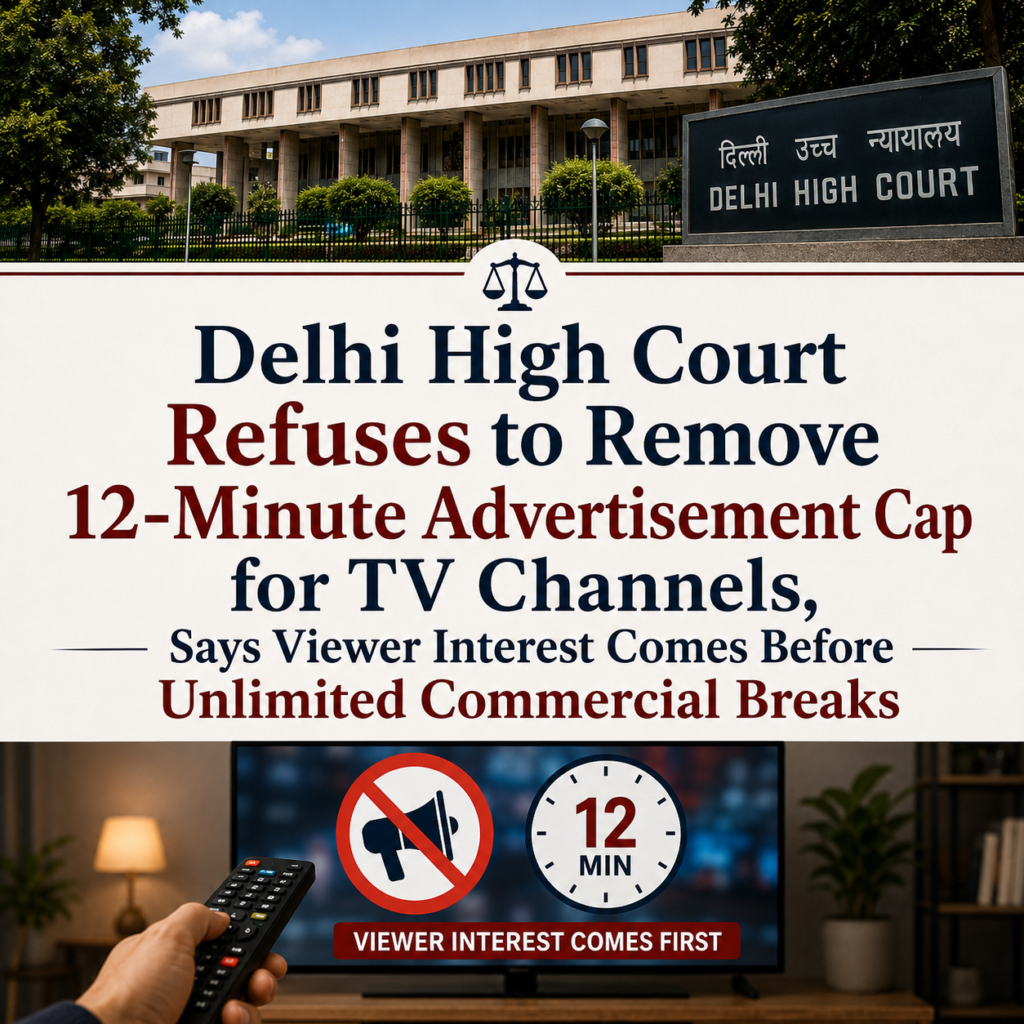
Delhi High Court Refuses to Remove 12-Minute Advertisement Cap for TV Channels, Says Viewer Interest Comes Before Unlimited Commercial Breaks


Delhi High Court Upholds TRAI’s 12-Minute Per Clock Hour Advertisement Cap for TV Channels, Says Broadcasters Have No Right to Unlimited Monetisation of Public Spectrum
Facts
A batch of 17 writ petitions was filed by general entertainment channels, news broadcasters and regional broadcasters challenging the regulatory framework limiting television advertisements to 12 minutes per clock hour. The challenge was directed against Rule 7(11) of the Cable Television Network Rules, 1994 and Regulation 3 of the Standards of Quality of Service (Duration of Advertisements in Television Channels) Regulations, 2012, as amended in 2013.
The impugned framework fixed a ceiling of 10 minutes for commercial advertisements and 2 minutes for self-promotional content per hour. The broadcasters argued that this cap, especially when applied on a strict “per clock hour” basis, affected their advertisement revenue and violated their rights under Articles 14 and 19 of the Constitution. The Court noted that the real challenge was not merely to the 12-minute ceiling itself, but to its application on a per clock hour basis.
Issues
The Court considered two principal issues:
- Whether TRAI had statutory competence to issue Regulation 3 of the 2012 Regulations governing advertisement duration in television channels.
- Whether the 12-minute per clock hour advertisement cap violated Articles 14 and 19 of the Constitution.
Petitioner’s Arguments
The petitioners argued that advertisement revenue is the principal source of income for several broadcasters, particularly news and regional channels. They submitted that once subscription revenue had already been regulated through TRAI’s tariff framework, a further restriction on advertisement time imposed a dual financial burden.
They contended that commercial advertisements form part of speech protected under Article 19(1)(a), and relied on precedents recognising commercial speech and press freedom. According to them, any restriction on advertisement inventory directly affected the financial viability of channels, which in turn impacted editorial freedom, circulation, reach and dissemination of content.
The broadcasters also argued that TRAI lacked jurisdiction to regulate advertisement duration because its role was limited to technical and interconnection aspects of broadcasting. They submitted that content regulation, including advertisements, falls under the Cable Television framework and not within TRAI’s quality-of-service powers.
The petitioners further challenged the cap under Article 14, arguing that the rule treated unequal broadcasters equally. According to them, the framework failed to distinguish between prime time and non-prime time, pay channels and free-to-air channels, news channels and entertainment channels, and commercial/public service/self-promotional advertisements. Regional broadcasters specifically argued that the cap disproportionately affected them because their subscription revenue was negligible and they depended heavily on advertisements.
Respondent’s Arguments
The Union of India and TRAI argued that the advertisement cap was introduced to protect viewers from excessive commercial interruptions and to preserve the quality of viewing experience. They submitted that television is different from print media because viewers cannot skip or avoid advertisements inserted into real-time broadcast content.
The respondents argued that airwaves and spectrum are scarce public resources held in trust by the State, and broadcasters using such resources cannot claim an unfettered right to monetise them. They submitted that the regulation did not control content, editorial choice or subscription pricing, but only regulated the duration of advertisements.
TRAI contended that the impugned regulation was issued under Sections 11 and 36 of the TRAI Act, 1997, read with the 2004 notification that brought broadcasting and cable services within the regulatory purview of TRAI. It was also argued that the 12-minute cap was consistent with international practice and was framed after a consultative process involving stakeholder inputs and consumer concerns.
Analysis of the Law
The Court examined the Cable Television Networks Act, 1995, the Cable Television Networks Rules, 1994, the TRAI Act, 1997, and the 2004 notification expanding TRAI’s regulatory domain to broadcasting and cable services.
The Court held that Section 11(1)(b)(v) of the TRAI Act empowers TRAI to lay down quality-of-service standards to protect consumer interests, while Section 36 empowers TRAI to frame regulations to carry out the purposes of the Act. Since excessive advertisement interruptions directly affect the consumer’s viewing experience, the Court held that advertisement duration could be regulated as a quality-of-service issue.
On Article 19, the Court held that the grievance regarding loss of advertising revenue primarily falls under Article 19(1)(g), not the core of Article 19(1)(a). The cap does not regulate editorial content, programme content or the viewpoint of broadcasters. It only restricts the quantity of advertisement time. Therefore, it is a neutral, time-based regulation.
On Article 14, the Court held that the distinction between programme content and advertisement time is intelligible and has a rational nexus with the object of preventing over-commercialisation and protecting viewer interest. The Court also held that the uniform cap was not manifestly arbitrary because it was based on consumer complaints, consultation, comparative international practice and a rational regulatory objective.
Precedent Analysis
The Court distinguished the print media cases relied upon by the petitioners, including Sakal Papers, Bennett Coleman, Indian Express and Hindustan Times. It held that those cases dealt with restrictions directly affecting newspaper circulation, page limits, newsprint supply or core press freedom. In contrast, the present case involved regulation of advertisement time on broadcast spectrum, which is a public resource.
The Court relied on the principle that airwaves and spectrum are scarce public resources and are subject to public interest regulation. It also referred to precedents recognising TRAI’s regulatory powers, including the distinction between TRAI’s recommendatory functions and binding regulatory functions.
The Court applied Cellular Operators Association of India v. TRAI to hold that regulatory bodies must act transparently and rationally, but they are not required to accept every stakeholder objection or write a quasi-judicial order answering every argument in detail. It also relied on Sukanya Shantha v. Union of India for the modern Article 14 test, including intelligible differentia, rational nexus, substantive equality and manifest arbitrariness.
Court’s Reasoning
The Court held that broadcasters using public spectrum cannot claim a right to maximise advertisement inventory at the cost of viewer welfare. The loss projected by broadcasters was only a reduction in one revenue lever, not a denial of their right to carry on business.
The Court found that the impugned framework struck a proportionate balance between broadcaster rights and the public interest in efficient and fair use of broadcast spectrum. It reasoned that the cap preserved viewer experience, prevented excessive commercialisation, and did not interfere with broadcasters’ freedom to choose content, pricing or business models.
The Court also held that the framework was protected by the constitutional policy underlying Articles 39(b) and 39(c), since spectrum and airwaves are public resources whose use must serve the common good. The Court further observed that the regulation attracted the protective ambit of Article 31C.
Conclusion
The Delhi High Court dismissed the batch of writ petitions and upheld Rule 7(11) of the Cable Television Network Rules, 1994 and Regulation 3 of the 2012 Regulations, as amended in 2013. It held that TRAI acted within its statutory authority and that the 12-minute per clock hour advertisement cap did not violate Articles 14 or 19 of the Constitution.
The Court concluded that there is no constitutional guarantee of profitability or unlimited monetisation of public spectrum. The pending applications were also closed.
Case Details
Case: 9X Media Pvt. Ltd. & Ors. v. Telecom Regulatory Authority of India and connected matters
Court: Delhi High Court
Case Number: W.P.(C) 7982/2013 and connected matters
Judge: Justice Anil Kshetrapal and Justice Amit Mahajan
Date: 29 May 2026; re-uploaded on 08 July 2026
Result: Writ petitions dismissed; TRAI’s 12-minute per clock hour advertisement cap upheld.