


Court’s decision
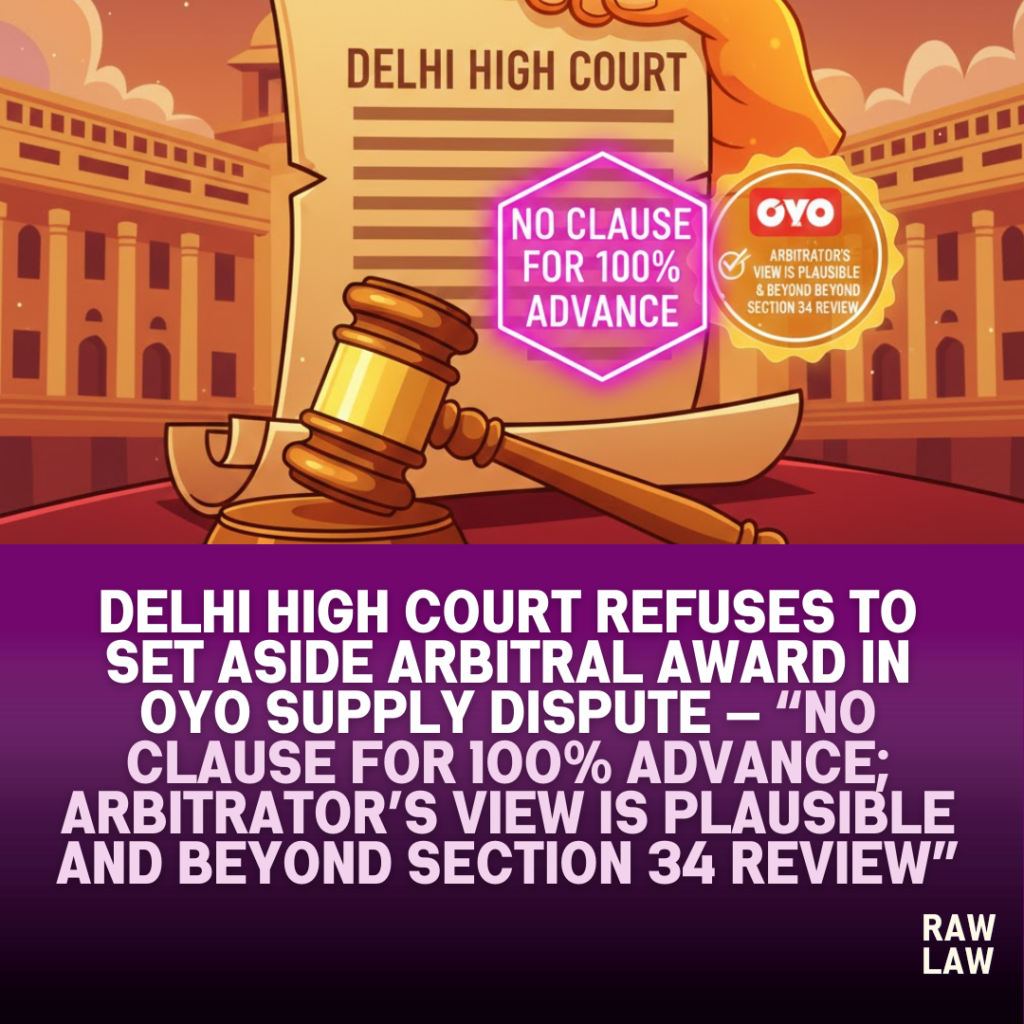
The Delhi High Court dismissed a petition under Section 34 of the Arbitration and Conciliation Act, 1996, filed by an electronic components supplier challenging an arbitral award passed in favour of OYO Hotels and Homes Pvt. Ltd.. The Court held that the arbitral tribunal’s interpretation of the vendor agreement and purchase order was a plausible and reasonable view, and therefore immune from interference. It ruled that there was no contractual requirement for payment of 100% advance for procurement of components and that the supplier’s failure to deliver goods justified the directions issued in the award.
Facts
The dispute arose out of a commercial transaction between a supplier of electronic switches and OYO, a hospitality management company. In September 2019, OYO placed a purchase order for supply of 52,360 electronic switches, valuing over ₹10 crore, inclusive of taxes. Subsequently, in December 2019, the parties executed a vendor agreement which governed the purchase order, even though the purchase order pre-dated the agreement.
Under the vendor agreement, the supplier was required to procure five major components from vendors identified by OYO, assemble the switches, and supply the finished products. OYO paid 50% of the invoice value as advance. However, the switches were not delivered within the stipulated time. Disputes arose regarding responsibility for procurement of components, advance payments, and delay in supply.
Arbitration was invoked by OYO. The arbitral tribunal held the supplier liable for non-performance, directed delivery of 11,000 switches claimed to be ready, and ordered payment of ₹2.84 crore with interest. Aggrieved, the supplier approached the High Court under Section 34.
Issues
The principal issue before the High Court was whether the arbitral award suffered from patent illegality or perversity warranting interference under Section 34 of the Arbitration and Conciliation Act. Central to this was whether the contractual framework required OYO to make 100% advance payment to the supplier for procurement of components, and whether the arbitrator had misinterpreted the nature of the supplier’s obligations under the vendor agreement.
Petitioner’s arguments
The supplier contended that it was merely an assembler and not a manufacturer, and that it was contractually dependent on OYO for advance payments to procure components from Chinese vendors. It argued that the arbitrator erred in treating the relationship as principal-to-principal and in holding the supplier responsible for delays.
The supplier relied on clauses of the vendor agreement and prior correspondence to argue that historically, advances were paid for component procurement and that non-payment of full advance by OYO prevented timely delivery. It was further contended that since the vendor agreement superseded all prior arrangements, the purchase order itself stood eclipsed, and therefore no liability could be fastened on the supplier.
Respondent’s arguments
OYO argued that the arbitral award was based on a correct and reasonable interpretation of the contract. It submitted that the vendor agreement clearly placed the obligation of procurement on the supplier and did not provide for any contractual requirement of 100% advance payment.
It was contended that the 50% advance paid was only a goodwill gesture and not a contractual obligation. OYO relied on cross-examination of witnesses to show that advances to component vendors were to be made by the supplier itself. The respondent further submitted that the supplier failed to deliver the contracted quantity for over a year, justifying termination and the reliefs granted by the arbitrator.
Analysis of the law
The High Court examined the scope of interference under Section 34 of the Arbitration and Conciliation Act, reiterating that courts do not sit in appeal over arbitral awards. Interference is permissible only when the award is vitiated by patent illegality, perversity, or conflict with the fundamental policy of Indian law.
The Court emphasised that interpretation of contractual terms is primarily within the domain of the arbitrator. Even if an alternative interpretation is possible, the court cannot substitute its own view unless the arbitrator’s interpretation is one that no reasonable person would adopt.
Precedent analysis
The Court relied on recent Supreme Court jurisprudence reaffirming the narrow scope of Section 34 review. It referred to decisions holding that where an arbitrator adopts one of two plausible interpretations of a contract, such a view must be respected. Errors of fact, reappreciation of evidence, or reassessment of contractual clauses are impermissible grounds for setting aside an award.
The High Court applied these principles to conclude that the arbitrator’s findings on advance payments, procurement obligations, and delay were well within jurisdiction and did not offend public policy.
Court’s reasoning
On a plain reading of the vendor agreement, the Court held that payment obligations arose only after supply and acceptance of goods. Since no switches were delivered, the question of payment beyond the 50% advance did not arise. The Court rejected the argument that identification of vendors by OYO implied an obligation to fund procurement.
The Court also found no merit in the contention that the purchase order stood nullified due to the “entire agreement” clause. It held that such clauses merely consolidate governing terms and do not extinguish purchase orders already issued.
Importantly, the Court noted that the supplier never demonstrated readiness to deliver the full quantity of switches, and even communications relied upon showed only unsupplied inventory, not finished goods. The arbitrator’s direction to supply 11,000 switches and adjust their value in the award was therefore found to be balanced and reasonable.
Conclusion
The Delhi High Court concluded that the arbitral award was based on a plausible interpretation of the contract and did not suffer from patent illegality or perversity. Holding that no ground under Section 34 was made out, the Court dismissed the petition and upheld the arbitral award in its entirety.
Implications
This ruling reinforces India’s pro-arbitration stance and underscores judicial restraint in commercial arbitration matters. It clarifies that suppliers cannot read unwritten financial obligations into contracts and later invoke Section 34 to escape adverse awards. For commercial parties, the judgment highlights the importance of clear contractual drafting and reaffirms that arbitral autonomy will be protected against routine judicial challenges.
Case law references
- Prakash Atlanta (JV) v. National Highways Authority of India
Held: A plausible interpretation of contract by an arbitrator cannot be substituted under Section 34.
Applied: Used to uphold the arbitral award. - Ramesh Kumar Jain v. Bharat Aluminium Company Limited
Held: Section 34 confers narrow supervisory jurisdiction, not appellate review.
Applied: Basis for refusing reappreciation of evidence. - Parsa Kente Collieries Ltd. v. Rajasthan Rajya Vidyut Utpadan Nigam Ltd.
Held: Construction of contractual terms lies primarily with the arbitrator.
Applied: Supported deference to arbitral interpretation.
FAQs
Q1. Can an arbitral award be set aside merely because another interpretation of the contract is possible?
No. Courts will not interfere under Section 34 if the arbitrator’s interpretation is plausible and reasonable.
Q2. Does identification of vendors imply an obligation to pay full advance?
No. Unless expressly stated, such an obligation cannot be implied into the contract.
Q3. What is the scope of court review under Section 34 of the Arbitration Act?
It is extremely limited and confined to patent illegality, perversity, or conflict with public policy.