Delhi High Court Rejects Property Ownership Claim Based on Unproduced Will, Holds Oral Evidence Cannot Prove Contents of Immovable Property Documents

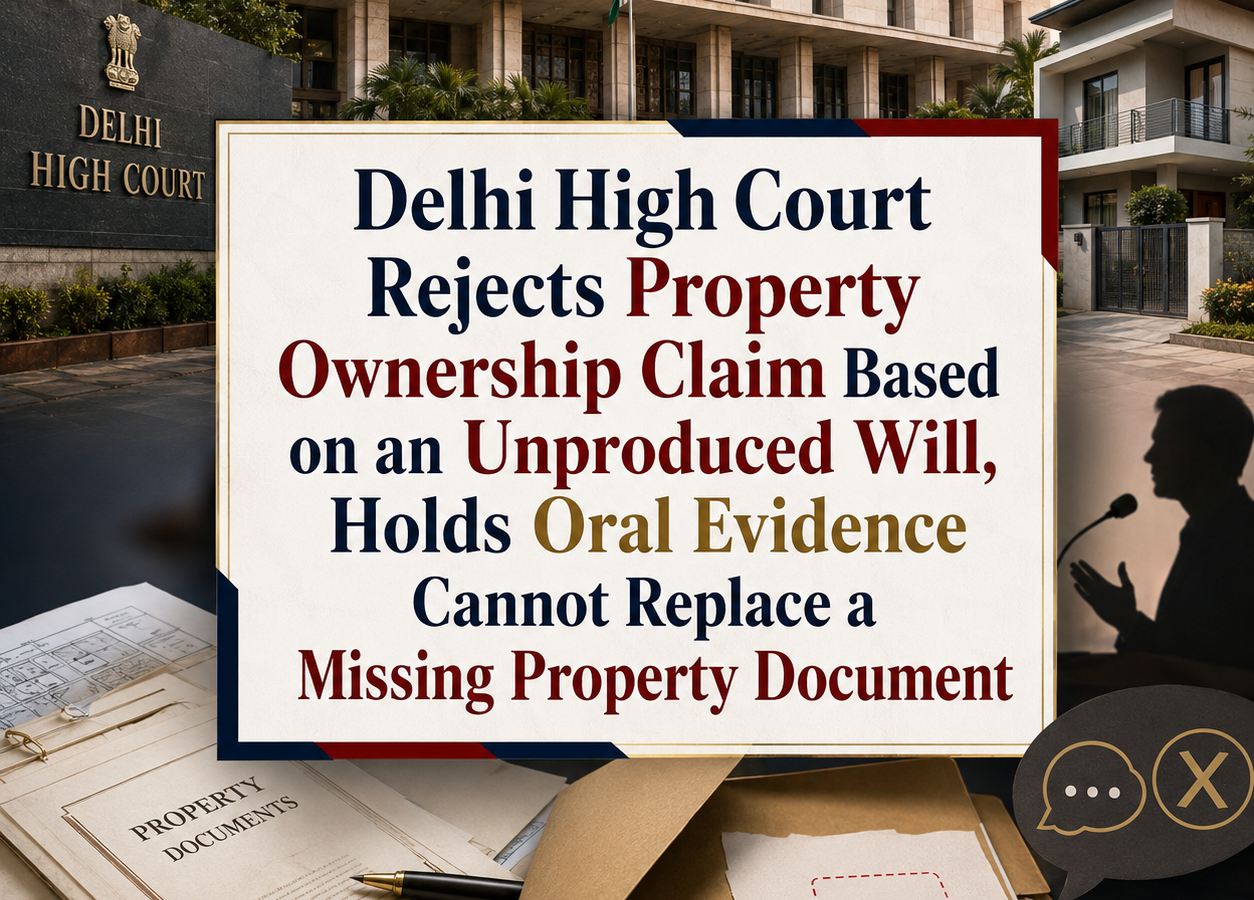
Delhi High Court Says Missing Will Cannot Prove Property Ownership, Rejects Claim Based Only on Oral Evidence
Facts
Anil Gupta filed a civil suit seeking possession, mesne profits and permanent injunction concerning a second-floor LIG flat situated at Vikas Puri, New Delhi.
The property was originally allotted by the Delhi Development Authority to Harish Chander Bhatt in 1983. He transferred it to Ascharaj Lal through an Agreement to Sell, Will and General Power of Attorney dated 14 July 1983.
Ascharaj Lal subsequently transferred the property to his son, Harish Talwar, through an Agreement to Sell, receipt and registered Will dated 1 November 1985.
Harish Talwar initially entered into a transaction concerning the property with his wife, Kiran Talwar, in December 2005. That transaction was later cancelled through a registered Cancellation Deed dated 18 October 2006, and the consideration was refunded to her.
On the same day, Harish Talwar transferred the property to Anil Gupta for ₹2 lakh through an Agreement to Sell, registered General Power of Attorney, Will and receipt.
Although the documents recorded delivery of possession to Anil Gupta, Harish Talwar requested time to vacate the premises. When he failed to do so, Kiran Talwar and her sons continued occupying the property.
Kiran Talwar claimed that she was the actual owner under an alleged handwritten Will dated 15 August 1986, purportedly executed by her father-in-law, Ascharaj Lal. She alleged that her husband, Harish Talwar, had forcibly taken away the original Will.
However, neither the original Will nor its photocopy was produced before the Court.
The Civil Judge held that Kiran Talwar and her sons failed to prove the existence, execution or contents of the alleged Will. Anil Gupta was held to have a better title and superior right to possession. The suit was decreed in his favour with mesne profits of ₹3,000 per month for the relevant period and interest at 10% per annum.
The First Appellate Court affirmed the decree. Kiran Talwar and her sons thereafter filed a Regular Second Appeal under Section 100 of the Code of Civil Procedure.
Issues
- Whether the disposition of immovable property could be proved without producing the document through which the disposition was allegedly made.
- Whether oral evidence could be used to prove the contents of an alleged Will relating to immovable property.
- Whether Kiran Talwar had established the foundational facts required for leading secondary evidence regarding the alleged Will.
- Whether the evidence of the alleged attesting witnesses was sufficient to prove the Will.
- Whether the dismissal of Kiran Talwar’s separate suit claiming ownership under the same Will operated as res judicata.
- Whether the evidence of Anil Gupta’s attorney was inadmissible merely because Anil Gupta did not personally enter the witness box.
Appellants’ Arguments
Kiran Talwar and her sons argued that Harish Talwar was not the owner of the property and was therefore not competent to transfer it to Anil Gupta.
They claimed that the property had been bequeathed to Kiran Talwar under a handwritten Will dated 15 August 1986 executed by Ascharaj Lal.
According to Kiran Talwar, the original Will was not available because it had been forcibly taken away by Harish Talwar.
They further contended that:
- the documents allegedly executed by Ascharaj Lal in favour of Harish Talwar in 1985 were forged and fabricated;
- Anil Gupta failed to produce sufficient documents proving Harish Talwar’s ownership;
- Anil Gupta did not personally appear as a witness; and
- the testimony of his Power of Attorney holder could not substitute Anil Gupta’s own evidence under Sections 59 and 60 of the Indian Evidence Act.
Respondent’s Case
Anil Gupta relied on the chain of documents beginning with the original allotment and subsequent transfers in favour of Ascharaj Lal, Harish Talwar and finally himself.
He maintained that Kiran Talwar had failed to prove the alleged Will dated 15 August 1986.
The alleged Will was never produced, and the explanation that it had been taken away by Harish Talwar was not supported by reliable contemporaneous evidence.
Kiran Talwar had also admitted during cross-examination that Ascharaj Lal had executed property documents in favour of Harish Talwar in 1985.
Her allegations that those documents were forged were unsupported by particulars or evidence.
Analysis of the Law
The High Court examined Sections 61, 63, 65, 91 and 92 of the Indian Evidence Act, 1872.
Section 91 embodies the best evidence rule. Where the terms of a transaction have been reduced to writing, the contents of the transaction must ordinarily be proved through the document itself or admissible secondary evidence.
Oral evidence cannot be used as a substitute for the document to prove the terms of a transaction involving immovable property.
Section 92 further prevents oral evidence from being used to contradict, vary, add to or subtract from the terms of a written document between the parties.
The Court clarified that oral evidence may sometimes be admissible to prove collateral facts, such as whether a document was sham or never intended to operate. However, oral testimony cannot be used to reconstruct or prove the actual contents of a document by which rights in immovable property were allegedly created.
Where the original document is unavailable, secondary evidence may be admitted under Section 65, but only after the party lays the necessary foundation.
The party must establish:
- that the original document actually existed and was executed; and
- a legally acceptable reason why the original cannot be produced.
Unless both requirements are satisfied, secondary evidence is inadmissible.
Precedent Analysis
Roop Kumar v. Mohan Thedani, (2003) 6 SCC 595
The Supreme Court held that where parties deliberately reduce an agreement to writing, the writing is presumed to contain the complete terms of the transaction.
Section 91 prohibits proof of the contents of the writing through oral evidence because documentary evidence is considered superior and more reliable.
Gangabai v. Chhabubai, (1982) 1 SCC 4
The Supreme Court distinguished between oral evidence concerning collateral facts and oral evidence intended to prove the contents of a document.
While oral evidence may be permitted to establish that a document was sham or never intended to operate, it cannot be used to prove the terms of a written transaction.
Bai Hira Devi v. Official Assignee of Bombay, AIR 1958 SC 448
The Supreme Court held that rights in immovable property created through a written instrument must be proved through the instrument itself.
Oral testimony cannot substitute the written document because the document is the most authentic evidence of its contents.
K.B. Saha & Sons Pvt. Ltd. v. Development Consultant Ltd., (2008) 8 SCC 564
The Supreme Court held that where a document is inadmissible for want of registration, its terms cannot be proved through oral evidence to establish a transaction affecting immovable property.
A party cannot bypass statutory requirements by proving orally what the law requires to be proved by an admissible document.
H. Siddiqui v. A. Ramalingam, (2011) 4 SCC 240
The Supreme Court reiterated that primary evidence is the normal mode of proof and secondary evidence is an exception.
Before secondary evidence is admitted, the party must first prove the circumstances justifying non-production of the original.
Rakesh Mohindra v. Anita Beri, (2016) 16 SCC 483
The Supreme Court held that a party seeking to rely on secondary evidence must establish that the original document could not be produced despite reasonable efforts and for reasons beyond the party’s control.
A bare assertion that the original was lost, destroyed or withheld is insufficient.
Court’s Reasoning
The Court held that Kiran Talwar failed at the first stage itself because she did not prove the existence of the alleged Will dated 15 August 1986.
Neither the original Will nor a photocopy was produced.
Her explanation that Harish Talwar had taken away the Will was considered unreliable. She relied on a police complaint dated 26 February 2007, but the complaint was made after institution of the connected ownership suit and referred to the alleged snatching of the Will only belatedly.
The Courts below were justified in concluding that the complaint appeared to have been created subsequently to support her case.
The Court further noted that Kiran Talwar admitted during cross-examination that Ascharaj Lal had already executed property documents in favour of Harish Talwar in 1985.
Although she described those documents as forged and fabricated, she failed to specify how they were forged or produce any evidence supporting that allegation.
Kiran Talwar examined her two sisters, Suman Anand and Swarn Dua, claiming that they were attesting witnesses to the alleged Will.
However, both witnesses contradicted themselves. While they initially claimed that they were present when the Will was executed, they admitted during cross-examination that they had not signed the Will.
Their testimony therefore failed to prove the execution or attestation of the alleged Will.
Since Kiran Talwar could not prove that the Will ever existed, no question arose of permitting secondary or oral evidence to prove its contents.
The Court also noted that Kiran Talwar had separately filed a suit seeking declaration of ownership on the basis of the same alleged Will. That suit was dismissed on 18 January 2014, and she did not challenge the dismissal.
The finding against her ownership claim had therefore attained finality and operated as res judicata.
Regarding the testimony of Anil Gupta’s Power of Attorney holder, the Court held that a person who has personal knowledge of the relevant facts is competent to testify.
Such a witness does not become incompetent merely because he also holds a Power of Attorney. The admissibility and value of his testimony depend upon his personal knowledge, not merely upon the authority granted to him.
The execution of the transfer documents in favour of Anil Gupta was also not substantially disputed. The real controversy concerned Kiran Talwar’s alleged Will, which she had failed to prove.
Conclusion
The Delhi High Court held that the contents of a document disposing of immovable property cannot be proved merely through oral evidence.
The document itself must be produced, or admissible secondary evidence must be led after establishing both the existence of the original and a valid reason for its non-production.
Kiran Talwar failed to prove even the existence of the alleged Will dated 15 August 1986. Neither the original nor a copy was produced, her explanation for its absence was unreliable, and the alleged attesting witnesses contradicted her case.
Her separate suit claiming ownership under the same Will had also been dismissed and had attained finality.
The Court therefore upheld the concurrent findings granting possession of the property to Anil Gupta and dismissed the Regular Second Appeal along with all pending applications.
Case: Kiran Talwar and Others v. Anil Gupta and Another
Court: High Court of Delhi at New Delhi
Case Number: RSA 150/2018 and CM Application 43827/2018
Judge: Justice Neena Bansal Krishna
Date: 1 July 2026
Result: Regular Second Appeal dismissed; decree granting possession and mesne profits to Anil Gupta upheld.