

Court’s decision
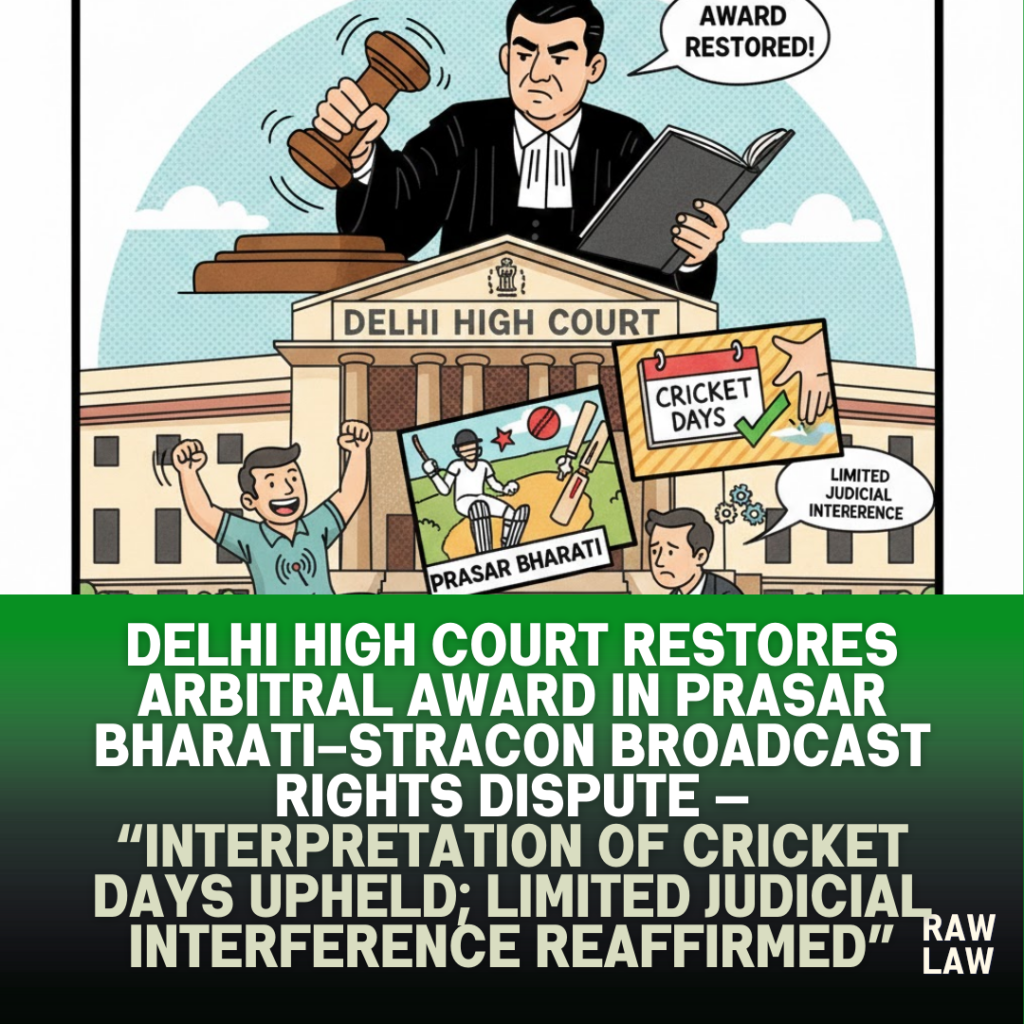
The Delhi High Court allowed cross-appeals arising from a Section 34 challenge and largely restored an arbitral award concerning global broadcast and marketing rights of cricketing events, holding that the arbitrator’s interpretation of contractual obligations on “cricketing days” was a plausible view immune from interference. The Court reiterated that courts under Sections 34 and 37 cannot re-write contracts or substitute their own interpretation merely because another view is possible — arbitral construction prevails unless perverse.
Court’s decision
A Division Bench comprising Justice Navin Chawla and Justice Madhu Jain set aside the Single Judge’s partial interference with the arbitral award dated 26.12.2016, ruling that the arbitrator had correctly construed the Global Rights Agreement independently of the earlier BCCI agreement. The Bench emphasised that contractual interpretation lies within the arbitral domain and upheld the award granting compensation for shortfall in international cricket days, subject to the limited confines of Section 34 scrutiny.
Facts
The dispute traces back to broadcast and marketing rights for cricketing events conducted by the Board of Control for Cricket in India during 1999–2004. Under an agreement dated 25.09.1999, Prasar Bharati obtained broadcasting rights for a five-year term, with BCCI guaranteeing 135 days of international cricket, at a minimum of 27 days per season.
Subsequently, Prasar Bharati entered into a Global Rights Agreement dated 19.02.2000 with a private broadcaster, granting global marketing rights for domestic and international matches up to 30.09.2004 for a consideration of USD 43.75 million. The agreement stipulated provision of a minimum of 27 days of international cricket in each cricket season and allowed pro-rata reduction in consideration if fewer matches were delivered.
Disputes arose when certain bilateral series did not take place, leading the broadcaster to withhold instalments and invoke arbitration. The sole arbitrator found a shortfall of international cricket days and awarded compensation exceeding USD 5.5 million with interest. The award was partially set aside by a Single Judge, prompting cross-appeals.
Issues
The principal issues before the Division Bench were whether the arbitrator had impermissibly re-written the contract by holding that 135 days of international cricket were required under the Global Rights Agreement, and whether earlier cricket days played prior to execution of the agreement could be excluded on a pro-rata basis. A connected issue concerned the extent to which courts could interfere with arbitral interpretation of contractual clauses under Sections 34 and 37 of the Arbitration and Conciliation Act.
Petitioner’s arguments
Prasar Bharati contended that the arbitrator erred by importing obligations from the BCCI agreement and ignoring that the Global Rights Agreement commenced mid-season. It argued that cricket days played in October 1999 had to be excluded and that the requirement of 27 days per season was subject to proportionate reduction. It was further submitted that the arbitrator re-wrote the contract, failed to consider domestic cricket valuation, and awarded excessive damages and interest without adequate reasoning.
Respondent’s arguments
The broadcaster defended the award, arguing that the Global Rights Agreement was a standalone contract that did not incorporate definitions from the BCCI agreement. It was submitted that the obligation to provide minimum cricketing days was unqualified and that the arbitrator’s interpretation was commercially sensible and consistent with the contract’s text. The respondent stressed the narrow scope of judicial review and argued that the Single Judge exceeded jurisdiction by substituting the arbitrator’s view.
Analysis of the law
The Court undertook an extensive survey of arbitration jurisprudence under Sections 34 and 37, reiterating that courts do not sit in appeal over arbitral awards. It relied on Supreme Court precedent clarifying that even errors of law or fact cannot justify interference unless the award is patently illegal or contrary to fundamental public policy. Interpretation of contractual terms, particularly in complex commercial agreements, falls squarely within the arbitrator’s remit.
Precedent analysis
The Bench relied on authoritative rulings including Associate Builders, MMTC v. Vedanta, Parsa Kente Collieries, and Prakash Atlanta, all of which underscore that if an arbitral view is plausible, it must be respected. These precedents were applied to hold that the arbitrator’s construction of “cricketing events” and “cricketing days” could not be displaced merely because an alternative interpretation existed.
Court’s reasoning
The Court held that the Global Rights Agreement did not define “cricket season” nor provide for any pro-rata reduction for a partial season. It found that importing definitions from the BCCI agreement would amount to re-writing the parties’ bargain. Clause 4 of the Global Rights Agreement clearly required a minimum of 27 days of international cricket per season, and Clause 9 provided a mechanism for pro-rata reduction only where fewer matches were delivered, not for excluding entire periods.
The arbitrator’s conclusion that a total of 135 days were required over the contract term was therefore a legitimate interpretation. The Court found no perversity or patent illegality and held that the Single Judge erred in interfering with the award by recalculating the shortfall.
Conclusion
The Delhi High Court restored the arbitral award substantially in favour of the broadcaster, holding that the arbitrator’s interpretation of the Global Rights Agreement was a plausible view deserving deference. The Court reaffirmed that judicial intervention under Sections 34 and 37 is strictly limited and that arbitral autonomy in contractual interpretation must be respected.
Implications
The judgment strengthens the pro-arbitration stance of Indian courts, particularly in high-value media and sports broadcasting contracts. It clarifies that courts cannot recalibrate commercial bargains or substitute contractual interpretations under the guise of patent illegality. The ruling provides certainty to stakeholders in sports media rights that arbitral determinations on complex valuation and deliverables will receive strong judicial protection.
Case law references
- Associate Builders v. DDA: Limits of public policy and patent illegality. Applied to restrict interference.
- MMTC v. Vedanta: Section 34 is not appellate review; plausible views protected.
- Parsa Kente Collieries v. Rajasthan Rajya Vidyut: Contract interpretation primarily for arbitrator.
- Prakash Atlanta v. NHAI: If two views are possible, arbitrator’s view must prevail.
FAQs
1. Can courts re-interpret commercial contracts in arbitration matters?
No. Courts cannot substitute their interpretation if the arbitrator’s view is plausible and reasoned.
2. Does partial performance justify pro-rata reduction automatically?
Only if the contract expressly provides for it. Courts cannot infer reductions not stipulated.
3. What is the scope of Section 37 appeals?
Section 37 review is even narrower than Section 34 and confined to jurisdictional errors.


