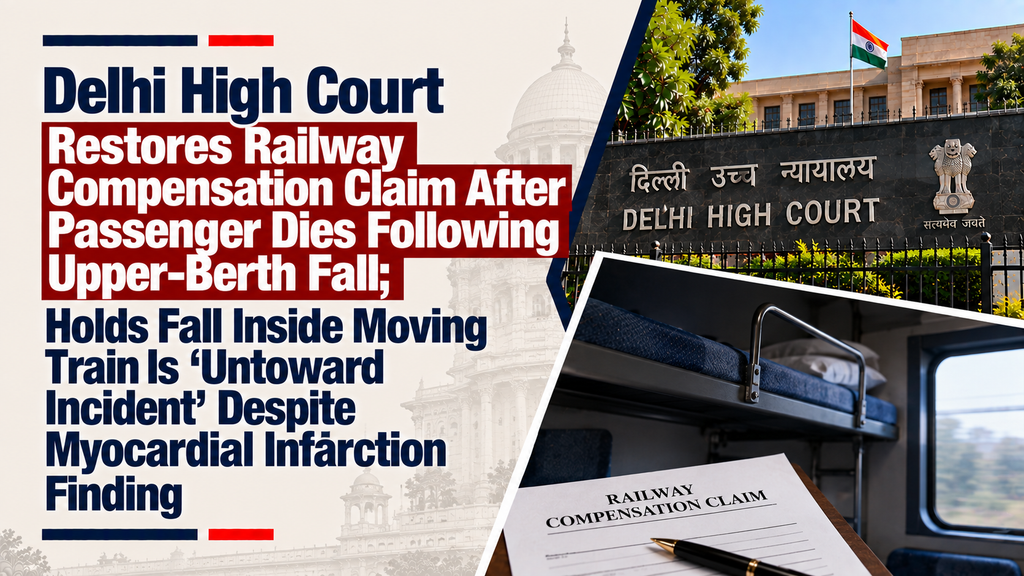
Delhi High Court Restores Railway Compensation Claim After Passenger Dies Following Upper-Berth Fall; Holds Fall Inside Moving Train Is ‘Untoward Incident’ Despite Myocardial Infarction Finding

Delhi High Court Restores Compensation Claim for Passenger Who Fell From Upper Berth; Says ‘Untoward Incident’ Includes Falls Occurring Inside Running Trains
Facts
The appeal was filed by Shyam Singh and another under Section 23 of the Railway Claims Tribunal Act, 1987, challenging the Railway Claims Tribunal’s judgment dated 22 September 2022 in Claim Application No. OA(IIU)/DLI(Lko)/445/2021.
On 10 November 2015, the deceased, Sanjeev Kumar, was travelling with his father Shyam Singh from Etawah to Agra Cantt. by Train No. 64157, the Etawah-Agra Cantt. Shuttle MEMU, on a valid second-class journey ticket.
During the journey, while the train was approaching Agra Cantt. Railway Station, Sanjeev Kumar was occupying an upper berth. According to the claimants, a sudden jerk in the moving train caused him to fall from the berth and become unconscious.
He was attended by a railway doctor but was declared dead. A post-mortem was subsequently conducted at District Hospital, Agra.
The Railway Claims Tribunal accepted that Sanjeev Kumar was a bona fide passenger, but dismissed the compensation claim after concluding that his death resulted naturally from myocardial infarction and not from an “untoward incident” under the Railways Act, 1989.
Issues
The principal question before the Delhi High Court was whether the deceased’s accidental fall from an upper berth inside a moving train could constitute an “untoward incident” under Section 123(c)(2) read with Section 124-A of the Railways Act.
The Court also had to determine whether the post-mortem finding of myocardial infarction, by itself, was sufficient to negate contemporaneous evidence showing that the deceased had accidentally fallen inside the train.
The deceased’s status as a bona fide passenger was no longer in dispute because the Tribunal had already decided that issue in favour of the claimants and the Railways had not challenged the finding.
Appellants’ Arguments
The appellants argued that Sanjeev Kumar had fallen from the upper berth because of a sudden jerk in the moving train.
They relied upon the Dy. SS/AGC memo, the Panchnama and the testimony of AW-1/Shyam Singh, who was travelling with his son, to establish the accidental fall.
They submitted that the post-mortem report’s reference to myocardial infarction could not, by itself, negate the fact that an accidental fall had occurred.
Reliance was placed upon the Supreme Court decision in Union of India v. Prabhakaran Vijaya Kumar and the decision in Beena Bhatacharya v. Union of India.
Respondent/Railways’ Arguments
The Union of India supported the Tribunal’s decision.
It relied upon the post-mortem report, which recorded the cause of death as shock resulting from myocardial infarction, and emphasised that no external injuries were found on the deceased’s body.
The Railways further relied upon AW-1’s admission that Sanjeev Kumar was undergoing treatment and was travelling to Agra Cantt. to obtain medicines.
On that basis, it argued that the death resulted from a natural cause, rather than an untoward incident under Sections 123(c) and 124-A of the Railways Act.
Analysis of the Law
An Accidental Fall Need Not Be Outside the Train
The High Court first addressed whether a passenger must physically fall out of the train before Section 123(c)(2) can apply.
It answered the question in the negative.
Relying on Union of India through General Manager, Northern Railway v. Triveni, the Court held that an accidental fall inside the train itself can constitute an “untoward incident.” Section 123(c)(2) does not require that the passenger must fall outside the train.
Thus, a passenger falling from an upper berth due to the movement or jerk of a running train is not excluded merely because the passenger remains inside the compartment.
Contemporaneous Evidence Established the Fall
The Court found affirmative evidence supporting the claimants’ version.
The Dy. SS/AGC memo and Panchnama, both prepared on the date of the incident, recorded that the deceased had “fallen from the seat” of Train No. 64157 before his death.
This contemporaneous documentary evidence was corroborated by Shyam Singh, who was actually travelling with his son and testified that Sanjeev Kumar “fell from the upper berth due to a sudden jerk” in the moving train.
The occurrence of the fall was therefore independently established.
Myocardial Infarction Did Not Erase the Accidental Fall
The Court accepted that the post-mortem report was relevant evidence concerning the medical cause of death.
However, it drew an important distinction between the medical cause of death and the circumstances in which the fatal event occurred.
The post-mortem opinion stating “shock as a result of myocardial infarction” did not, by itself, erase the established fact that Sanjeev Kumar had accidentally fallen from the upper berth.
There was also no documentary or medical evidence establishing any pre-existing cardiac ailment.
The fact that Sanjeev Kumar was travelling to Agra for treatment of back pain did not establish either a cardiac condition or that a cardiac event had occurred before the fall.
Precedent Analysis
Union of India v. Prabhakaran Vijaya Kumar
The Supreme Court’s decision in Prabhakaran Vijaya Kumar, (2008) 9 SCC 527 was central to the Court’s approach.
The Supreme Court held that Section 124-A embodies the principle of strict liability/no-fault liability, and that “accidental falling of a passenger from a train carrying passengers” must receive a purposive and liberal interpretation.
The Delhi High Court therefore rejected an unduly restrictive approach based solely on the post-mortem finding.
Union of India v. Triveni
In Triveni, 2014 SCC OnLine Del 741, a Coordinate Bench of the Delhi High Court had specifically considered whether falling inside a train could qualify as an untoward incident.
The Court held that Section 123(c)(2) does not require the passenger to fall outside the train.
This precedent directly covered Sanjeev Kumar’s fall from the upper berth.
Elambal & Ors. v. Union of India
The Court also considered the Madras High Court’s decision in Elambal & Ors. v. Union of India, where the Railways had relied upon a pre-existing heart condition and a post-mortem finding of cardiac arrest to characterise the death as natural.
That Court nevertheless considered the circumstances surrounding the cardiac event and allowed compensation.
The Delhi High Court considered the present case to stand on an “even better footing”, because there was no evidence that Sanjeev Kumar had any pre-existing cardiac ailment.
Court’s Reasoning
The Tribunal had committed an error by treating the medical cause of death as virtually conclusive of the legal question whether an untoward incident had occurred.
The High Court instead assessed the evidence cumulatively.
The railway records prepared contemporaneously with the incident stated that Sanjeev Kumar had fallen from his seat. His father, an eyewitness travelling with him, confirmed that a sudden jerk caused him to fall from the upper berth.
Against this evidence, the post-mortem report merely established myocardial infarction as the medical cause of death. It did not establish that no accidental fall occurred, nor was there evidence of a pre-existing cardiac disease.
Applying the statutory scheme of strict/no-fault liability and the liberal interpretation mandated by Prabhakaran Vijaya Kumar, the Court held that the evidence cumulatively established the accidental fall.
It consequently held that the “accidental fall of the deceased from the upper berth inside the moving train” constituted an “untoward incident” within Section 123(c)(2).
Conclusion
The Delhi High Court allowed the appeal and set aside the Railway Claims Tribunal’s judgment.
It held that Sanjeev Kumar’s accidental fall from the upper berth inside the moving train constituted an “untoward incident” under Section 123(c)(2) of the Railways Act.
The matter was remanded to the Tribunal to assess the compensation payable to the appellants and direct the authorities to disburse it within two months from receipt of the High Court’s order. The matter was directed to be listed before the Tribunal on 30 September 2026.
Case Details
Case: Shyam Singh & Anr. v. Union of India
Court: Delhi High Court
Case Number: FAO 158/2023
CNR: DLHC010255502023
Judge: Justice Manoj Kumar Ohri
Reserved: 24 August 2026
Pronounced: 10 September 2026
Result: Appeal allowed; Tribunal judgment set aside; upper-berth fall inside moving train held to be an “untoward incident”; matter remanded for assessment and disbursement of compensation within two months.