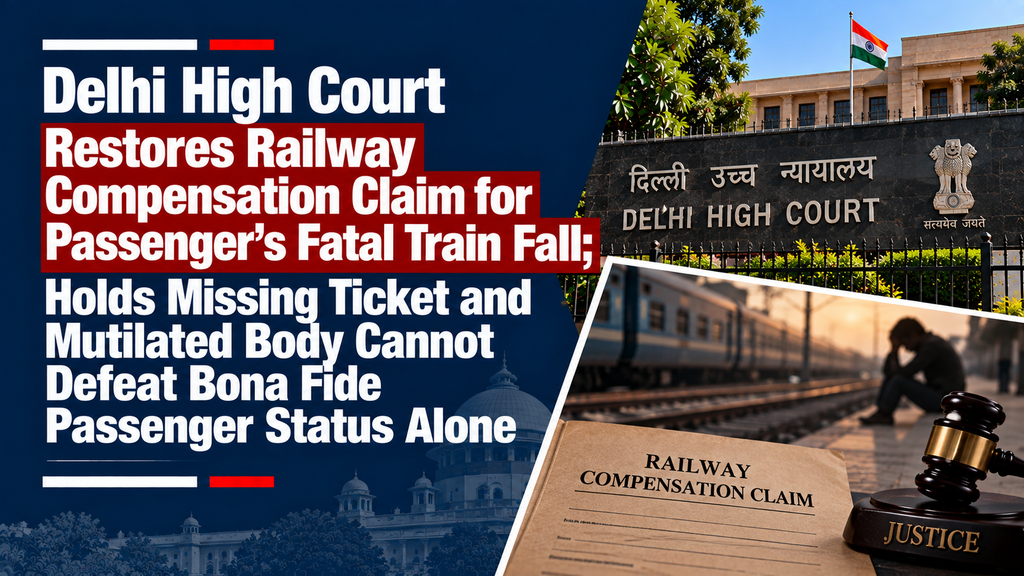
Delhi High Court Restores Railway Compensation Claim for Passenger’s Fatal Train Fall; Holds Missing Ticket and Mutilated Body Cannot Defeat Bona Fide Passenger Status Alone

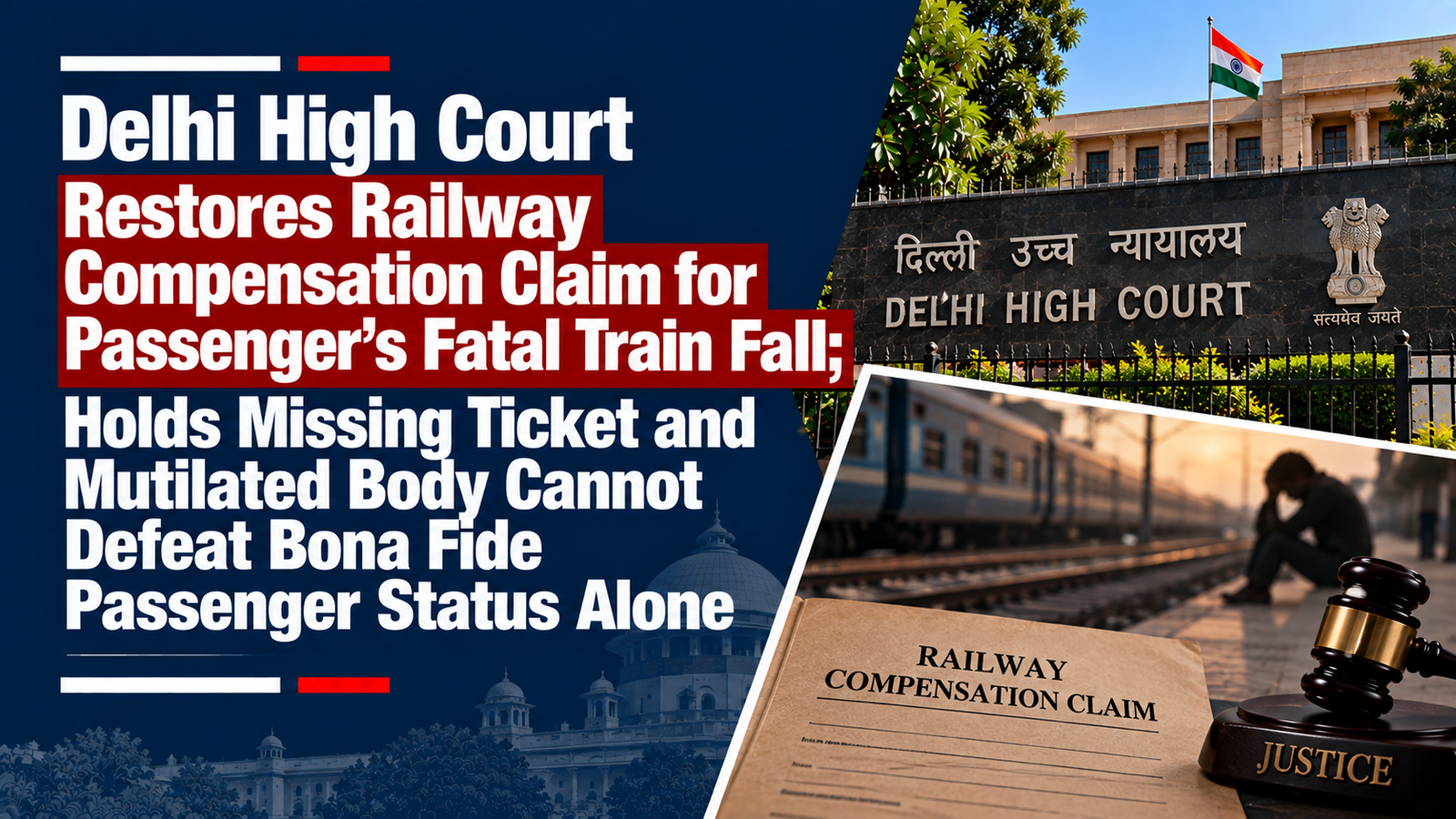
Delhi High Court Says No ‘Divine Camera’ Can Reconstruct Railway Accident; Mutilated Injuries Alone Cannot Rule Out Accidental Fall From Moving Train
Facts
The appeal was filed by Rinku Singh and others under Section 23 of the Railway Claims Tribunal Act, 1987, challenging the Railway Claims Tribunal’s judgment dated 18 December 2024 in OA/II/DLI/240/2024.
The deceased, Vikram Singh Chauhan, was stated to have boarded Train No. 14825, Hisar-Jaipur Express, on 29 July 2023 for his return journey to Harsoli. He was travelling in an unreserved compartment and, because of the rush of passengers, was allegedly standing near the gate.
After the train departed from Ajarka Railway Station, the deceased allegedly lost his balance amid the movement of passengers boarding and deboarding and fell from the moving train near KM 28/14-15, sustaining fatal injuries. His body was initially unidentified and was subsequently identified by his family from his clothes and footwear.
The Railway Claims Tribunal rejected the compensation claim, principally questioning whether the deceased was a bona fide passenger and whether his death resulted from an “untoward incident” under the Railways Act, 1989.
Issues
The principal issues before the Delhi High Court were whether non-recovery of a railway ticket was sufficient to reject the deceased’s status as a bona fide passenger; whether the claimants could discharge their initial burden despite AW-1 not personally witnessing the purchase of the ticket or boarding of the train; and whether the deceased’s mutilated injuries justified the Tribunal’s inference that he had been hit and run over rather than accidentally fallen from a moving train.
The Court also considered whether an accidental fall while standing near the door of a moving train constitutes an “untoward incident” under Section 123(c)(2) of the Railways Act, 1989.
Appellants’ Arguments
The claimants argued that the Tribunal had wrongly rejected the deceased’s bona fide passenger status merely because no journey ticket was recovered and because his son, Rinku Singh (AW-1), had not personally seen him purchase the ticket or board the train.
They pointed out that the body was found on the railway track along the route between Rewari and Harsoli, which the deceased habitually travelled for work.
They further emphasised that the Railways had not examined any witness and relied only upon the Divisional Railway Manager’s report.
Respondent/Railways’ Arguments
The Union of India argued that no journey ticket had been recovered from the deceased.
Accordingly, it contended that the appellants had failed to discharge the initial burden of proving that Vikram Singh Chauhan was a bona fide passenger at the time of the incident.
Analysis of the Law
Missing Ticket Does Not Automatically Disprove Passenger Status
The High Court found the Tribunal’s approach inconsistent with the Supreme Court’s decision in Union of India v. Rina Devi.
Under Rina Devi, the mere absence of a ticket from the deceased does not automatically establish that he was not a bona fide passenger. The claimant bears an initial burden, but that burden may be discharged through the relevant facts and circumstances, after which the onus shifts to the Railways.
The Court noted that this principle had recently been reiterated by the Supreme Court in Lata v. Union of India, 2026 SCC OnLine SC 1350.
Sworn Testimony Was Sufficient to Discharge Initial Burden
Although AW-1 had not personally seen his father purchase the ticket or board the train, the Court held that this circumstance alone could not defeat the claim.
The deceased himself was no longer available to explain the journey. AW-1 had specifically stated on oath that the deceased had boarded Train No. 14825 after purchasing a valid second-class general ticket and had fallen during the journey.
This was therefore not merely an unsupported assertion contained in the claim petition. The High Court held that the appellants had discharged their initial burden under Rina Devi.
Once that burden shifted, the Railways produced no cogent material other than non-recovery of the ticket. Although it relied upon the DRM report, no witness was examined to prove or support it.
Nature of Injuries Cannot Alone Reconstruct the Accident
The Tribunal had relied substantially upon the condition of the body and the post-mortem findings to reconstruct how the death occurred.
The High Court rejected this approach because there was no direct evidence establishing the sequence of events inferred by the Tribunal.
In a notable observation, the Court stated:
“There is no ‘divine camera’ which can capture the exact sequence of a railway accident.”
The fact that the body was mutilated therefore could not, without supporting evidence, establish that the deceased had been crossing the railway tracks or had first been hit and thereafter run over.
Precedent Analysis
Union of India v. Rina Devi
Rina Devi, (2019) 3 SCC 572, was central to the Court’s analysis.
The Supreme Court had clarified that mere absence of a ticket does not by itself negate bona fide passenger status. A claimant may discharge the initial burden through relevant facts and circumstances, after which the burden shifts to the Railways.
The High Court found that AW-1’s sworn evidence satisfied this initial requirement.
Lata v. Union of India
The Court noted that the same burden-of-proof principle had recently been reiterated by the Supreme Court in Lata v. Union of India, 2026 SCC OnLine SC 1350.
Prempal Singh & Anr. v. Union of India
The High Court relied on its earlier decision in Prempal Singh concerning a similarly mutilated body.
That judgment rejected the assumption that severe or mutilating injuries necessarily proved that a deceased person had been crossing the railway track. A passenger might fall from a moving train and subsequently come beneath its wheels.
Jameela v. Union of India
The Supreme Court’s decision in Jameela v. Union of India, (2010) 12 SCC 443 was relied upon to address the deceased’s alleged position near the train door.
The Supreme Court had recognised that a passenger standing near an open door may accidentally fall from a running train. Such conduct may be negligent or even rash, but without anything further it is not the kind of criminal act contemplated by the proviso to Section 124A of the Railways Act.
Accordingly, standing near the door did not by itself exclude compensation.
Court’s Reasoning
The Court found no evidence supporting the alternative accident theory adopted by the Tribunal.
The Gateman at LC Gate No. 77 had merely reported seeing the mutilated body near KM 28/13-15 and informed the Station Master.
The Station Master recorded that no driver or guard of any train had reported a run-over incident.
Thus, the Tribunal’s conclusion that the deceased had first been hit and thereafter run over was based only upon an inference drawn from the injuries rather than direct or cogent evidence.
Conversely, the appellants’ case that the deceased had accidentally fallen from the running train could not be ruled out. The Court therefore set aside the finding that the death was not caused by an “untoward incident.”
The judgment is significant because it rejects two assumptions often made in railway compensation cases: absence of a recovered ticket does not automatically establish ticketless travel, and the condition of a body found on railway tracks cannot, without corroborative evidence, conclusively establish how the accident occurred.
Conclusion
The Delhi High Court allowed the appeal and set aside the Railway Claims Tribunal’s judgment dated 18 December 2024.
The matter was remanded to the Tribunal solely for assessment of the compensation payable to the appellants in accordance with law.
The Tribunal was directed to ensure that the concerned authorities disburse the compensation within two months from receipt of the High Court’s order. The matter was directed to be listed before the Tribunal on 30 September 2026.
Case Details
Case: Rinku Singh & Ors. v. Union of India
Court: Delhi High Court
Case Number: FAO 79/2025
CNR: DLHC010175702025
Judge: Justice Manoj Kumar Ohri
Reserved: 2 September 2026
Pronounced: 10 September 2026
Result: Appeal allowed; Railway Claims Tribunal judgment set aside; deceased treated as having established bona fide passenger status and accidental train fall as an untoward incident; matter remanded for assessment and disbursement of compensation within two months.