

HEADNOTE
Joy Deb Chatterjee v. Meenu Ghosh & Ors.
Court: Delhi High Court
Jurisdiction: Ordinary Original Civil Jurisdiction
Bench: Justice Amit Bansal
Date of Judgment: December 11, 2025
Citation: CS(OS) 452/2023, I.A. 40688/2024 (Delhi High Court)
Laws / Provisions Involved: Code of Civil Procedure, 1908 – Order XXXIX Rules 1 & 2; Negotiable Instruments Act, 1881 – Section 138 (contextual)
Keywords: Interim injunction, fabricated MOA, compound interest, cheque discrepancy, Section 138 NI Act, coercion and misrepresentation
Summary
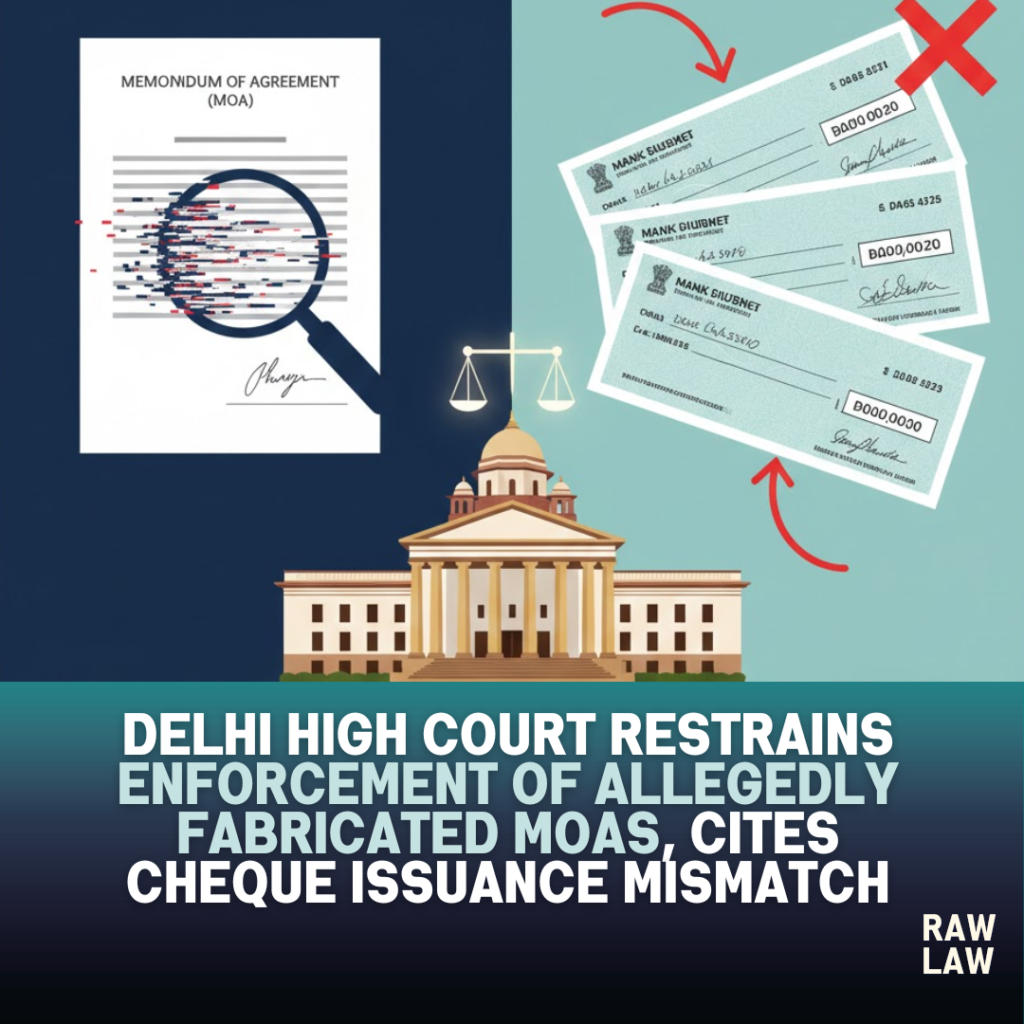
The Delhi High Court granted interim injunction restraining enforcement of three Memoranda of Agreements (MOAs) allegedly executed between the plaintiff and defendants, holding that the documents prima facie appeared to be fabricated and manufactured. The Court found glaring inconsistencies between contemporaneous email correspondence and draft MOUs—which provided for simple interest at 18% per annum—and the impugned MOAs stipulating compound interest at 2.5% per month. Crucially, the MOAs referred to cheque numbers that were proven, through bank certificates, to have been issued more than a year later, rendering it impossible for such cheques to have been handed over on the stated execution dates. Holding that balance of convenience favoured the plaintiff and that irreparable harm would be caused if the defendants continued to act on the MOAs, the Court restrained their enforcement pending final adjudication.
Court’s decision
The Delhi High Court allowed the plaintiff’s application under Order XXXIX Rules 1 and 2 CPC and restrained the defendants from acting upon or enforcing three impugned MOAs dated 20 March 2019 and 17 August 2019. The restraint will operate till final adjudication of the suit. The Court clarified that its observations are prima facie and will not affect the final merits.
Facts
The plaintiff, engaged in coal supply business, alleged that defendants induced him to accept investment through defendant no.1 but later misused blank signed documents to fabricate loan MOAs. Negotiations were conducted through a Chartered Accountant, and draft MOUs exchanged in August 2019 contemplated profit sharing or simple interest at 18% per annum. Contrary to this, three MOAs surfaced later, showing exorbitant compound interest and additional profits. Based on these MOAs, defendants initiated criminal proceedings under Section 138 NI Act and allegedly took possession of the plaintiff’s residential flat.
Issues
Whether the plaintiff had made out a prima facie case for interim injunction by showing that the impugned MOAs were fabricated or manufactured, and whether enforcement of such MOAs would cause irreparable harm pending trial.
Plaintiff’s arguments
The plaintiff relied on extensive email correspondence and draft MOUs to show that agreed terms never included compound interest. He highlighted bank certificates proving that cheques mentioned in the MOAs were issued only in October and December 2020, making it impossible for them to have been handed over in August 2019 as recorded. It was argued that the MOAs were created later to falsely support Section 138 proceedings.
Defendants’ arguments
The defendants contended that the MOAs were validly executed and notarised in 2019 and that cheques were mentioned only as security. They argued that the suit was a counterblast to cheque dishonour cases and that the plaintiff’s allegations were inconsistent and afterthoughts.
Analysis of the law
The Court applied settled principles governing interim injunctions—prima facie case, balance of convenience, and irreparable injury. It examined documentary material, particularly emails and bank certificates, to assess whether the plaintiff’s challenge was bona fide at the interlocutory stage.
Precedent analysis
While no specific precedent was cited, the Court followed established jurisprudence that where documents appear ex facie doubtful and capable of causing grave prejudice, courts are justified in preserving the status quo until trial.
Court’s reasoning
Justice Amit Bansal found it illogical that negotiations culminating in a draft MOU with simple interest at 18% per annum could suddenly transform into MOAs providing compound interest at 2.5% per month. The decisive factor was the cheque-number anomaly: cheques allegedly handed over in August 2019 were conclusively shown to have been issued by banks only in late 2020. This contradiction, the Court held, strongly supported the plaintiff’s plea of fabrication.
Conclusion
The Court held that the plaintiff had established a strong prima facie case, that balance of convenience lay in his favour, and that irreparable harm would ensue if the defendants continued to act on the impugned MOAs. Interim injunction was accordingly granted.
Implications
This ruling underscores judicial readiness to scrutinise commercial documents at the interim stage where objective evidence suggests fabrication. It also highlights that cheque issuance records can decisively undermine claims in loan and Section 138 NI Act-related disputes, reinforcing safeguards against misuse of blank signed instruments.
Case law / principles referenced
• Order XXXIX Rules 1 & 2, CPC
Principle: Courts may grant interim injunction to prevent irreparable harm where a strong prima facie case exists.
Application: Applied to restrain enforcement of impugned MOAs.
FAQs
Q1. Why did the Delhi High Court restrain the MOAs?
Because documentary evidence showed prima facie fabrication, including cheques issued after the alleged execution dates.
Q2. Did the Court decide the final validity of the MOAs?
No. The findings are prima facie and subject to final adjudication.
Q3. What role did cheque records play in the decision?
They conclusively showed that cheques mentioned in the MOAs could not have existed on the stated dates.
Also Read: Bombay High Court restores deemed membership to flat purchasers despite pending civil suit


