Delhi High Court Revives Railway Compensation Claim for Fatal Train Fall; Holds Genuine Verified Ticket and Accident Records Established Bona Fide Travel and Untoward Incident

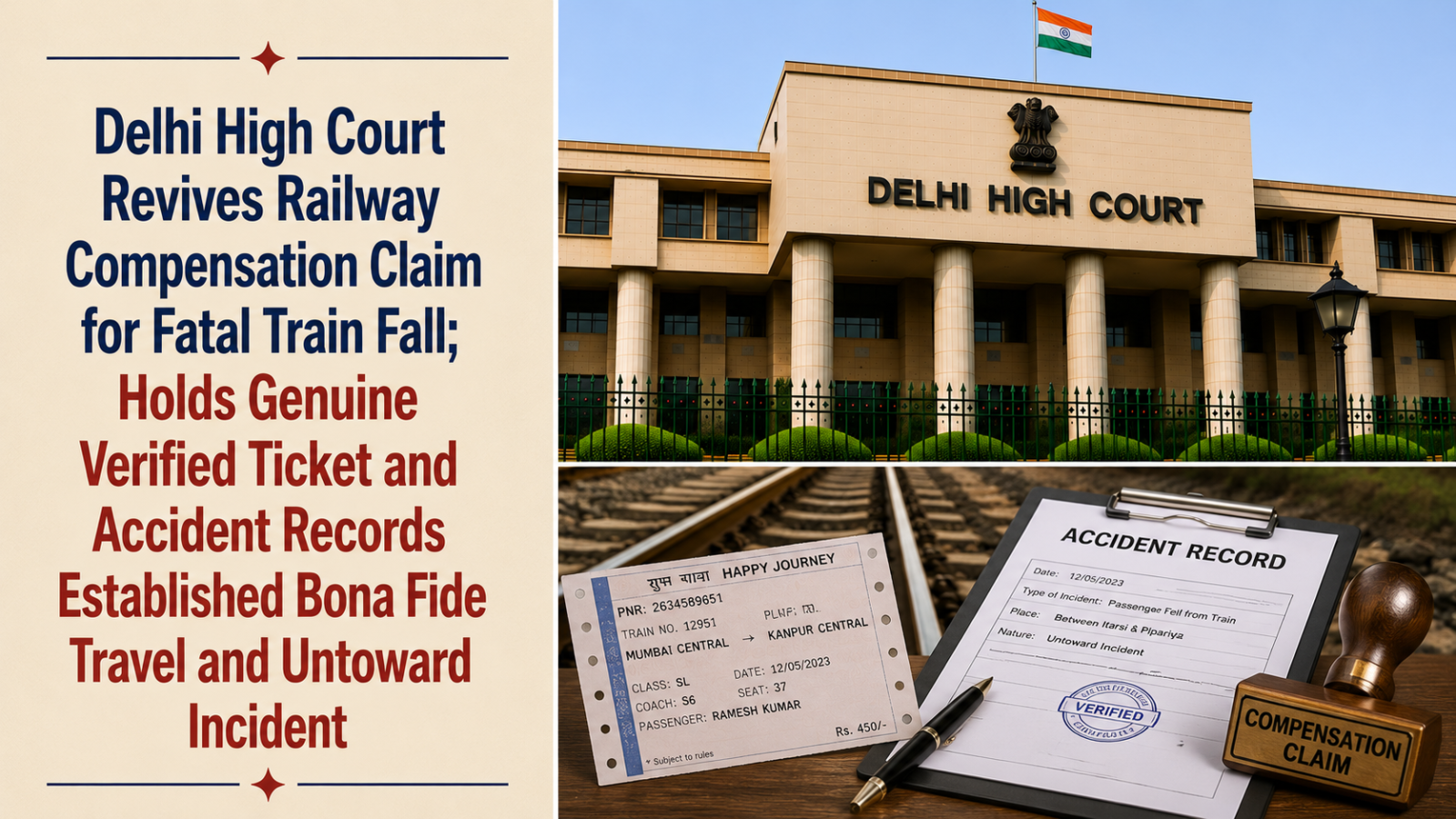
Delhi High Court Directs Railway Compensation Assessment Within Two Months; Finds Tribunal Erred in Rejecting Genuine Ticket and Accidental Fall Evidence
Facts
The appeal was filed by Geeta Kumari @ Geeta Devi under Section 23 of the Railway Claims Tribunal Act, 1987, challenging the Railway Claims Tribunal’s judgment dated 10 July 2024 dismissing her compensation claim arising from the death of her son, Yogendra Pratap.
According to the appellant, on 30 June 2018, the deceased left his home to travel to Ahmedabad for employment. He reached Agra Fort and purchased a second-class Superfast railway ticket for Ahmedabad. During the journey, he allegedly fell accidentally from the running train and suffered fatal injuries. His body was subsequently discovered near the railway line and taken to Government Amrit Kaur Hospital, Beawar.
The Railway Claims Tribunal rejected the claim, holding that the claimant had failed to establish either that the deceased was a bona fide passenger or that his death resulted from an “untoward incident” under the Railways Act, 1989.
The mother therefore appealed to the Delhi High Court.
Issues
The principal issues before the High Court were:
- Whether the deceased was a bona fide passenger, despite the journey ticket not being recovered during the initial search of his body.
- Whether the subsequently produced and Railway-verified journey ticket sufficiently established bona fide travel.
- Whether the deceased’s death constituted an untoward incident arising from an accidental fall from a running train.
- Whether the fact that the body was discovered outside the railway track disproved an accidental fall.
- Whether failure to identify the particular train from which the deceased allegedly fell was fatal to the claim.
- What evidentiary weight could be attached to a DRM inquiry initiated almost one year after the accident.
Appellant’s Arguments
The appellant contended that the Tribunal had failed to properly appreciate the cumulative evidence.
She relied upon:
- the deceased’s belongings recovered after the incident;
- the original journey ticket subsequently produced by the family;
- verification of that ticket by the Railways;
- contemporaneous police proceedings; and
- the medical record.
The appellant argued that mere non-recovery of the ticket from the deceased immediately after the accident could not, by itself, defeat the compensation claim.
She also challenged reliance on the DRM report because the inquiry had commenced almost one year after the accident.
Respondent’s Arguments
The Union of India opposed the claim.
The Railways argued that neither the particular train in which the deceased was allegedly travelling nor the precise manner in which he sustained the fatal injuries had been established.
It emphasised that no railway ticket was recovered from the deceased during the initial search and that the ticket relied upon by the appellant was produced by the family only subsequently.
The Railways also relied upon the fact that the deceased’s body was found outside the railway line and upon the findings recorded in the DRM report.
Analysis of the Law
Bona Fide Passenger Status
The High Court first considered whether the deceased was a bona fide passenger.
The original journey ticket bearing No. 92613696, from Agra Fort to Ahmedabad, was produced before the Tribunal.
Crucially, the Railways itself verified the ticket and found it to be genuine.
Although the ticket had not been recovered during the initial search, the claimant had furnished an explanation for its subsequent recovery.
More importantly, there was no material suggesting that the ticket was fabricated or could not have been possessed by the deceased.
The Court therefore found that the Tribunal had attached excessive significance to the initial non-recovery of the ticket.
Precedent Analysis
Union of India v. Rina Devi
The principal Supreme Court authority relied upon by the High Court was Union of India v. Rina Devi, (2019) 3 SCC 572.
Rina Devi establishes that mere absence of a railway ticket from the body of the deceased does not automatically negate bona fide passenger status.
The initial burden lies on the claimant, but that burden may be discharged through an affidavit and surrounding circumstances, following which the evidentiary burden shifts to the Railways.
The High Court found the present case to stand on an even stronger footing than the ordinary Rina Devi situation because an actual journey ticket had been produced and its genuineness had been independently verified by the Railways.
Whether Death Resulted From an Untoward Incident
The contemporaneous evidence established that the deceased was found dead on 1 July 2018 near LC Gate No. 22 at KM No. 339/5-6.
The Station Master/Gateman informed railway authorities at approximately 7:30 a.m., following which GRP proceedings were conducted.
The deceased had sustained severe head and bodily injuries, and the final GRP report recorded that he had died in a train accident causing severe head injury and shock.
This contemporaneous material supported the claimant’s version that the death arose from a railway accident.
Body Found Outside Railway Track Was Not Conclusive
The Railways relied heavily upon the fact that the deceased’s body had been found “outside the railway line.”
The High Court rejected the proposition that this fact necessarily disproved an accidental fall.
The Court reasoned that a person falling from a moving train may, because of the train’s speed and direction, land outside the track.
Therefore, the final location of the body could not constitute conclusive evidence that the deceased had not been travelling on a train.
This was an important factual finding because the Tribunal had treated the location of the body as a circumstance adverse to the claimant.
Failure to Identify Exact Train Was Not Fatal
The Railways also relied upon the Train Signal Register (TSR) from Bangur Gram Station.
However, the High Court found that this register related to trains passing Bangur Gram around 7:30 a.m. on 1 July 2018, approximately when the deceased’s body was discovered.
By contrast, the deceased had purchased his ticket at Agra Fort around 7:02 p.m. on 30 June 2018.
The Bangur Gram TSR therefore did not establish which trains were available from Agra Fort at the relevant time on the previous evening.
Significantly, the Agra Fort TSR itself was not produced by the Railways.
The Tribunal could therefore not draw an adverse inference merely because the claimant could not link the deceased to a particular train reflected in the Bangur Gram register.
No Evidence That Deceased Was Run Over While Crossing Tracks
The High Court also examined whether there was an alternative explanation for the death.
Although a loco pilot and guard of Train No. 12547 had been examined, their evidence did not establish the particular train involved.
More importantly, there was no independent eyewitness or railway official who had seen the deceased being run over while crossing the railway line or otherwise established that he had not fallen from a moving train.
Accordingly, the mere location of the body outside the track could not be converted into affirmative proof of an alternative cause of death.
Belated DRM Inquiry
The Court was particularly critical of the timing of the DRM inquiry.
The accident occurred on 1 July 2018, but the DRM inquiry was initiated only on 30 June 2019, almost one year later. The report itself was submitted on 15 July 2019, after the compensation proceedings had already commenced.
The Court observed that belated DRM inquiries cannot ordinarily be permitted to displace contemporaneous evidence merely on the basis of inferences drawn substantially later.
Here, the DRM report essentially relied on:
- non-recovery of the ticket during the initial search; and
- the fact that the body was discovered outside the railway line.
The first circumstance substantially lost its force once the subsequently produced ticket was verified as genuine by the Railways itself.
Court’s Reasoning
The High Court considered the evidence cumulatively rather than isolating each circumstance.
First, a genuine Agra Fort-Ahmedabad journey ticket had been produced and verified by the Railways.
Second, the contemporaneous GRP record attributed the death to a train accident involving severe head injuries and shock.
Third, the body being found outside the railway line did not logically exclude an accidental fall from a moving train.
Fourth, the Railways failed to produce the relevant Agra Fort TSR.
Fifth, there was no positive evidence showing that the deceased was instead run over while crossing the tracks.
Finally, the DRM inquiry was initiated almost one year later and could not override the stronger contemporaneous evidence.
The Tribunal therefore erred in holding that the deceased had not been proved to be a bona fide passenger or victim of an untoward railway incident.
Conclusion
The Delhi High Court allowed the appeal and set aside the Railway Claims Tribunal’s judgment dated 10 July 2024.
Rather than itself quantifying compensation, the High Court remanded the matter to the Tribunal solely for assessment of the compensation payable to the deceased passenger’s mother in accordance with law.
The Tribunal was directed to ensure that the compensation is disbursed within two months from receipt of the High Court’s order.
The matter was directed to be listed before the Tribunal on 8 September 2026.
Key Ratio
Non-recovery of a railway ticket from a deceased passenger does not defeat a compensation claim where a subsequently produced ticket is verified as genuine. Nor does discovery of the body outside the railway track, or inability to identify the exact train, by itself disprove an accidental fall when contemporaneous evidence supports a railway accident and no positive evidence establishes an alternative cause of death.
Case Details
Case: Geeta Kumari @ Geeta Devi v. Union of India
Court: High Court of Delhi at New Delhi
Case Number: FAO 404/2024
Judge: Justice Manoj Kumar Ohri
Reserved on: 10 August 2026
Date: 19 August 2026
Tribunal Case: OA/II(U)/DLI/134/2023
Result: Appeal allowed; Tribunal judgment set aside; matter remanded for assessment and disbursement of compensation within two months