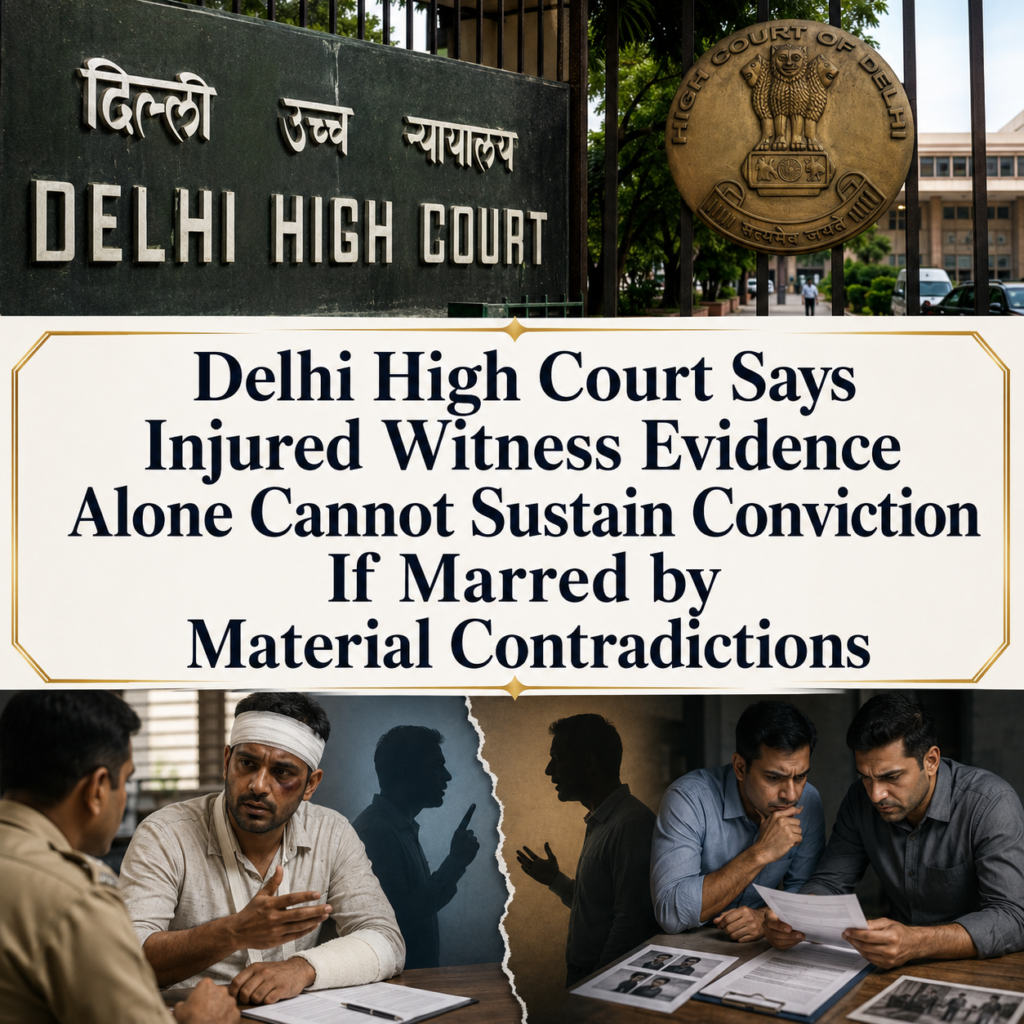
Delhi High Court Says Injured Witness Evidence Alone Cannot Sustain Conviction If Marred by Material Contradictions

Delhi High Court Refuses to Reverse Acquittal in Section 308 IPC Case, Holds Injured Witness Testimony Must Still Inspire Confidence
Facts
The State filed a criminal appeal under Section 378 of the Code of Criminal Procedure challenging the judgment of acquittal passed by the Additional Sessions Judge-05, South East District, Saket, New Delhi.
The respondents were tried for the offence under Section 308 read with Section 34 of the Indian Penal Code. The prosecution alleged that on 25 February 2007, at about 8:22 p.m., near Nehru Place Bus Terminal, the accused persons assaulted the injured witness, PW3, with iron rods and baseball/cricket bats.
According to the prosecution, PW3 owned an RTV bus plying between Malviya Mandir and Nehru Place. A dispute allegedly arose because buses of the accused persons were also operating on the same route. PW3 claimed that after his driver informed him about an earlier quarrel, he reached Nehru Place Bus Terminal, where the accused persons allegedly attacked him.
The FIR was registered at Police Station Kalkaji. After investigation, the charge-sheet was filed alleging offences under Sections 308, 506 and 34 IPC. The Trial Court framed charge under Section 308 read with Section 34 IPC.
During trial, the prosecution examined 12 witnesses, including the injured PW3, his driver PW1, and his wife PW7. The Trial Court found the evidence insufficient and acquitted the accused persons.
During the pendency of the appeal, respondent no. 1/A1 was reported to have died, and the appeal against him stood abated. The appeal continued against the remaining respondents.
Issues
- Whether the Trial Court’s acquittal of the accused persons under Section 308 read with Section 34 IPC suffered from perversity or illegality.
- Whether the testimony of the injured witness PW3 was sufficiently reliable to reverse the acquittal.
- Whether the evidence of PW1 and PW7 corroborated the prosecution case.
- Whether material inconsistencies in the prosecution evidence created reasonable doubt.
- Whether the High Court, in an appeal against acquittal, could interfere when the Trial Court’s view was a possible view.
Petitioner’s Arguments
The State argued that the Trial Court failed to properly appreciate the evidence on record.
It submitted that the injured witness PW3 had specifically named the accused persons and described the assault. His evidence was supported by PW1, the driver, and PW7, the wife of PW3.
The State contended that the injuries suffered by PW3, including the head injury and fracture, supported the prosecution version that the accused persons had assaulted him with dangerous weapons.
According to the State, the acquittal was contrary to the facts and circumstances of the case and was bad in law. Therefore, the judgment of acquittal deserved to be set aside.
Respondent’s Arguments
The respondents supported the Trial Court’s judgment and argued that no interference was warranted.
They submitted that the prosecution evidence suffered from material contradictions and inconsistencies regarding the persons involved, the role of each accused, the presence of witnesses, and the nature of injuries.
The respondents contended that PW7’s claim of being present during the incident was inconsistent with the versions of PW1 and PW3.
They also argued that although the incident allegedly occurred at a busy bus terminal, no independent public witness was examined.
According to the respondents, the Trial Court had taken a plausible view of the evidence, and in an appeal against acquittal, the High Court should not interfere merely because another view was possible.
Analysis of the Law
The High Court examined the scope of interference in an appeal against acquittal.
The Court held that an appellate court has the power to review and reappreciate the evidence in an acquittal appeal. However, where an accused has already been acquitted, there is a double presumption in his favour: first, the general presumption of innocence, and second, the strengthened presumption arising from the acquittal recorded by the Trial Court.
The Court held that an acquittal can be reversed only if the Trial Court’s judgment suffers from patent perversity, misreading of evidence, omission to consider material evidence, or if the only possible view on the evidence is the guilt of the accused.
The Court also reiterated that the evidence of an injured witness ordinarily carries great weight. However, such evidence is not immune from scrutiny. It must still be tested on consistency, probability and corroboration.
The Court further noted that non-examination of independent witnesses is not always fatal. However, where the prosecution evidence otherwise suffers from material inconsistencies, failure to examine independent witnesses from a busy public place becomes relevant.
Precedent Analysis
The Court referred to Babu Sahebogouda Rudragoudar v. State of Karnataka, Rajesh Prasad v. State of Bihar, and Chandrappa v. State of Karnataka on the principles governing appeals against acquittal.
These decisions establish that although an appellate court can reappreciate evidence, it must not disturb an acquittal if two reasonable views are possible.
The Court also relied on H.D. Sundara v. State of Karnataka, where the Supreme Court held that interference with acquittal is justified only when the Trial Court’s view is not a possible view, or where the only conclusion from the evidence is guilt beyond reasonable doubt.
The Court also referred to Moidu K. v. State of Kerala while noting that non-compliance with Section 232 CrPC does not automatically vitiate the trial unless serious prejudice to the accused is shown.
Court’s Reasoning
The Court found that the prosecution case mainly rested on the testimony of PW3, the injured witness, supported by PW1 and PW7.
However, the Court found material inconsistencies in the evidence regarding the role attributed to the accused persons and the manner of assault.
The Court noted that PW7, wife of PW3, claimed that she was present at the scene when the assault occurred. However, PW1 and PW3 did not support this version. According to PW1, PW7 arrived only after PW3 had already been assaulted and injured. This created serious doubt about PW7’s presence during the incident.
The Court also found inconsistency regarding the number and identity of assailants. PW1 referred to one “Murlidhar”, who was not named in the FIR or charge-sheet. PW3 referred to one “Sonu” and a bus helper. PW7 stated that Sonu and two others were also involved. However, the charge-sheet did not explain these alleged additional participants.
The Court observed that PW7 was herself a Head Constable in Delhi Police. If she genuinely believed that all assailants were not named or investigated, she could have pursued appropriate remedies. Although she claimed to have complained to senior officers, no such complaints were produced despite an opportunity.
The Court also found doubts in the medical evidence. PW3 claimed that he was beaten all over the body and suffered internal injuries, but the medical records did not support the allegation of internal injuries. The discharge summary also referred to an old radial head injury, which added to the uncertainty regarding the nature of injuries.
The Court further noted that the incident allegedly occurred at a busy bus terminal where members of the public had gathered, but no independent public witness was examined. In view of the inconsistencies in the prosecution case, this omission became significant.
The Court held that the Trial Court had considered these inconsistencies and had given cogent reasons for granting benefit of doubt. The Trial Court’s appreciation of evidence was neither perverse nor unreasonable.
Conclusion
The Delhi High Court dismissed the State’s appeal.
The Court held that the prosecution failed to show that the Trial Court’s acquittal was perverse, illegal or contrary to the evidence on record.
It ruled that the evidence of the injured witness, though important, suffered from inconsistencies and did not receive reliable corroboration from PW1 and PW7.
The Court further held that where two reasonable views are possible, the view favouring the accused must prevail, especially in an appeal against acquittal.
Accordingly, the acquittal of the respondents under Section 308 read with Section 34 IPC was upheld.
Case Details
Case: State v. Bansi Lal & Ors.
Court: Delhi High Court
Case Number: CRL.A. 853 of 2016
Judge: Justice Chandrasekharan Sudha
Date: 07 July 2026
Result: State appeal dismissed; acquittal under Section 308 read with Section 34 IPC upheld; appeal against respondent no. 1/A1 abated due to death.