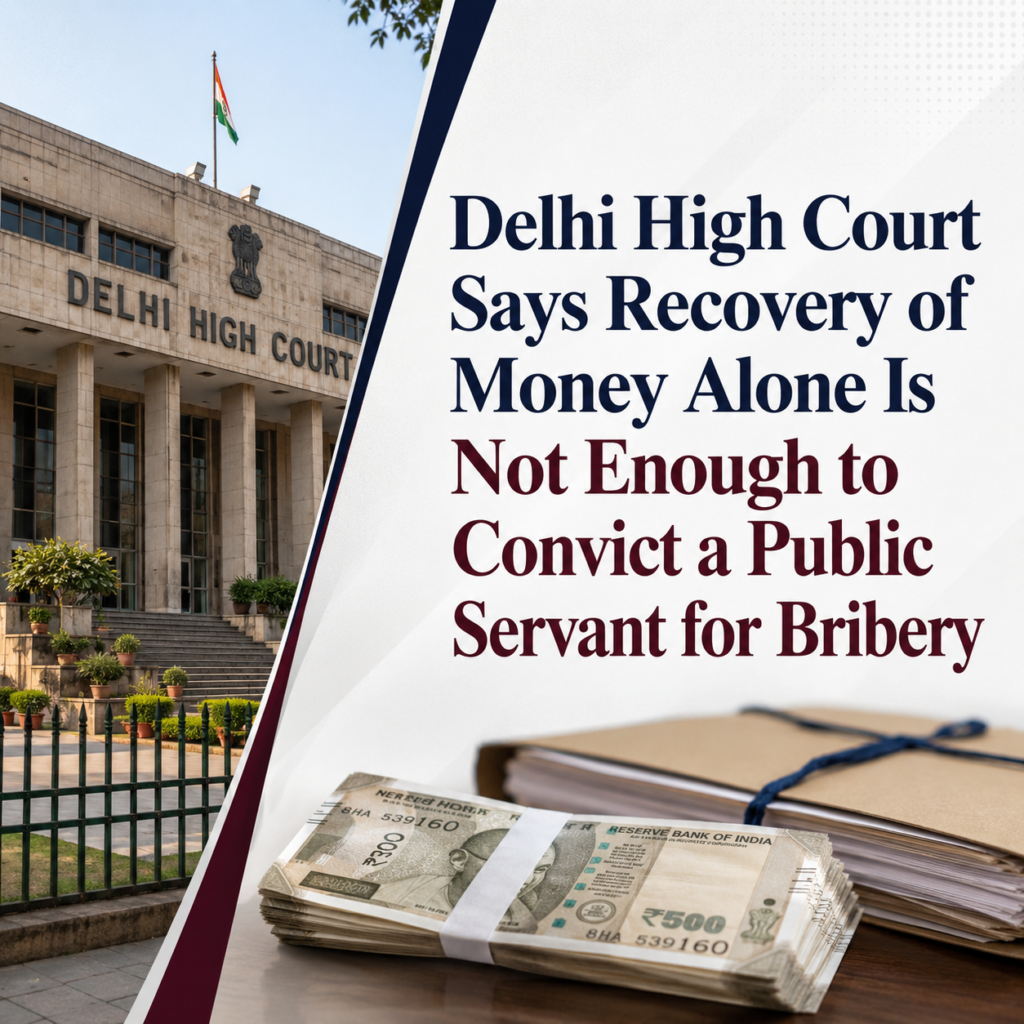
Delhi High Court Acquits SDM Office Bailiff in ₹100 Bribery Case, Holds Demand of Illegal Gratification and Recovery Not Proved Beyond Reasonable Doubt
Facts
The appellant, Sanjeev Sharma, was convicted by the Trial Court in a corruption case arising from FIR No. 13/1998 registered at Police Station Anti-Corruption Branch, Delhi. The prosecution alleged that the complainant, Saleem Khan, had applied for a Central OBC Certificate at the SDM Office, Seelampur, and that the appellant, who was working as a Bailiff, demanded ₹100 for processing or conducting inquiry in relation to the certificate.
Acting on the complaint dated 8 May 1998, the Anti-Corruption Branch conducted pre-raid proceedings and laid a trap. The prosecution alleged that the appellant accepted the tainted ₹100 note and kept it in his shirt pocket, after which he was apprehended. The Trial Court convicted him under Sections 7 and 13(2) of the Prevention of Corruption Act, 1988, and sentenced him to rigorous imprisonment. The appellant challenged the conviction before the Delhi High Court.
Issues
Whether the prosecution proved the demand and acceptance of illegal gratification beyond reasonable doubt.
Whether the recovery of the tainted ₹100 currency note from the appellant was proved beyond reasonable doubt.
Whether contradictions in the complainant’s testimony, panch witness testimony, raid officer’s evidence and official records created reasonable doubt.
Whether conviction under the Prevention of Corruption Act could be sustained when demand itself was doubtful.
Petitioner’s Arguments
The appellant argued that the prosecution case suffered from serious inconsistencies. It was submitted that the complainant initially alleged a demand of ₹100, but later improved his version by stating that ₹200 was initially demanded and then reduced to ₹100. This improvement was not mentioned in the original complaint.
The appellant also relied on official SDM office records to show that the complainant’s OBC certificate application was assigned to him only on 8 May 1998, i.e. the very day of the complaint and trap. Therefore, it was argued that there was no occasion for him to have demanded money from the complainant earlier.
It was further submitted that there were contradictions regarding the place of demand and acceptance. The complainant stated that the transaction occurred outside the house near a scooter, whereas the panch witness stated that it occurred inside the house.
The appellant also argued that recovery of the tainted currency note was doubtful because the complainant and seizure memo stated that the panch witness recovered the note, while the panch witness and raid officer stated that the raid officer recovered it.
Respondent’s Arguments
The State argued that the prosecution had proved the complaint, pre-raid proceedings, demand, acceptance, recovery of the tainted note, positive wash reports and valid sanction.
It was submitted that the complainant supported the prosecution case on material particulars and proved that the appellant had demanded illegal gratification and accepted the tainted currency note.
The State further relied on the panch witness and the raid officer to argue that the trap proceedings were properly conducted. It was also submitted that the CFSL report showing presence of phenolphthalein in the hand-wash and shirt-pocket wash supported the prosecution case.
The State argued that minor discrepancies were natural due to passage of time and did not affect the core of the prosecution case.
Analysis of the Law
The Court reiterated that in a prosecution under the Prevention of Corruption Act, proof of demand of illegal gratification is the foundational requirement. Mere recovery of tainted money is not sufficient unless demand and voluntary acceptance are proved beyond reasonable doubt.
The Court held that before any presumption under Section 20 of the Prevention of Corruption Act can operate, the prosecution must first establish the foundational facts, particularly demand and acceptance of bribe.
The Court found that the evidence did not clearly establish when the demand was made, where it was made, how it was made, and whether the appellant had any occasion to demand money before the complainant’s application was even assigned to him.
Precedent Analysis
The Court relied on State of Lokayuktha Police v. C.B. Nagaraj, where the Supreme Court held that merely because money changed hands, it cannot automatically be presumed that it was paid pursuant to a bribe demand. The complete chain of demand, acceptance and recovery must be proved.
The Court also referred to Paritala Sudhakar v. State of Telangana, where the Supreme Court held that where demand is not proved, the presumption under Section 20 of the Prevention of Corruption Act does not operate against the accused.
The Court further referred to Om Parkash v. State of Haryana, which held that where demand has not been proved, Section 20 has no application.
Court’s Reasoning
The Court found that PW-2, who was present at the complainant’s house, did not support the prosecution on demand or acceptance. PW-4 claimed that he heard conversation regarding money, but this was not mentioned in his police statement and was contradicted by the complainant and panch witness.
The Court found material improvements in the complainant’s version. The original complaint did not mention that ₹200 was demanded and later reduced to ₹100. The complainant later stated that the demand was made at 11:00 AM on 8 May 1998, but also stated that he was at the Anti-Corruption Branch at around 11:00–11:30 AM, making his version doubtful.
The Court attached significance to the official SDM records produced by PW-5, which showed that the complainant’s application was marked to the appellant only on 8 May 1998. Therefore, the Court found it difficult to accept that the appellant had been demanding money for the application before it was assigned to him.
On recovery, the Court held that the prosecution put forward two conflicting versions. The complainant and seizure memo stated that the panch witness recovered the tainted note, while the panch witness and raid officer stated that the raid officer recovered it. The Court held that this was not a minor discrepancy because it related to the very recovery of the tainted money.
Conclusion
The Delhi High Court held that the prosecution failed to prove the essential ingredients of demand, acceptance and recovery beyond reasonable doubt. It found serious contradictions and improvements in the prosecution case, especially on the demand of bribe and recovery of the tainted currency note.
Accordingly, the Court set aside the conviction dated 23 April 2007 and sentence dated 24 April 2007, acquitted the appellant of all charges, cancelled his bail bond and discharged the surety.
Case: Sanjeev Sharma v. State of NCT of Delhi
Court: Delhi High Court
Case Number: CRL.A. 273/2007
Judge: Dr. Justice Swarana Kanta Sharma
Date: 2 July 2026
Result: Appeal allowed; conviction and sentence set aside; appellant acquitted of all charges.