

Court’s decision
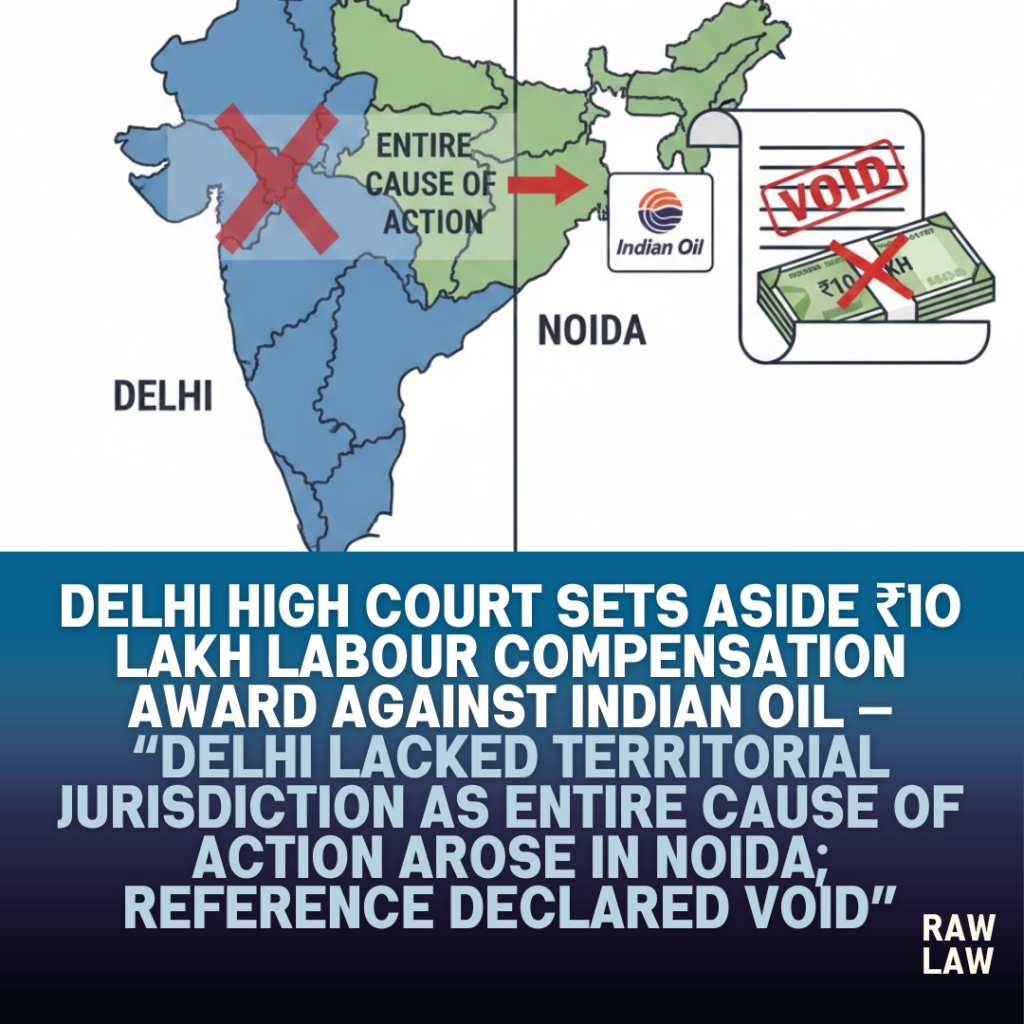
The Delhi High Court allowed the writ petition filed by Indian Oil Corporation Limited and set aside the Labour Court’s award granting ₹10 lakh compensation with interest to a workman, holding that the Delhi Administration lacked territorial jurisdiction to refer the industrial dispute in the first place. The Court ruled that since the workman was employed, posted, and terminated entirely in Noida, Uttar Pradesh, no part of the cause of action arose in Delhi — “an award passed without jurisdiction is a nullity”; labour compensation award quashed.
Court’s decision
Justice Manoj Kumar Ohri held that the issue of territorial jurisdiction goes to the root of the matter and can be examined even after remand. The Court concluded that the Labour Court at Delhi could not have entertained the reference, as the employment, posting, and termination of the workman were all connected exclusively with Noida. Consequently, the impugned award dated 10.07.2023 was declared without jurisdiction and set aside, without examining the merits of the workman’s claim.
Facts
The respondent workman raised an industrial dispute alleging illegal termination of service and sought reinstatement with back wages. By a notification dated 05.10.1991, the Secretary (Labour), Delhi Administration, referred the dispute to the Labour Court. The workman claimed that he was employed by the management since December 1985 and that his services were terminated in April 1989 without compliance with Section 25(F) of the Industrial Disputes Act, 1947.
Indian Oil Corporation Limited contested the claim, denying the existence of an employer–employee relationship and specifically objecting to territorial jurisdiction. The management asserted that the workman was employed as a chowkidar at a housing construction project located in Noida, Uttar Pradesh, run by a Housing Project Committee, and that he was never employed or posted in Delhi.
Issues
The principal issue before the High Court was whether the Labour Court at Delhi and the Delhi Administration had territorial jurisdiction to entertain and refer the industrial dispute, when the workman’s employment, posting, and termination had taken place entirely in Noida. A connected issue was whether the question of territorial jurisdiction stood concluded in earlier rounds of litigation or could still be examined.
Petitioner’s arguments
Indian Oil Corporation Limited argued that the Labour Court’s award was void ab initio as the entire cause of action arose in Noida. It was submitted that the workman was posted at the Noida residential complex throughout his service, his appointment and termination were oral, and no part of his service conditions were connected with Delhi.
The petitioner relied heavily on Supreme Court judgments holding that territorial jurisdiction is determined by where the cause of action arises, and not merely by the location of a head office or subsequent correspondence. It was argued that earlier remand orders did not decide jurisdiction and therefore did not bar reconsideration of this foundational issue.
Respondent’s arguments
The workman opposed the writ petition, contending that the issue of territorial jurisdiction had already been decided in earlier proceedings and had therefore attained finality. It was argued that the management was estopped from reopening the issue after remand. The respondent supported the Labour Court’s view that it could not go behind the reference made by the appropriate government and that Delhi Administration was competent to make the reference.
Analysis of the law
The Court analysed Article 226(2) of the Constitution and reiterated that the concept of “cause of action” must be understood in the same manner as under Section 20(c) of the Code of Civil Procedure. It emphasised that territorial jurisdiction depends on where the material facts giving rise to the dispute occurred.
Relying on binding Supreme Court precedent, the Court reaffirmed that the mere location of a head office or issuance of notices from a particular place does not confer jurisdiction if the employment, disciplinary control, and termination occurred elsewhere. Jurisdictional defects, the Court held, render proceedings void and can be raised at any stage.
Precedent analysis
The Court relied on Eastern Coalfields Ltd. v. Kalyan Banerjee and V. G. Jadishan v. Indofos Industries Ltd., where the Supreme Court held that labour disputes must be adjudicated by courts within whose territorial jurisdiction the employment and termination took place. These decisions clarified that neither the situs of a management’s head office nor post-termination residence of a workman creates jurisdiction.
Applying these rulings, the High Court concluded that Delhi had no nexus with the dispute and that the reference itself was incompetent.
Court’s reasoning
On appreciation of evidence, the Court noted that the workman himself admitted in cross-examination that he was employed and worked at the Noida housing project throughout his service. There was no pleading or proof that he was appointed in Delhi or that any part of his service was performed there.
The Court held that its earlier remand order had not examined or decided territorial jurisdiction, as the issue was neither raised nor argued at that stage. Since jurisdiction is a threshold issue, the Labour Court’s award, passed without authority, was held to be a nullity.
Conclusion
The Delhi High Court set aside the Labour Court’s award granting ₹10 lakh compensation to the workman, holding that the reference itself was incompetent for want of territorial jurisdiction. The writ petition was allowed, and the Court clarified that it had not examined any other issues on merits.
Implications
This judgment reinforces that territorial jurisdiction in labour disputes is determined strictly by the place of employment and termination. It cautions labour courts and appropriate governments against assuming jurisdiction without a clear territorial nexus. For employers and workmen alike, the ruling underscores that awards passed without jurisdiction are void and unenforceable, regardless of the merits of the underlying dispute.
Case law references
- Eastern Coalfields Ltd. v. Kalyan Banerjee: Cause of action determines territorial jurisdiction, not head office location. Applied to quash the award.
- V. G. Jadishan v. Indofos Industries Ltd.: Labour dispute must be raised where employment and termination occurred. Applied to hold Delhi lacked jurisdiction.
- Jurisdictional nullity doctrine: Orders passed without jurisdiction are void. Applied to set aside the labour award.
FAQs
1. Can a labour award be set aside for lack of territorial jurisdiction?
Yes. If the labour court lacks territorial jurisdiction, the award is a nullity and can be set aside irrespective of merits.
2. Does a company’s head office location confer labour jurisdiction?
No. Jurisdiction depends on where the employee worked and where termination occurred, not on head office location.
3. Can jurisdiction be examined after remand?
Yes. Territorial jurisdiction is a foundational issue and can be examined at any stage if it was not previously decided.


