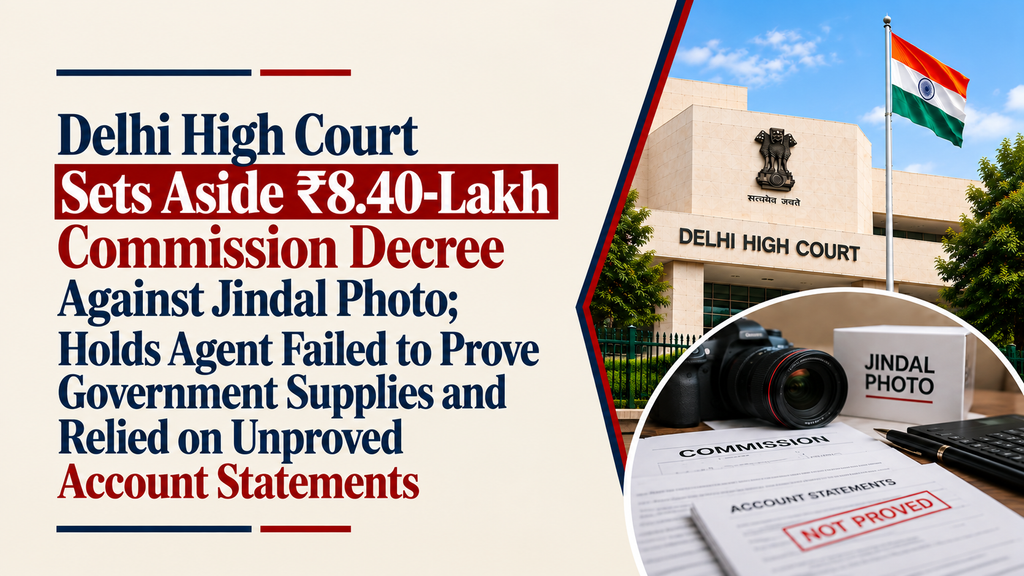
Delhi High Court Sets Aside ₹8.40-Lakh Commission Decree Against Jindal Photo; Holds Agent Failed to Prove Government Supplies and Relied on Unproved Account Statements

Delhi High Court Overturns ₹8.40-Lakh Recovery Against Jindal Photo; Finds Medical Agent Produced No Proof of Supplies Made to Government Departments
Facts
The appeal was filed by M/s Jindal Photo Ltd. under Section 96 CPC against the Trial Court judgment dated 28 September 2015, which had decreed the recovery suit filed by M/s Rays Medical Services (P) Ltd. for ₹8,40,982 along with 12% annual interest.
Jindal Photo was engaged in manufacturing photo films, including X-ray films. By letter dated 22 May 2003, it appointed Rays Medical as its agent for supplying X-ray films to government departments and institutions in Delhi on a commission basis. The agency was withheld on 26 March 2004 and subsequently restored on 27 September 2004.
Rays Medical issued a legal notice on 2 May 2007 claiming ₹8,40,982 toward commission and refund of security deposit. It ultimately instituted a suit claiming ₹12.20 lakh comprising commission, security deposit and 18% interest.
Jindal Photo denied liability and alleged that Rays Medical had committed malpractice by procuring goods in the names of government institutions and disposing of them in the open market at higher prices for personal gain.
The Trial Court nevertheless decreed ₹8,40,982 with 12% interest, leading to the present first appeal.
Issues
The principal questions before the High Court were:
- Whether Rays Medical had proved its entitlement to the claimed commission of ₹8,40,982.
- Whether its alleged malpractice disentitled it from receiving commission.
- Whether the Trial Court could rely upon statements of account not properly filed and proved in evidence.
- Whether substitution of Jindal Photo for its former Managing Director amounted merely to correction of misdescription or addition of a new defendant.
- Whether the limitation plea could be entertained for the first time in appeal.
Appellant’s Arguments
Jindal Photo argued that ₹4,06,229 of the claim was barred by limitation because the amount was allegedly due by 26 March 2004 whereas the suit was instituted only on 3 August 2007.
It further argued that the original suit was incorrectly filed against its former Managing Director, R.B. Paul, personally, and that the amendment substituting the company at the final-argument stage was impermissibly belated. It also invoked Section 21 of the Limitation Act to argue that the suit against the company should be treated as instituted only upon its substitution.
On merits, Jindal Photo attacked the plaintiff’s statement of account because it had not been filed with the plaint and was introduced only during cross-examination. Another statement was produced only at final arguments.
Most importantly, Jindal Photo relied upon admissions by Rays Medical’s witness that he could not produce documentary proof demonstrating that the goods for which commission was claimed had actually been supplied to government departments.
Respondent’s Arguments
Rays Medical contended that limitation had never been raised before the Trial Court and therefore could not be introduced for the first time in appeal.
It alternatively argued that dealings continued after restoration of its agency in September 2004 and correspondence concerning commission continued through 2005–2006.
On substitution, it maintained that replacing the former Managing Director with Jindal Photo merely corrected a misdescription and did not introduce a new defendant or cause of action.
It further argued that it functioned as a liaison/collection agent and was not independently responsible for physically supplying the goods. According to Rays Medical, Jindal Photo had not disputed that business was generated and payments were received.
Analysis of the Law
1. Burden of Proving the Recovery Claim Remained on the Plaintiff
The High Court emphasized that Rays Medical sought recovery of ₹8,40,982 and therefore bore the burden of proving that amount.
Although the plaint referred to a statement of account, the plaintiff inexplicably failed to file that statement either with the plaint or with its affidavit in evidence.
The defendant’s inability to prove its own statement of account could not relieve the plaintiff of its independent evidentiary burden.
The Court stated that the plaintiff “could not have succeeded merely on account of the inability of the defendant company to prove its statement of account.”
2. Documents Introduced During Cross-Examination Must Still Be Proved
The Court examined Order VII Rule 14 CPC and the decision in Subash Chander v. Bhagwan Yadav.
A document shown to an opposing witness during cross-examination does not automatically become substantive evidence for the party producing it.
The Court cautioned against parties attempting to introduce documents at the cross-examination stage which ought properly to have been filed earlier.
In the present case, the statement of account was an internal document belonging to Rays Medical. If the company intended to rely upon it, it ought to have filed and proved it in accordance with law.
The Trial Court therefore erred in exhibiting and relying upon that statement merely because it had been confronted to Jindal Photo’s witness during cross-examination.
3. Statement Produced at Final Arguments Was Also Inadmissible
A second detailed statement of account was produced by Rays Medical at the final-hearing stage.
The High Court found no Trial Court order permitting its filing or taking it on record.
Under Order VII Rule 14(3), a document which ought to have accompanied the plaint cannot subsequently be received in evidence without leave of the Court.
No such leave had been sought.
The document was not even formally exhibited, and Jindal Photo had no proper opportunity to respond to it.
The Trial Court’s reliance upon it was therefore held to be “completely erroneous.”
4. No Proof of Government Supplies
This became decisive.
Rays Medical’s witness admitted in cross-examination that he:
- could not produce proof of payment made by any government department to Jindal Photo;
- could not produce proof of delivery to government departments; and
- had no documentary evidence establishing supply of the goods for which commission was claimed.
The appointment documents showed that Rays Medical’s agency related specifically to X-ray film business with government/state institutions.
The contractual commission structure was linked to such government business.
Accordingly, if Rays Medical could not establish supplies to government bodies, it could not establish its contractual entitlement to commission.
The Court therefore rejected the Trial Court’s reasoning that restoration of the agency amounted to condonation of previous conduct and consequently entitled the agent to commission.
5. Substitution of Company Was Merely Correction of Misdescription
The High Court did not accept Jindal Photo’s objection regarding its substitution for the former Managing Director.
The Trial Court had already permitted the amendment, and that amendment order had not been independently challenged.
More importantly, the Court held that this was merely a correction of misdescription because the parties knew the actual dispute and had gone to trial with full knowledge.
Therefore, Section 21 of the Limitation Act did not apply as though a completely new defendant had been added.
6. Limitation Plea Not Considered for First Time in Appeal
The High Court noted that Jindal Photo had neither pleaded limitation in its written statement nor obtained an issue on limitation before the Trial Court.
The Court therefore declined to examine limitation for the first time at the appellate stage.
Precedent Analysis
The judgment referred to several authorities:
- Subash Chander v. Bhagwan Yadav, 2009 SCC OnLine Del 3818 — concerning documents introduced during cross-examination and the limits on subsequently proving such documents.
- Nikhila Divyang Mehta v. Hitesh P. Sanghvi — relied upon by Jindal Photo regarding limitation.
- Praveen Bethapudi v. Savithramma — relied upon concerning personal liability of company officers.
- Golesh Kumar v. Ganesh Dass Chawla Charitable Trust — relied upon regarding Section 21 of the Limitation Act.
- Brakewel Automotive Components v. P.R. Selvam Alagappan and Chitturi Subbanna v. Kudapa Subbanna — relied upon by Rays Medical concerning limitation and procedural objections.
- Pradeep Khanna v. Ashok Electric Company and Ashbee Systems Pvt. Ltd. v. Agauta Sugar & Chemicals — relied upon to support the argument that substitution merely corrected misdescription.
The decisive precedent was effectively Subash Chander, because the appeal turned substantially upon the improper introduction and proof of the plaintiff’s account statements.
Court’s Reasoning
The High Court’s reasoning rested on a straightforward evidentiary principle:
A plaintiff seeking a money decree must prove its own entitlement; weaknesses in the defendant’s evidence cannot substitute for proof of the plaintiff’s claim.
Rays Medical’s claim depended upon proving transactions generating commission.
Yet its principal account statements were either:
- improperly introduced during the defendant’s cross-examination; or
- produced only at final arguments without leave and without being formally proved.
More fundamentally, its own witness admitted that there was no documentary proof showing that the relevant goods had been supplied to government departments.
Since the contractual arrangement made commission payable for government business, this evidentiary failure went to the root of the claim.
The Trial Court therefore erred in decreeing the recovery suit.
Conclusion
The Delhi High Court allowed Jindal Photo’s challenge on the merits and held that Rays Medical failed to discharge the burden of proving its entitlement to the commission claimed.
The Court consequently set aside the Trial Court decree for ₹8,40,982 with 12% interest.
It further directed the Registry to refund to the appellant the decretal amount deposited pursuant to the interim order, together with accrued interest.
Case Details
Case: M/s Jindal Photo Ltd. v. M/s Rays Medical Services (P) Ltd.
Court: High Court of Delhi at New Delhi
Case Number: RFA 36/2016
CNR No.: DLHC016755742015
Judge: Justice Amit Bansal
Reserved on: 6 August 2026
Date: 3 September 2026
Original Decree: ₹8,40,982 with 12% interest
Result: Appeal allowed; Trial Court’s recovery decree set aside; deposited decretal amount directed to be refunded to Jindal Photo with accrued interest.