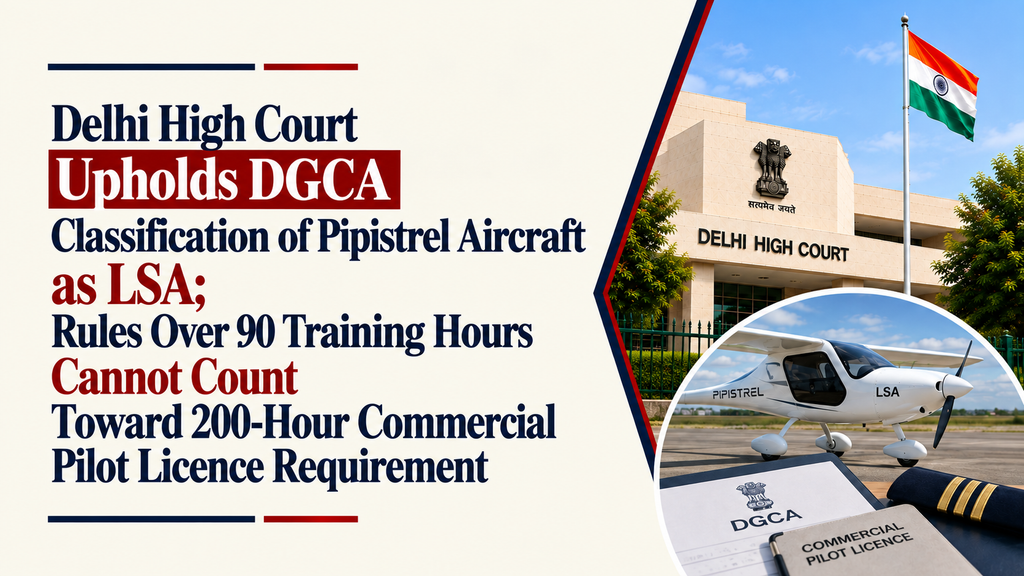
Delhi High Court Upholds DGCA Classification of Pipistrel Aircraft as LSA; Rules Over 90 Training Hours Cannot Count Toward 200-Hour Commercial Pilot Licence Requirement

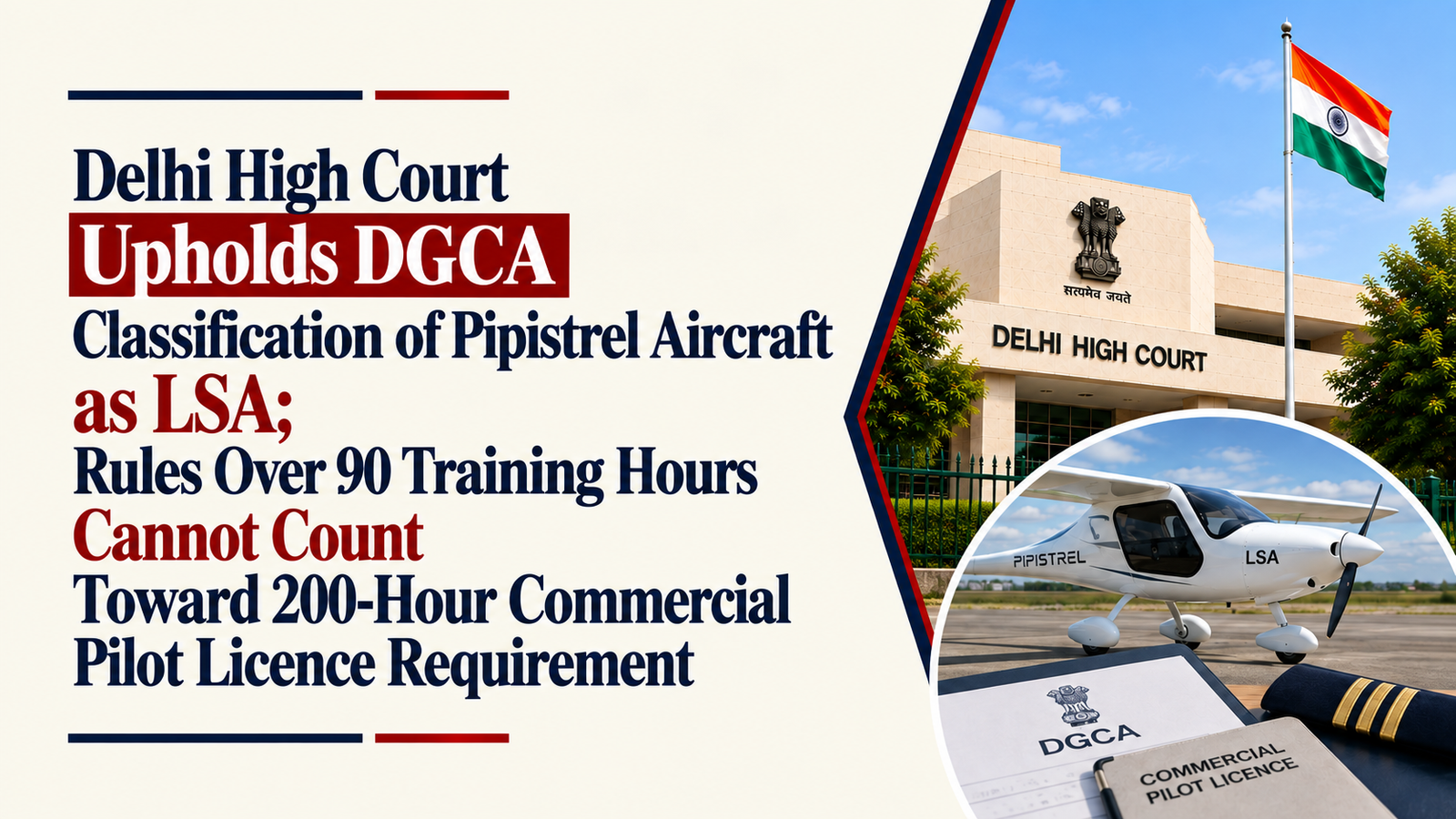
Delhi High Court Rejects Aviation Academy’s Challenge to Pipistrel Classification; Holds DGCA Entitled to Treat Aircraft as LSA for Commercial Pilot Licensing
Facts
The appeal was filed by Global Avianautics Limited against the Single Judge’s order dated 26 July 2024 in a writ petition concerning the classification of Pipistrel VIRUS SW 121 aircraft forming part of the fleet of the Government Aviation Training Institute (GATI).
Global Avianautics had been selected in 2007 for development of GATI into an aviation academy, followed by a Lease-Develop-Operate Agreement in 2008. The controversy subsequently arose concerning two Pipistrel aircraft imported for GATI’s training operations.
EASA had granted Type Certification to the Pipistrel in 2016. The certification basis used was CS-LSA. DGCA accepted the EASA Type Certification in November 2019.
Significantly, DGCA itself subsequently issued Certificates of Airworthiness for aircraft VT-DPA and VT-DPB in August and October 2022, recording their category as “Normal” and subdivision as “Passengers.”
However, in its 2023 list of approved Flying Training Organisations, DGCA reflected both Pipistrel aircraft in GATI’s fleet as belonging to the Light Sport Aircraft (LSA) category.
EASA thereafter informed DGCA on 2 August 2023 that the Pipistrel was categorised as a “Normal” aircraft and not an LSA under the European regulatory framework and requested correction of DGCA’s categorisation.
The dispute became critical for student pilots because DGCA eventually classified the Pipistrel as an LSA through its communication dated 26 February 2024 and refused CPLs to three GATI student pilots.
Issues
The Division Bench identified two central questions:
- Whether DGCA was justified in classifying the Pipistrel as a Light Sport Aircraft.
- Whether flying experience acquired by the student pilots on the Pipistrel could count toward the mandatory 200-hour aeroplane flying experience required for a Commercial Pilot Licence (CPL), despite the aircraft possessing valid Certificates of Airworthiness.
Appellant’s Arguments
Global Avianautics argued that the Single Judge had confused two technically and legally distinct concepts:
- certification basis; and
- airworthiness category.
According to the appellant, CS-LSA was merely the technical certification specification used by EASA. It did not mean that the aircraft itself belonged to the LSA airworthiness category.
The appellant relied heavily upon DGCA’s own earlier clarification stating that the aircraft was type certificated under the “Normal” Airworthiness category, with CS-LSA merely being the certification basis.
It also relied upon the two subsisting DGCA Certificates of Airworthiness which expressly recorded the aircraft as “Normal.”
The appellant further argued that “Normal” and “LSA” were mutually exclusive categories. According to it, DGCA could not effectively reclassify the aircraft as an LSA without first cancelling or revoking the existing Certificates of Airworthiness and following the prescribed statutory procedure.
It also relied on EASA’s communications expressly stating that the Pipistrel was a “Normal” aircraft and not an LSA.
The appellant additionally raised:
- legitimate expectation;
- natural justice;
- Articles 14, 19(1)(g) and 21;
- DGCA’s earlier conduct approving the aircraft;
- alleged technical errors concerning stall speed; and
- adverse career consequences for students whose flying hours were subsequently excluded.
DGCA’s Arguments
DGCA contended that EASA’s classification under the European regulatory framework did not determine the aircraft’s treatment under Indian pilot-licensing law.
According to DGCA, the relevant certification basis was CS-LSA, and acceptance of EASA’s Type Certificate did not prevent DGCA from independently applying Indian aviation legislation and licensing requirements.
DGCA further distinguished between:
- the aircraft’s airworthiness; and
- whether flying experience on that aircraft could legally count toward a CPL.
A Certificate of Airworthiness concerns whether an aircraft is safe to operate. It does not automatically determine whether hours flown on that aircraft qualify toward a particular pilot licence.
DGCA maintained that each of the student pilots had accumulated more than 90 hours on the Pipistrel. Those hours could not count toward the 200-hour aeroplane requirement for CPL eligibility.
Analysis of the Law
1. CS-LSA Certification Basis Was Legally Relevant
The Division Bench rejected the appellant’s contention that CS-LSA was merely an irrelevant technical standard.
The Court held that DGCA was entitled to consider the certification basis recorded in EASA’s Type Certificate Data Sheet while determining the regulatory consequences of flying experience under Indian licensing law.
Although EASA described the aircraft as “Normal” under European regulations, that did not prevent DGCA from considering the CS-LSA certification basis under India’s domestic licensing framework.
2. Certificate of Airworthiness Is Distinct From Licensing Eligibility
This is one of the judgment’s most important findings.
The Court held that a Certificate of Airworthiness concerns an aircraft’s fitness to operate safely.
Whether flying hours accumulated on that aircraft count toward a pilot licence is a separate issue governed by Schedule II to the Aircraft Rules.
Therefore, DGCA did not need to cancel or revoke the Pipistrel’s existing Certificates of Airworthiness before determining that its flying hours would receive LSA treatment for CPL purposes.
3. “Normal” and “LSA” Were Not Mutually Exclusive for Every Regulatory Purpose
The Court rejected the proposition that a “Normal” CoA necessarily prevented DGCA from applying LSA-related licensing consequences.
It held that the regulatory provisions relied upon by the appellant did not establish mutual exclusivity for all purposes.
4. GATI Had Notice of DGCA’s Position
The Court rejected GATI’s claim that it learned of the LSA classification only at a late stage.
The 2023 FTO List, published on 26 May 2023, expressly identified both Pipistrel aircraft as LSAs. GATI thereafter continued corresponding with DGCA while also continuing training operations.
5. EASA’s “Normal” Classification Did Not Bind DGCA
The Court held that EASA’s classification governed the aircraft under the European regulatory framework.
It did not bind DGCA while exercising independent statutory functions under Indian aviation law.
Likewise, Article 33 of the Chicago Convention did not require India to disregard its domestic pilot-licensing regime merely because a foreign authority had issued or recognised an airworthiness certificate.
6. No Estoppel Against DGCA
The appellant relied upon DGCA’s earlier conduct, including:
- maintenance approvals;
- training manual approvals;
- FTO status;
- aircraft rating extensions; and
- endorsement of Pipistrel on one pilot’s CPL.
The Court held that these acts could not create an estoppel against DGCA’s statutory regulatory functions.
An erroneous or inadvertent administrative act cannot create a vested right requiring an aviation regulator to perpetuate the error, particularly where public safety and licensing standards are involved.
7. Court Would Defer to DGCA on Technical Aviation Questions
The appellant challenged DGCA’s technical assessment concerning stall-speed parameters, including the distinction between “Vs0” and “Vs.”
The Division Bench refused to substitute its own technical assessment for that of DGCA.
It held that such matters fall squarely within the specialised domain of the aviation regulator. Judicial interference would be justified only where the technical determination was shown to be:
- perverse;
- mala fide;
- manifestly arbitrary; or
- contrary to the statutory framework.
None was established.
8. No Violation of Natural Justice
The Court rejected the contention that the February 2024 communication had been issued without notice or hearing.
GATI had been corresponding with DGCA since July 2023, attended a meeting in December 2023, submitted its objections and documents, and the issue was considered by an Expert Committee in January 2024.
Therefore, the impugned communication was effectively DGCA’s response to GATI’s own objections.
9. Legitimate Expectation Cannot Override Aviation Safety Regulation
The appellant’s legitimate expectation argument was also rejected.
The Court held that even where legitimate expectation exists, it cannot fetter a regulator’s duty to correctly apply licensing and safety standards.
The Court placed particular emphasis on the public interest involved in ensuring the competence of prospective commercial pilots.
10. DGCA Is the Expert Statutory Regulator
The Court ultimately held that DGCA’s power to classify and periodically reassess aircraft involved specialised technical considerations.
A writ court should interfere only where the regulatory determination is manifestly arbitrary, perverse, mala fide or contrary to law.
No such infirmity was demonstrated.
Commercial Pilot Licence Issue
Under Section J of Schedule II to the Aircraft Rules, a CPL applicant must establish 200 hours of flying experience on aeroplanes.
Each of the three student pilots had accumulated more than 90 hours on the Pipistrel.
Once the Pipistrel was validly treated as an LSA, those hours could not count toward the 200-hour aeroplane-experience requirement.
The Court noted a limited statutory exception allowing a maximum of 20 hours of solo LSA flying to count toward a Private Pilot Licence, but not toward a CPL.
Consequently, the students lacked the requisite 200 hours of reckonable aeroplane flying experience, and DGCA’s rejection of their CPL applications was legally valid.
Precedent / Principle Analysis
Unlike many constitutional or administrative-law judgments, the Court’s analysis here was driven principally by the governing Aircraft Rules, CAR framework, EASA certification material, DGCA-EASA Working Arrangement and Chicago Convention, rather than by an extended discussion of judicial precedents.
The principal legal doctrines applied were:
- courts ordinarily defer to expert statutory regulators on specialised technical matters;
- no estoppel can compel a statutory authority to perpetuate an administrative error;
- legitimate expectation cannot override statutory licensing and safety requirements;
- foreign certification does not displace India’s domestic regulatory regime; and
- airworthiness certification and pilot-licensing eligibility are legally distinct questions.
Court’s Reasoning
The central distinction underlying the judgment is:
An aircraft may possess a valid Certificate of Airworthiness and still not generate flying hours that qualify toward every category of pilot licence.
The Court accepted DGCA’s view that the Pipistrel’s CS-LSA certification basis was relevant for determining the licensing treatment of flying experience.
EASA’s description of the aircraft as “Normal” did not bind DGCA for Indian licensing purposes.
Further, DGCA’s earlier approvals and even endorsement of the Pipistrel on another pilot’s CPL could not compel it to repeat what it considered an erroneous regulatory treatment.
Since each student had more than 90 hours on the Pipistrel, exclusion of those hours left them short of the mandatory 200 hours required for CPL eligibility.
Conclusion
The Delhi High Court held that:
- DGCA was justified in classifying the Pipistrel as an LSA;
- the classification was neither arbitrary nor contrary to the statutory framework;
- the valid Certificates of Airworthiness did not compel DGCA to count Pipistrel hours toward CPL requirements;
- flying hours acquired on the Pipistrel could not satisfy the 200-hour aeroplane-experience requirement;
- the three student pilots therefore lacked sufficient reckonable flying experience; and
- their CPL rejection orders were legally sustainable.
Accordingly, the Division Bench found no infirmity in the Single Judge’s decision and dismissed the appeal with no order as to costs.
Case Details
Case: Global Avianautics Limited v. Directorate General of Civil Aviation & Ors.
Court: High Court of Delhi at New Delhi
Case Number: LPA 680/2025 & CM APPL. 69961/2025
Bench: Chief Justice Devendra Kumar Upadhyaya and Justice Tejas Karia
Judgment by: Justice Tejas Karia
Reserved on: 25 August 2026
Date: 3 September 2026
Aircraft: Pipistrel VIRUS SW 121
Registration Marks: VT-DPA and VT-DPB
Core Issue: Whether Pipistrel could be classified as LSA and whether flying hours on it could count toward the 200-hour CPL requirement
Result: Appeal dismissed; DGCA’s LSA classification upheld; flying experience on Pipistrel held ineligible toward the 200-hour CPL aeroplane-experience requirement; rejection of student pilots’ CPL applications upheld; no costs.