

HEADNOTE
Mangtu v. Commissioner of Police & Ors.
Court: Delhi High Court
Jurisdiction: Writ Jurisdiction (Article 226)
Bench: Justices Navin Chawla & Madhu Jain
Date of Judgment: December 11, 2025
Citation: W.P.(C) 18796/2025 (Delhi High Court)
Laws / Rules Involved: Central Administrative Tribunal Act, 1985; Service jurisprudence principles; APAR rules
Keywords: CAT order challenge, disciplinary proceedings, APAR adverse entry, costs on officers, Delhi Police service law
Summary
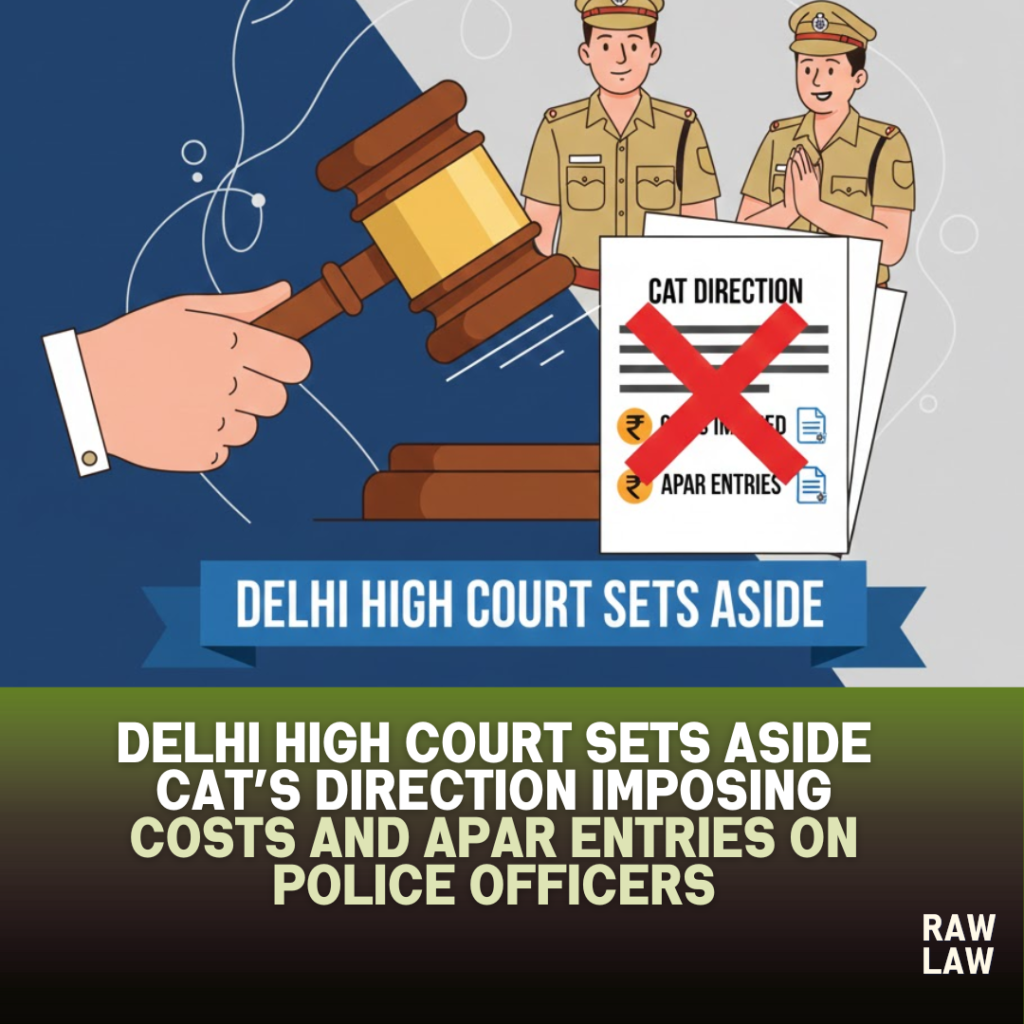
The Delhi High Court partly allowed a writ petition filed by the Commissioner of Police and others, setting aside the Central Administrative Tribunal’s direction imposing personal costs and adverse APAR entries on senior police officers. While the High Court left untouched the substantive relief granted by the Tribunal in favour of HC Mangtu—quashing disciplinary and appellate orders and granting consequential benefits—it held that no mala fides were attributable to the officers concerned, and therefore the Tribunal exceeded its jurisdiction in imposing punitive directions against them. The Court confined its interference strictly to Paragraph 34(v) of the Tribunal’s order, which had directed payment of ₹50,000 each as costs and recording of adverse APAR remarks, and disposed of the writ petition accordingly.
Court’s decision
The Delhi High Court allowed the writ petition to a limited extent, setting aside only Paragraph 34(v) of the Central Administrative Tribunal’s order dated April 16, 2025. The Court held that the Tribunal’s directions imposing personal costs on respondent officers and mandating adverse APAR entries were unsustainable in the absence of any finding of mala fides. All other directions of the Tribunal, which had already been complied with, were left undisturbed.
Facts
HC Mangtu, a Delhi Police official, had approached the Central Administrative Tribunal challenging disciplinary and appellate orders passed against him. The Tribunal partly allowed his Original Application, quashing the disciplinary orders and granting consequential benefits. In addition, the Tribunal imposed costs of ₹50,000 each on two senior officers, directed payment to the Prime Minister’s Relief Fund, and ordered that their alleged inaction be recorded adversely in their APARs for the year 2025–26. Aggrieved only by these punitive directions, the Commissioner of Police and other authorities approached the Delhi High Court.
Issues
Whether the Central Administrative Tribunal was justified in imposing personal costs and directing adverse APAR entries against senior police officers in the absence of any finding of mala fides or deliberate misconduct.
Petitioners’ arguments
The petitioners contended that while they had complied with the substantive directions of the Tribunal, the additional punitive directions were wholly unwarranted. It was argued that no mala fides were attributed or established against the officers, and that the Tribunal exceeded its jurisdiction by issuing directions affecting service records and imposing personal monetary liability without legal basis.
Respondent’s arguments
The respondent, appearing in person, did not dispute that the substantive directions of the Tribunal had been complied with. He opposed interference with the Tribunal’s order but did not controvert the limited nature of the challenge mounted by the petitioners.
Analysis of the law
The Court examined the scope of judicial and quasi-judicial powers of the Tribunal and reiterated that punitive directions against officers require a clear finding of mala fides or deliberate abuse of authority. In the absence of such findings, directions affecting APARs or imposing personal costs cannot be sustained merely on the basis of perceived administrative lapses.
Precedent analysis
The Court noted the Tribunal’s reliance on an earlier Delhi High Court judgment in Commissioner of Police v. Om Prakash (2014), but held that such reliance did not justify punitive directions in the present case, where factual circumstances did not disclose mala fide conduct or willful disobedience by the officers.
Court’s reasoning
The Bench found that the Tribunal itself had not recorded any finding of mala fides against respondent officers Nos. 2 and 3. In such circumstances, directing personal costs and adverse APAR remarks was disproportionate and legally unsustainable. The Court therefore confined its interference strictly to the impugned paragraph, ensuring that the relief granted to the employee remained unaffected.
Conclusion
The Delhi High Court set aside Paragraph 34(v) of the Tribunal’s order imposing costs and adverse APAR directions, while affirming the remaining reliefs granted to the respondent employee. The writ petition and connected application were disposed of accordingly.
Implications
This judgment draws a clear boundary on the limits of the Central Administrative Tribunal’s powers in issuing punitive directions against government officers. It reinforces that adverse service record entries and personal costs cannot be imposed in the absence of proven mala fides, while simultaneously respecting and preserving employee-centric reliefs granted on merits.
Case law references
• Commissioner of Police & Ors. v. Om Prakash & Anr. (Delhi High Court, 2014)
Holding: Administrative inaction may invite judicial scrutiny, but punitive consequences require clear justification.
Application: Distinguished; absence of mala fides led to setting aside punitive directions.
FAQs
Q1. Did the Delhi High Court overturn the CAT’s relief to the employee?
No. The substantive relief granted to HC Mangtu was left untouched.
Q2. Why were the costs and APAR directions set aside?
Because no mala fides were attributed to the officers, making punitive directions unsustainable.
Q3. What is the significance of this ruling?
It limits tribunals from imposing personal penalties on officers without clear findings of misconduct.
Also Read: Bombay High Court: Arbitral award by unilaterally appointed arbitrator void even at execution stage


