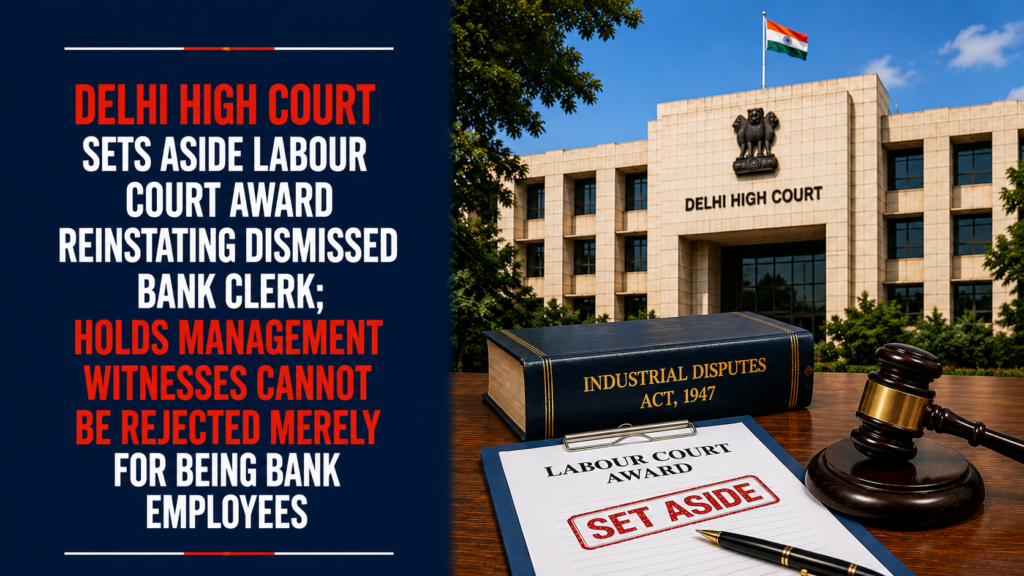
Delhi High Court Sets Aside Labour Court Award Reinstating Dismissed Bank Clerk; Holds Management Witnesses Cannot Be Rejected Merely for Being Bank Employees

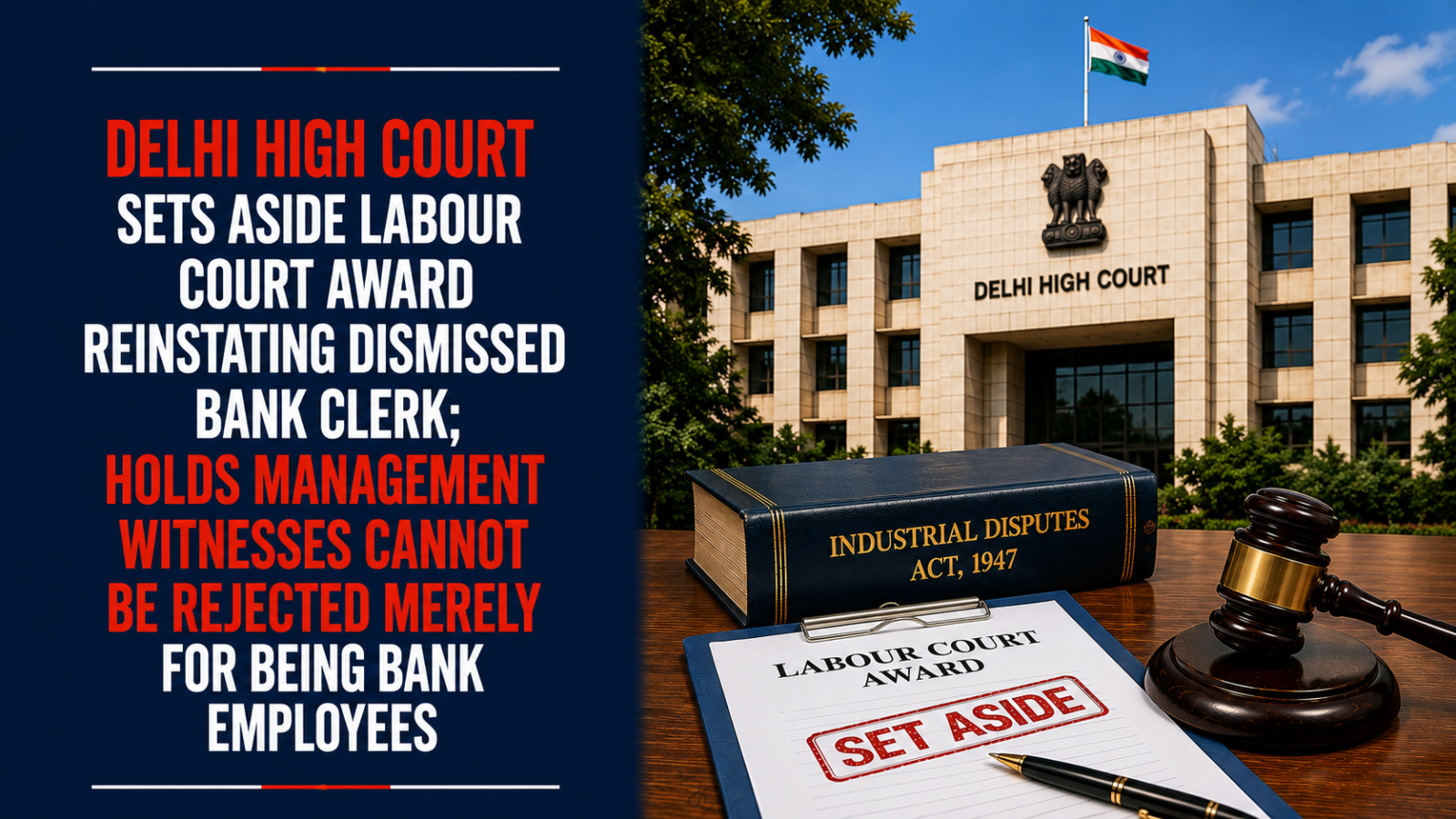
Management Witnesses Cannot Be Disbelieved Merely Because They Are Employer’s Employees, Holds Delhi High Court
Facts
The respondent joined Federal Bank Ltd. as a Clerk in 1998. In 2001, two charge sheets were issued against him alleging (i) misconduct arising out of an altercation with senior officers inside the branch and (ii) facilitating the opening of savings bank accounts allegedly involving impersonation and fraudulent transactions. Following a domestic enquiry, the respondent was dismissed from service on 10 August 2002, and his departmental appeal was rejected.
The respondent thereafter raised an industrial dispute. The Central Government Industrial Tribunal (CGIT) first held that the domestic enquiry was unfair and vitiated, but permitted the Bank to independently prove the charges before the Tribunal. After recording fresh evidence, the Tribunal concluded that the Bank had failed to establish the misconduct and directed reinstatement with continuity of service, consequential benefits and full back wages. Aggrieved thereby, the Bank filed the present writ petition before the Delhi High Court.
Issues
- Whether the Labour Court correctly appreciated the evidence led by the Bank after holding the domestic enquiry to be vitiated.
- Whether the Tribunal erred in rejecting the testimony of management witnesses merely because they were Bank officials.
- Whether departmental misconduct was assessed by applying an incorrect standard akin to proof required in criminal proceedings.
- Whether the award directing reinstatement with full back wages was legally sustainable.
Petitioner’s Arguments
The Bank contended that:
- the Tribunal wrongly rejected the testimony of Bank officials solely because they were management witnesses;
- both management witnesses were natural witnesses to the alleged incidents and their evidence could not be discarded merely due to their employment with the Bank;
- the Tribunal incorrectly treated the allegations relating to fraudulent bank accounts as though the Bank was required to prove criminal offences of forgery and cheating;
- allegations of victimisation were neither specifically pleaded nor proved;
- the domestic enquiry had been conducted fairly in accordance with principles of natural justice; and
- reinstatement with continuity of service and full back wages was granted mechanically without proof that the respondent remained unemployed.
Respondent’s Arguments
The respondent argued that:
- the writ petition merely sought re-appreciation of evidence, which is impermissible under Articles 226 and 227;
- the Bank had accepted the Tribunal’s earlier order declaring the domestic enquiry vitiated and, after leading fresh evidence before the Tribunal, could not subsequently challenge that finding;
- the Tribunal had correctly appreciated the evidence and found that the Bank failed to independently prove either charge;
- victimisation was established from the surrounding circumstances; and
- once the dismissal was found illegal, reinstatement with consequential benefits naturally followed.
Analysis of the Law
The High Court examined:
- the principles governing domestic disciplinary enquiries;
- the distinction between fairness of an enquiry and proof of misconduct;
- the evidentiary standard applicable in departmental proceedings;
- the limited scope of judicial review over Labour Court awards under Articles 226 and 227.
The Court reiterated that departmental proceedings are not governed by the strict rules applicable to criminal trials. The employer must provide a fair opportunity to defend, while the charges need only be established on the preponderance of probabilities, rather than beyond reasonable doubt. The Court also emphasised that fairness of procedure and sufficiency of evidence are separate legal inquiries which should not be conflated.
Precedent Analysis
The Court relied upon:
- Sur Enamel and Stamping Works Ltd. v. Workmen — essential requirements of a fair domestic enquiry.
- State of Haryana v. Rattan Singh — departmental enquiries are not governed by strict rules of the Evidence Act and management witnesses cannot be discarded merely because they are employer’s employees.
- Chandravarkar Sita Ratna Rao v. Ashalata S. Guram — scope of judicial review.
- G.M., ONGC v. ONGC Contractual Workers Union — limits on re-appreciation of evidence in writ jurisdiction.
The Court distinguished the principles applicable to criminal trials from those governing disciplinary proceedings and reiterated that proof in departmental proceedings rests on the preponderance of probabilities rather than proof beyond reasonable doubt.
Court’s Reasoning
The High Court observed that although the Bank could no longer challenge the Tribunal’s earlier order declaring the domestic enquiry vitiated—having accepted that order and proceeded to lead fresh evidence—it was nevertheless entitled to challenge the final award based on errors in appreciation of evidence.
The Court held that the Tribunal committed serious legal errors by:
- rejecting management witnesses merely because they were officers of the Bank;
- treating the absence of independent witnesses as virtually fatal to the Bank’s case;
- applying standards appropriate to criminal prosecutions while assessing departmental misconduct involving alleged fraudulent bank accounts; and
- conflating the concepts of fairness of the enquiry and proof of the charges.
The Court clarified that the evidence of employer’s witnesses must be assessed on its intrinsic credibility and cannot be rejected solely because they are employees of the management. Likewise, absence of independent witnesses or a short delay in lodging complaints may affect the weight of evidence but cannot automatically invalidate the employer’s case.
Since the Tribunal had applied incorrect legal standards while appreciating the evidence, the award directing reinstatement and consequential benefits could not be sustained. However, the High Court declined to itself determine whether the respondent was guilty of misconduct, holding that such factual assessment should first be undertaken by the Tribunal applying the correct legal principles.
Conclusion
The Delhi High Court allowed the writ petition and set aside the Labour Court’s award directing reinstatement with continuity of service, consequential benefits and full back wages. The matter was remanded to the Central Government Industrial Tribunal for fresh adjudication, directing it to reassess the evidence in accordance with the correct principles governing departmental enquiries without treating management witnesses as inherently unreliable merely because they were Bank employees. The Tribunal was also requested to dispose of the reference expeditiously, preferably within six months.
Case Details
Case: Federal Bank Ltd. v. Vikas Gupta
Court: Delhi High Court
Case Number: W.P.(C) 10502/2017
Judge: Justice Shail Jain
Date: 4 August 2026
Result: Writ petition allowed. The Labour Court’s award directing reinstatement was set aside, and the industrial dispute was remanded to the Central Government Industrial Tribunal for fresh adjudication in accordance with law.