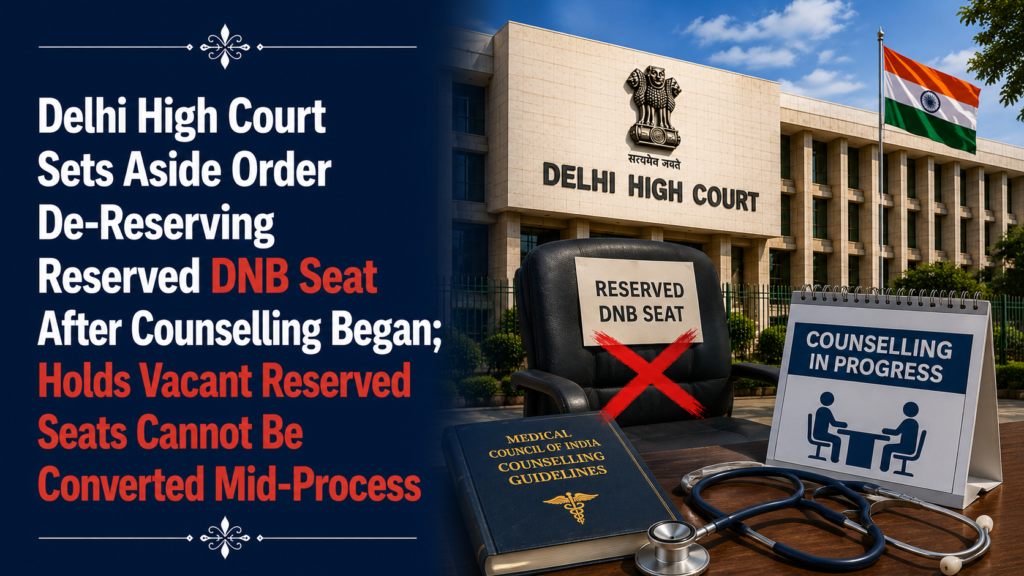
Delhi High Court Sets Aside Order De-Reserving Reserved DNB Seat After Counselling Began; Holds Vacant Reserved Seats Cannot Be Converted Mid-Process.

Vacant OBC DNB Seat Cannot Be Converted to General Category Midway Through Admission Process, Rules Delhi High Court.
Facts
Dr. Aditi Panwar, an unreserved category candidate, qualified the DNB Post Diploma Centralised Entrance Test (DNB PDCET), 2025 and secured 142nd rank in Radio-Diagnosis.
The seat matrix published by the National Board of Examinations in Medical Sciences (NBEMS) showed one Radiodiagnosis seat at General Hospital, Panchkula reserved for an OBC candidate. According to the petitioner, no OBC candidate had qualified in that specialty and the seat had remained vacant for several years. She nevertheless exercised her preference for that seat but was instead allotted another institution (IVY Health and Life Science, Punjab), while the Panchkula seat remained vacant.
She filed a writ petition seeking de-reservation of the OBC seat and its conversion into an unreserved seat. The Single Judge allowed the petition and directed NBEMS to convert the seat into an unreserved category seat and allot it according to merit. NBEMS filed an intra-court appeal, resulting in a split verdict before a Division Bench. The matter was consequently referred for decision on whether the Single Judge’s direction for de-reservation was legally sustainable.
Issues
The Delhi High Court considered:
- Whether a reserved DNB seat can be directed to be de-reserved after the counselling process has commenced merely because no reserved category candidate qualified.
- Whether an unreserved category candidate can claim admission against a reserved seat remaining vacant during counselling.
- Whether the Single Judge was justified in directing de-reservation of the OBC seat after publication of the seat matrix.
Appellant’s Arguments
NBEMS contended that Clause 4.6 of the counselling handbook expressly prohibited conversion of vacant reserved seats into another category during the admission process.
It argued that reservation of seats was determined by the State Government and NBEMS possessed no authority to de-reserve seats once the admission process had begun. Mere vacancy of a reserved seat could not justify its conversion into an unreserved seat.
NBEMS further relied upon the decision of its 15th Accreditation Committee dated 9 August 2024, under which unfilled Post Diploma DNB seats would be transferred to the three-year Post MBBS DNB course, thereby ensuring that the seat would not ultimately go waste.
Respondent’s Arguments
The writ petitioner argued that since no OBC candidate had qualified in Radiodiagnosis, the reserved seat was bound to remain vacant and valuable national educational resources would be wasted.
She contended that de-reservation would serve the larger public interest by ensuring utilisation of available medical seats and relied upon judicial precedents emphasising that vacant educational seats should ordinarily not remain unfilled.
It was also argued that the internal decision of the Accreditation Committee had never been incorporated into the published counselling handbook and therefore could not defeat her claim.
Analysis of the Law
The Court recognised that although preventing wastage of educational seats is an important consideration, reservation principles cannot be altered after the admission process has commenced.
The Court observed that once the seat matrix is published and candidates exercise their preferences based upon that published matrix, subsequent de-reservation may seriously prejudice more meritorious candidates who never opted for a seat because it was shown as reserved.
The Court also distinguished between the possibility of de-reservation before counselling and judicial directions requiring mid-process de-reservation, holding that the latter may produce inequitable consequences and disturb the fairness of the admission process.
The Court further noted that the counselling handbook functions as a procedural guide and cannot override the larger statutory admission framework.
Precedent Analysis
The petitioner relied upon the Himachal Pradesh High Court decision in Archana Thakur v. State of Himachal Pradesh, which emphasised that vacant educational seats represent wastage of national resources.
The Court, however, balanced that principle against the competing requirement of fairness in admissions, observing that de-reservation after counselling begins may unfairly advantage candidates who opted for seats not originally available to them while disadvantaging higher-ranked candidates who never had the opportunity to compete for those seats.
The Court also recognised that de-reservation remains an executive function requiring appropriate approval from the concerned State authorities.
Court’s Reasoning
The Court held that the respondent, being an unreserved category candidate, could not legitimately claim admission against a seat specifically reserved for an OBC candidate after publication of the seat matrix.
It observed that permitting de-reservation after candidates had already exercised their preferences would create serious inequality because several more meritorious candidates might have preferred the Government Hospital at Panchkula had the seat originally been shown as unreserved. Granting admission to the writ petitioner would therefore reward a candidate merely because she opted for a seat that was never legally available to her category.
The Court also accepted NBEMS’s submission that the seat would not ultimately remain wasted because the Accreditation Committee had already decided that such unfilled seats would shift to the three-year DNB programme.
However, the Court criticised NBEMS for failing to anticipate situations where no reserved category candidate qualifies in a specialty. It held that NBEMS should, in future, obtain necessary approval from the concerned State Government to de-reserve such seats before publication of the final seat matrix, so that deserving open category candidates may compete fairly during counselling itself.
The Court clarified that although courts are not absolutely barred from directing de-reservation in appropriate circumstances, no such direction should ordinarily be issued after candidates have filled their preferences and counselling has commenced.
Conclusion
The Delhi High Court allowed NBEMS’s appeal and set aside the Single Judge’s direction directing de-reservation of the OBC Radiodiagnosis seat.
The Court held that an unreserved candidate cannot claim admission against a reserved seat after the admission process has begun merely because the seat remains vacant. At the same time, it directed NBEMS to evolve a mechanism whereby, if reserved category candidates do not qualify in a particular specialty, timely de-reservation may be undertaken with State approval before publication of the seat matrix to prevent future wastage of seats.
Case Details
Case: National Board of Examinations in Medical Sciences v. Dr. Aditi Panwar & Others
Court: High Court of Delhi
Case Number: LPA 438 of 2025
Judge: Justice Dinesh Mehta (answering the reference)
Date: 29 July 2026
Result: The appeal was allowed. The Delhi High Court held that reserved DNB seats cannot ordinarily be de-reserved after publication of the seat matrix and commencement of counselling, though it directed NBEMS to formulate a future mechanism for timely de-reservation before counselling where reserved seats are likely to remain unfilled.