

Court’s decision
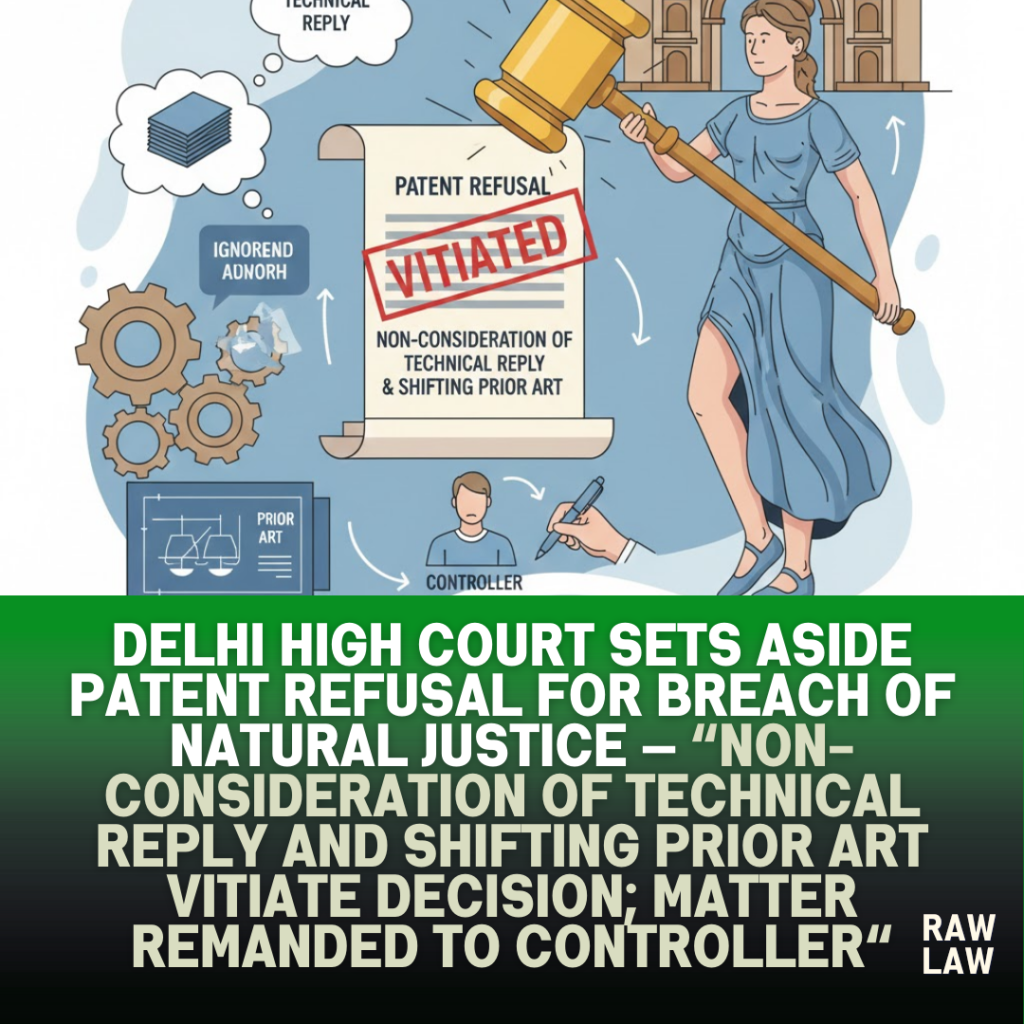
The Delhi High Court allowed an appeal under the Patents Act and set aside the Controller’s order refusing a patent application on the ground of lack of inventive step, holding that the decision was vitiated by violation of principles of natural justice, non-application of mind, and failure to consider detailed technical submissions made by the applicant. The Court ruled that when new prior art is introduced at the hearing stage, the applicant’s comprehensive response must be meaningfully examined — mechanical rejection cannot stand; refusal order quashed and matter remanded.
Court’s decision
Justice Tushar Rao Gedela held that the impugned refusal dated 07.10.2020 suffered from patent infirmities, including complete non-consideration of a crucial technical response filed by the applicant and inconsistency in identifying the “closest prior art.” The Court remanded the patent application for fresh consideration, directing that the applicant be granted a proper hearing and that the Controller decide the matter afresh in accordance with law, uninfluenced by earlier observations.
Facts
The appellant filed a patent application in April 2018 titled “A Comforter System Having an Application in Conjunction with a Supporter.” The invention related to a highly customisable therapeutic comforter system capable of providing independent, adjustable support to different parts of the human body, addressing issues such as backache, cervical pain, spinal disorders, and posture-related ailments across varied settings like beds, chairs, vehicles, and medical facilities.
After publication, the First Examination Report raised objections on novelty and inventive step based on two prior art documents. The appellant filed a detailed response. Subsequently, at the hearing stage, the Patent Office introduced additional prior art documents not cited earlier and, after two hearings, refused the application solely on the ground that the requirement of inventive step under Section 2(1)(ja) of the Patents Act was not met. This refusal led to the present appeal.
Issues
The primary issues before the High Court were whether the Controller could refuse a patent application without considering a detailed technical reply filed by the applicant, particularly when new prior art was introduced at the hearing stage, and whether such refusal violated principles of natural justice. The Court also examined whether inconsistency in identifying the closest prior art and failure to engage with claim-specific technical distinctions rendered the refusal order unsustainable.
Appellant’s arguments
The appellant argued that the refusal order was passed in a mechanical manner without application of mind and in blatant violation of natural justice. It was contended that while the First Examination Report relied on two prior art documents, the hearing notice introduced three additional prior art documents for the first time. The appellant had filed a comprehensive technical response addressing these new documents, but the Controller failed to consider it at all.
The appellant further submitted that the impugned order inconsistently treated different prior art documents as the “closest prior art” at different stages, demonstrating lack of analytical coherence. It was urged that the refusal be set aside and the matter remanded for proper reconsideration.
Respondent’s arguments
The Controller General opposed the appeal, asserting that adequate opportunities of hearing were granted and that the Controller had complied with statutory requirements. It was argued that there is no statutory mandate for issuing a second examination report and that the Controller was entitled to consider additional prior art at the hearing stage. The respondent contended that the impugned order reflected due consideration of the applicant’s submissions and that the invention lacked inventive step in view of the cited prior art.
Analysis of the law
The Court analysed the patent examination framework under the Patents Act, particularly the quasi-judicial nature of the Controller’s functions. It reiterated that refusal of a patent application must be preceded by meaningful consideration of the applicant’s responses, especially when new objections or prior art are introduced beyond the First Examination Report. Procedural fairness, the Court held, is integral to patent adjudication, and applicants must have a real opportunity to meet all objections in a consolidated and reasoned manner.
Precedent analysis
While not relying on specific case citations, the Court applied settled administrative law principles governing natural justice and reasoned decision-making. It reaffirmed that non-consideration of relevant material placed on record constitutes a jurisdictional error and that quasi-judicial authorities must demonstrate, through their orders, that submissions have been duly evaluated rather than merely acknowledged.
Court’s reasoning
The Court found that the impugned order made only a passing reference to the appellant’s reply while completely failing to analyse the detailed technical response filed after the first hearing notice. This response directly addressed the additional prior art documents relied upon for refusal. The Court also noted a fundamental inconsistency: while the First Examination Report identified one document as the closest prior art, the refusal order relied on a different document without explanation.
The Court further observed factual errors in the Controller’s understanding of the cited prior art, particularly regarding the rearrangement and spatial configuration of compartments, which went to the heart of the inventive step analysis. These deficiencies cumulatively rendered the refusal order unsustainable.
Conclusion
Allowing the appeal, the Delhi High Court set aside the refusal order dated 07.10.2020 and remanded the patent application to the Controller for fresh consideration. The Court clarified that it had not examined the merits of patentability and directed that the application be decided afresh, in accordance with law, after granting the appellant a proper hearing.
Implications
This judgment reinforces procedural discipline in patent examination and underscores that patent refusals cannot rest on cursory or selective consideration of the record. It sends a clear message that when patent offices rely on additional prior art or technical grounds, applicants’ detailed responses must be substantively addressed. The ruling strengthens transparency and fairness in India’s patent adjudication process and will guide future Controller decisions.
Case law references
- Natural justice in patent refusal: Non-consideration of detailed technical replies vitiates refusal orders. Applied to set aside the Controller’s decision.
- Consistency in prior art analysis: Shifting identification of closest prior art without reasoning reflects non-application of mind. Applied to hold refusal unsustainable.
- Quasi-judicial duty of Controller: Patent authorities must pass reasoned orders demonstrating evaluation of submissions. Applied to remand the matter.
FAQs
1. Can a patent be refused without considering all technical replies filed by the applicant?
No. Failure to consider detailed technical responses, especially to newly introduced prior art, violates principles of natural justice.
2. Is the Controller required to follow procedural fairness during patent examination?
Yes. Patent examination is a quasi-judicial process, and applicants must be given a meaningful opportunity to meet all objections.
3. Does remand mean the patent is granted?
No. Remand only requires fresh consideration. The Controller must decide patentability afresh in accordance with law.


