


Court’s decision
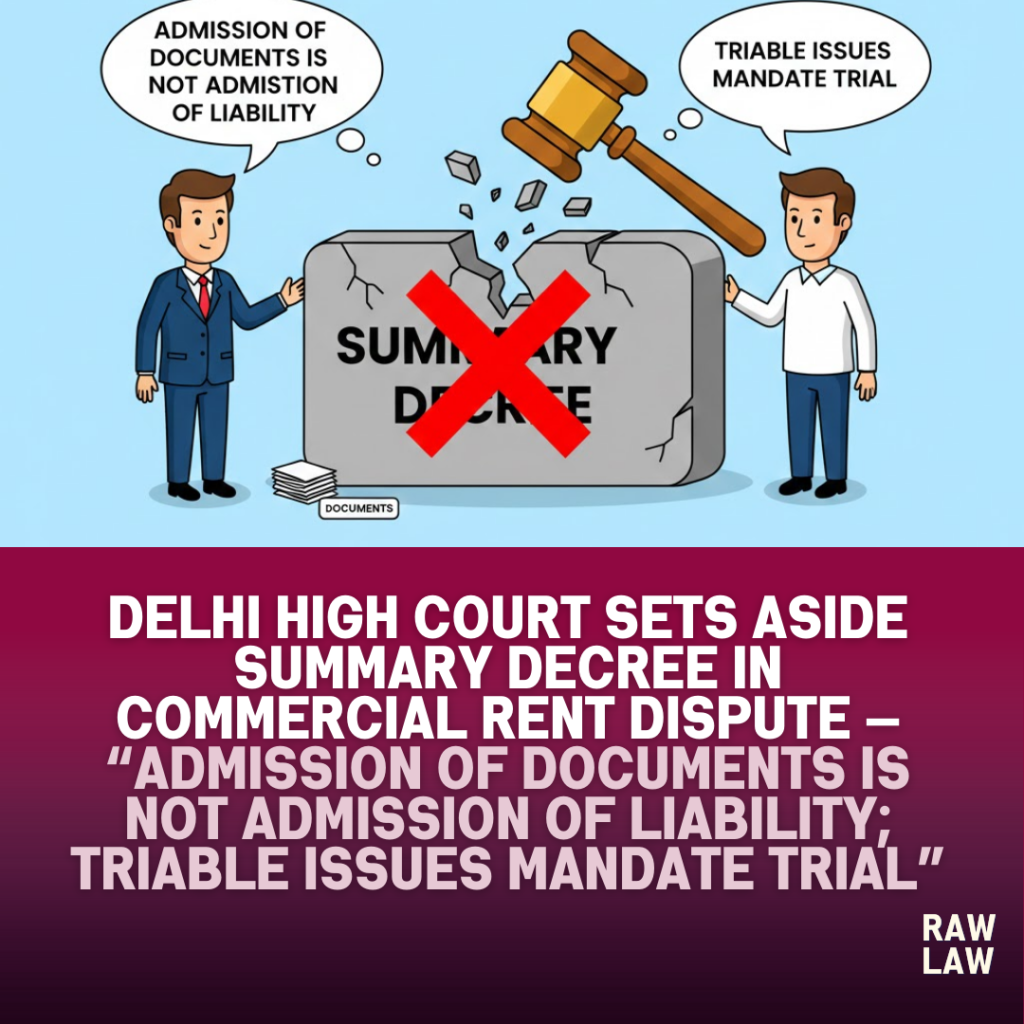
The Delhi High Court allowed a commercial appeal and set aside a summary judgment passed by the Commercial Court under Order XIII-A of the Code of Civil Procedure, 1908. The Court held that the Commercial Court had exceeded its limited jurisdiction by decreeing a recovery suit without trial, despite the existence of serious and bona fide disputes relating to subsistence of contractual obligations, termination of tenancy, offer and refusal of possession, and liability to pay rent and consultancy charges. It ruled that admission of contractual documents does not amount to admission of liability, and where triable issues exist, summary judgment is impermissible.
Facts
The dispute arose out of a commercial tenancy at Barakhamba Road, New Delhi. The appellant company was inducted as a tenant under a registered lease deed for a fixed term of nine years. Following earlier litigation between the parties over arrears, the disputes were resolved through mediation, leading to execution of a supplementary lease deed which reduced rent. Simultaneously, a separate consultancy agreement was executed under which monthly consultancy fees were payable. The parties expressly agreed that the supplementary lease deed and consultancy agreement would be co-terminus.
Both agreements admittedly expired by efflux of time on 30 June 2018. Nevertheless, the tenant continued in occupation and paid rent and consultancy charges till early 2020. Upon the outbreak of the COVID-19 pandemic, the tenant sought waiver of rent citing non-usability of premises. This request was rejected, after which the tenant expressed its intention to vacate and offered to hand over possession. Physical possession was ultimately handed over in February 2021, with disputes regarding rent, consultancy charges, and adjustment of security deposit being kept open. The landlords thereafter instituted a commercial suit seeking recovery of dues.
Issues
The core issue before the High Court was whether the Commercial Court was justified in exercising summary judgment jurisdiction under Order XIII-A of the CPC. Specifically, the Court had to examine whether the tenant had “no real prospect” of defending the claim and whether there was “no other compelling reason” for the matter to proceed to trial, as required under Rule 3 of Order XIII-A. Ancillary issues related to subsistence of rent liability after offer of possession, continuation of consultancy obligations beyond contractual term, and entitlement to interest.
Appellant’s arguments
The appellant contended that the Commercial Court fundamentally misconstrued the scope of Order XIII-A. It was argued that while documents such as the lease deed and consultancy agreement were admitted, the liabilities flowing from them were vigorously disputed. The appellant emphasized that its defence raised substantial questions concerning termination of contractual relationships by efflux of time, cessation of rent liability after offering possession, refusal by the landlords to accept possession, and non-rendering of consultancy services.
It was further submitted that the Commercial Court wrongly assumed that mere existence of agreements automatically established liability. According to the appellant, the disputes involved mixed questions of fact and law which could only be adjudicated after framing of issues and recording of evidence, rendering summary disposal legally unsustainable.
Respondents’ arguments
The respondents supported the summary decree, arguing that the foundational contractual documents and communications stood admitted. They contended that the tenant continued in possession till February 2021 and had, therefore, remained liable to pay rent and consultancy charges for the intervening period. It was submitted that the defence raised was illusory and did not disclose any real prospect of success, justifying the Commercial Court’s decision to bypass trial and decree the suit.
Analysis of the law
The High Court undertook a detailed examination of Order XIII-A of the CPC, introduced by the Commercial Courts Act to enable expeditious disposal of commercial disputes. It reiterated that summary judgment is an exception to the normal rule of trial and can be invoked only where the statutory preconditions are strictly satisfied. The provision does not permit courts to dispense with trial merely because documents are admitted; rather, the court must be satisfied that the defence is completely untenable and that no compelling reason exists to proceed to trial.
The Court stressed that where liability itself is disputed and the defence raises issues that go to the root of the claim, the matter necessarily falls outside the ambit of summary adjudication.
Precedent analysis
The High Court analysed prior decisions governing summary judgment in commercial disputes. It distinguished cases where courts had upheld summary decrees on the basis that material facts were undisputed and liability was clear. It also examined reliance placed on earlier rulings dealing with rent obligations during the COVID-19 lockdown, clarifying that those decisions addressed situations where tenants continued in possession while seeking waiver of rent, not cases where the tenant elected to vacate and offered possession.
The Court further clarified that precedents permitting summary judgment do not dilute the mandatory statutory requirements of Order XIII-A and cannot be applied mechanically where foundational facts remain contested.
Court’s reasoning
Applying these principles, the High Court held that the Commercial Court committed a serious jurisdictional error. The defence raised by the tenant was neither evasive nor a sham. Issues relating to expiry of agreements by efflux of time, co-terminus nature of the consultancy arrangement, effect of offer and refusal of possession, and liability for rent during the disputed period were all matters requiring evidence.
The Court found that the Commercial Court wrongly conflated admission of documents with admission of liability. It further noted that even the grant of interest by the Commercial Court raised independent legal questions, reinforcing the unsuitability of the matter for summary disposal. Consequently, the statutory conditions under Order XIII-A were not met.
Conclusion
The Delhi High Court concluded that the summary decree could not be sustained. It set aside the impugned judgment and decree, restored the commercial suit to its original number, and directed the Commercial Court to proceed with framing of issues, recording of evidence, and adjudication on merits. The Court clarified that it had expressed no opinion on the substantive claims or defences of either party.
Implications
This judgment serves as a significant reaffirmation of the limited and cautious use of summary judgment in commercial litigation. It underscores that Order XIII-A is not a shortcut to bypass trial where genuine disputes exist. For commercial litigants, the ruling clarifies that admission of contractual documents does not foreclose the right to contest liability, and courts must remain vigilant against converting summary judgment into a substitute for full adjudication.
Case law references
- Summary judgment under Order XIII-A CPC (general principle)
Held: Summary judgment is permissible only when the defence has no real prospect of success and no triable issues exist.
Applied: Used to set aside the commercial court’s decree. - COVID-19 rent liability jurisprudence (distinguished)
Held: Non-use of premises does not absolve rent where possession continues.
Applied: Distinguished as inapplicable where tenant elected to vacate and offered possession.
FAQs
Q1. When can a commercial court pass summary judgment under Order XIII-A CPC?
Only when the court is satisfied that the defendant has no real prospect of defending the claim and no compelling reason exists to proceed to trial.
Q2. Does admission of a lease deed amount to admission of rent liability?
No. Admission of documents does not automatically translate into admission of liability if the defence raises substantive disputes.
Q3. Can disputes about rent after offer of possession be decided summarily?
Generally no. Such disputes involve mixed questions of fact and law and ordinarily require evidence.