Delhi High Court slams ‘backdoor’ second revision plea in 30-year-old property fraud—”Holds petition frivolous, imposes costs”

Court’s decision
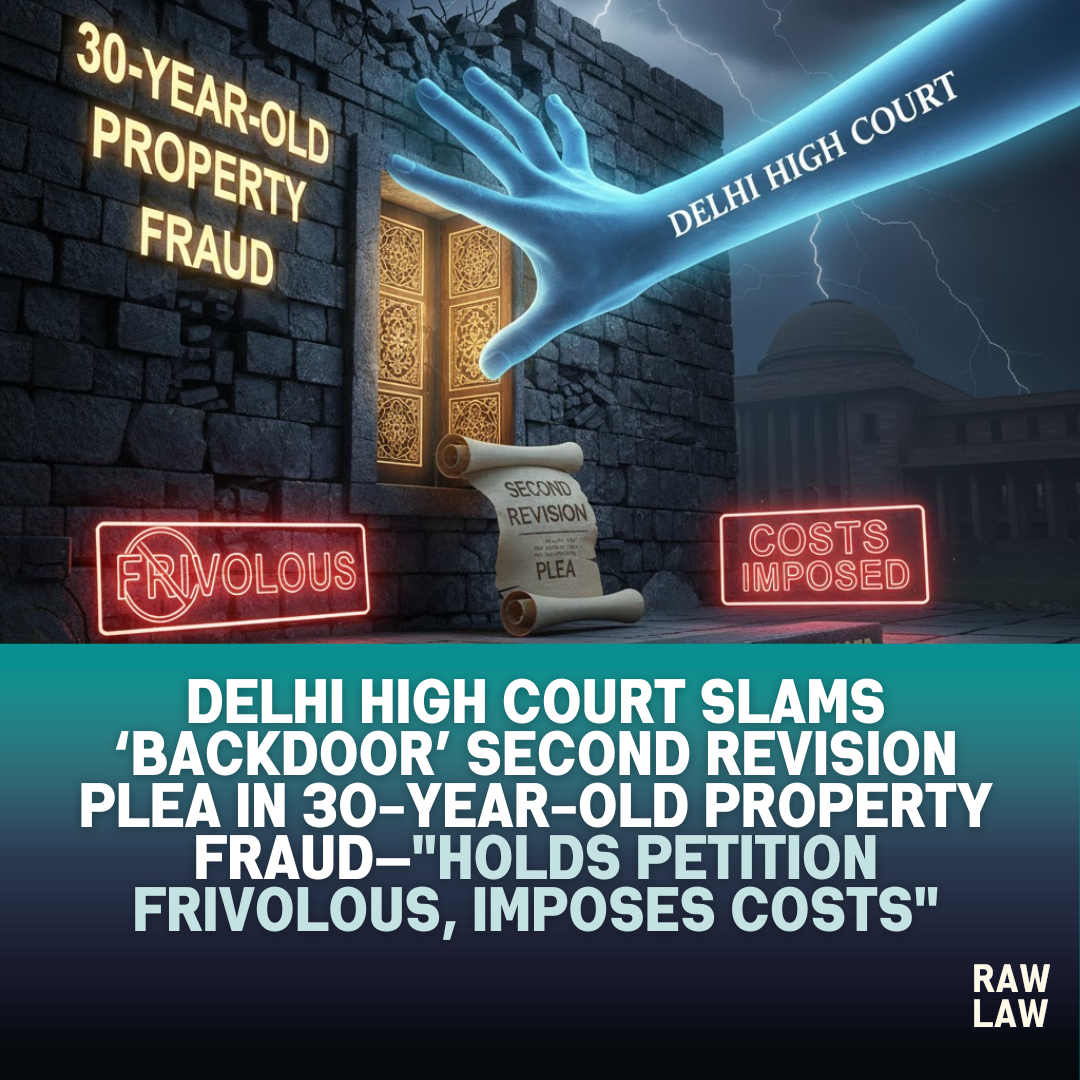
The Delhi High Court dismissed a petition seeking to invoke inherent jurisdiction to challenge concurrent orders summoning the accused in a long-pending property fraud case, holding that the plea was a clear attempt to bypass the statutory bar on second revision. The Court ruled that what is expressly prohibited by law cannot be permitted through a “backdoor entry” unless gross injustice is demonstrated. Finding none—and terming the petition “completely frivolous”—the Court not only refused to issue notice but also imposed costs, directing payment to a public welfare fund.
Court’s decision
The High Court rejected the criminal miscellaneous petition assailing dismissal of a revision petition by the Sessions Court, which had upheld the summoning of the petitioner for cheating and criminal conspiracy. The Court held that Section 397(3) of the Code of Criminal Procedure (now Section 438(3) of the Bharatiya Nagarik Suraksha Sanhita) bars a second revision, and inherent powers cannot be used to circumvent this prohibition. The petition was dismissed with costs of ₹15,000 for abuse of process.
Facts
The criminal proceedings arose from a property transaction dating back to the mid-1990s. The complainant, a property developer, alleged that he was induced to invest in development of a residential property at Shivalik, New Delhi, on the representation that the accused persons had clear authority to sell the property. It was claimed that assurances were given regarding valid title and power of attorney, leading the complainant to part with ₹30 lakh as earnest money over several years.
Subsequently, it emerged that the original allottee of the property had already expired at the time of the transaction, rendering the alleged power of attorney ineffective. Despite repeated assurances, the sale was never completed, the money was not returned, and the property was eventually sold to third parties. Criminal proceedings were initiated alleging offences of cheating, forgery, criminal breach of trust, and conspiracy.
Issues
The principal issue before the High Court was whether the petitioner could invoke the Court’s inherent jurisdiction to challenge summoning orders after having already failed in revision before the Sessions Court. This raised the broader question of whether inherent powers can be exercised to overcome the statutory bar on a second revision, and whether the petitioner had demonstrated any “gross injustice” warranting such exceptional interference.
Petitioner’s arguments
The petitioner contended that the amount of ₹30 lakh was not received by him but by co-accused persons, and that he had merely signed receipts at their request. It was argued that the money stood forfeited due to the complainant’s failure to pay the balance consideration within time. The petitioner sought to portray the dispute as essentially civil in nature, asserting that criminal prosecution was unwarranted and that continuation of proceedings amounted to injustice.
Respondent’s arguments
The State opposed the petition, pointing out that two courts had concurrently found a prima facie case against the petitioner. It was emphasised that the petitioner admittedly signed receipts acknowledging receipt of ₹30 lakh, had not refunded the amount, and had never issued any notice of forfeiture. The prosecution highlighted that the property was ultimately sold to third parties, strengthening allegations of dishonest intention and conspiracy. The State argued that the petition was a blatant attempt to re-litigate issues barred by law.
Analysis of the law
The Court examined the statutory scheme governing revisions and inherent powers. It reiterated that Section 397(3) CrPC imposes an express bar on a second revision, reflecting legislative intent to prevent endless challenges and delays in criminal proceedings. Inherent powers under Section 482 CrPC are not appellate or revisional substitutes and cannot be invoked to defeat statutory prohibitions. Such powers may be exercised only to prevent gross miscarriage of justice or abuse of process, not to grant a “second bite at the cherry.”
Precedent analysis
The judgment applied settled principles that inherent jurisdiction cannot be used as a substitute for a barred revision. Courts have consistently held that once a litigant has exhausted the remedy of revision, recourse to inherent powers is permissible only in the rarest cases involving manifest injustice. The High Court found that the present case fell far short of this threshold, particularly in light of concurrent findings by the trial court and the Sessions Court.
Court’s reasoning
The Court noted that the petitioner admitted to signing receipts for ₹30 lakh, had neither refunded the amount nor issued any forfeiture notice, and yet sought quashing of proceedings. It observed that had the money been returned, the case might have warranted closer scrutiny for possible injustice. Instead, the facts disclosed a continuing grievance, compounded by the sale of the property to third parties.
Given these circumstances, the Court held that allowing the petition would effectively permit a prohibited second revision through the guise of inherent powers. Terming the petition frivolous and an abuse of process, the Court dismissed it at the threshold and imposed costs to deter similar litigation.
Conclusion
The Delhi High Court refused to entertain a criminal miscellaneous petition seeking to reopen concurrent findings in a decades-old property fraud case. Reaffirming the statutory bar on second revisions, the Court held that inherent powers cannot be used to circumvent clear legislative prohibitions. The petition was dismissed with costs, underscoring judicial intolerance for frivolous attempts to delay criminal trials.
Implications
This ruling sends a strong message against misuse of inherent jurisdiction to stall criminal proceedings. It reinforces finality in interlocutory criminal litigation and clarifies that accused persons cannot endlessly challenge summoning orders by creatively invoking different procedural routes. For practitioners, the decision underscores the high threshold required to bypass the bar on second revision and highlights the risk of adverse costs where courts perceive abuse of process.
Case law reference
- Bar on second revision: Statutory prohibition under criminal procedure law prevents multiple revisional challenges to the same order.
- Limits of inherent powers: Inherent jurisdiction cannot override express legislative bars and is reserved for preventing gross injustice.
- Application in present case: These principles led the Court to dismiss the petition as frivolous and impose costs.
FAQs
Q1. Can a second revision be filed in criminal proceedings?
No. Criminal procedure law expressly bars a second revision against the same order.
Q2. Can inherent powers be used to bypass this bar?
Only in exceptional cases of gross injustice. Courts will not permit inherent powers to be used as a substitute for a barred revision.
Q3. What happens if such petitions are found frivolous?
Courts may dismiss them at the threshold and impose costs to deter abuse of process.