


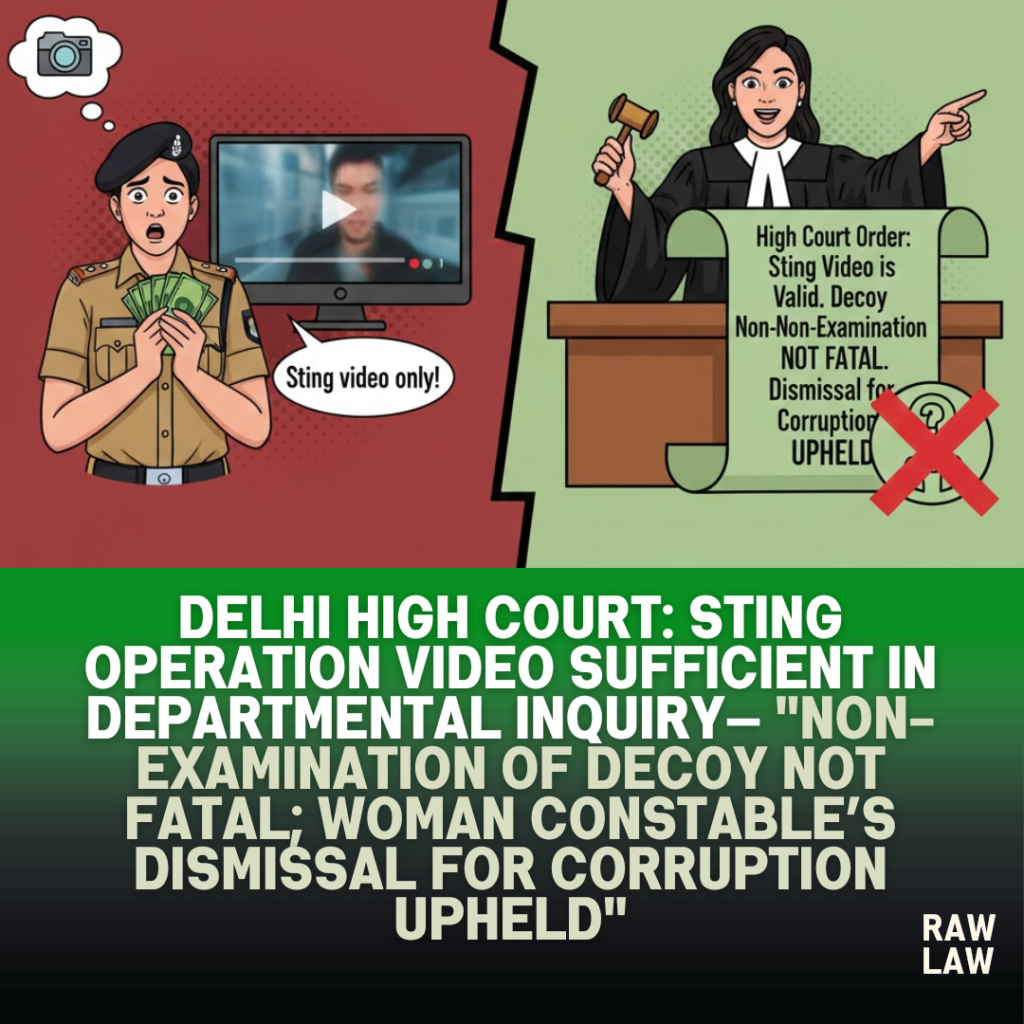
Court’s decision
The Delhi High Court dismissed a writ petition challenging dismissal from service of a woman constable found guilty of demanding and accepting illegal gratification during a sting operation.
The Court held that in departmental proceedings, strict rules of evidence under the Indian Evidence Act do not apply. The video-CD of the televised sting operation, coupled with departmental witnesses and official records, constituted “some evidence” sufficient to sustain findings on a preponderance of probabilities. Non-examination of the decoy or media personnel was not fatal. The dismissal order was upheld.
Facts
The petitioner was appointed as a Woman Constable in Delhi Police on compassionate grounds in 2002. On 06.09.2005, while posted as a Daily Diary (DD) Writer at Police Station New Ashok Nagar, she was allegedly caught in a sting operation conducted by a television news channel.
A decoy approached her to lodge a Non-Cognizable Report (NCR) regarding a lost mobile phone. It was alleged that she demanded ₹200 and accepted ₹150 for registering the NCR. The incident was recorded using a concealed camera and telecast on 14.09.2005 in the “Sansani” programme.
A joint departmental inquiry under the Delhi Police (Punishment and Appeal) Rules, 1980 was initiated. Though the decoy and media personnel were not examined, the video-CD of the telecast formed the central piece of evidence. The Enquiry Officer found the charge proved. The Disciplinary Authority dismissed her from service, and the Appellate Authority affirmed the punishment. The Tribunal also upheld the dismissal.
Issues
The High Court examined:
- Whether reliance solely on an edited video-CD vitiated the departmental proceedings.
- Whether non-examination of the decoy and TV personnel violated principles of natural justice.
- Whether the findings suffered from perversity or were based on “no evidence”.
- Whether writ jurisdiction under Article 226 could reappreciate evidence in disciplinary matters.
Petitioner’s arguments
The petitioner argued that the entire case rested exclusively on an edited video clip telecast by a private channel. No independent complaint was lodged, no recovery of alleged bribe was effected, and no independent witness supported the allegation.
She contended that once the authenticity of the video-CD was disputed, it was incumbent upon the department to prove it in accordance with law. Reliance was placed on Roop Singh v. Punjab National Bank and Raja Ram Pal v. Speaker, Lok Sabha, arguing that unproved and edited footage could not form the sole basis of guilt.
It was further submitted that failure to examine the decoy deprived her of the right to cross-examination, violating natural justice.
Respondents’ arguments
The respondents contended that the video-CD clearly depicted the petitioner accepting money while performing official duties. It was argued that she did not deny being the person shown in the recording nor the act of accepting money.
They emphasized that in departmental inquiries, strict evidentiary rules do not apply. The visual evidence, supported by duty roster entries and official records, constituted substantive material.
The absence of voice testing or examination of the decoy did not dilute the probative value of the recording in a disciplinary context.
Analysis of the law
The Court reiterated the limited scope of judicial review in disciplinary matters, relying on State of Rajasthan v. Bhupendra Singh and State of Andhra Pradesh v. S. Sree Rama Rao. High Courts do not sit as appellate authorities over departmental findings.
It reaffirmed that domestic inquiries are governed by principles of natural justice, not the strict provisions of the Evidence Act. In State of Haryana v. Rattan Singh, the Supreme Court held that “some evidence” logically probative for a prudent mind is sufficient.
The Court emphasized that the standard of proof in departmental proceedings is preponderance of probabilities, not proof beyond reasonable doubt.
Precedent analysis
The Court distinguished Roop Singh v. Punjab National Bank, where findings were based solely on unproved documents without oral evidence. In the present case, two departmental witnesses were examined to prove official records and link the incident to the petitioner.
Reliance was also placed on Airports Authority of India v. Pradip Kumar Banerjee (2025 INSC 149), where the Supreme Court held that non-examination of the complainant is not per se fatal in disciplinary proceedings if reliable material exists.
The Court reiterated principles from Rattan Singh that hearsay or non-strict evidence may be considered if credible and relevant.
Court’s reasoning
The Court noted that the Enquiry Officer, Disciplinary Authority, Appellate Authority, and Tribunal recorded concurrent findings of guilt.
The petitioner was supplied with the video-CD, allowed to cross-examine witnesses, lead defence evidence, and make representations. Thus, natural justice was complied with.
Significantly, the petitioner did not deny that she appeared in the video or that she accepted money. Her defence centered on lack of proof of demand and absence of forensic voice testing.
The Court observed that acceptance of money by a police official while on duty, visually recorded, constitutes cogent material from which misconduct can reasonably be inferred.
It further noted that the petitioner did not initiate any defamation or fabrication proceedings against the channel, nor produce expert evidence to challenge authenticity.
The grievance regarding non-examination of the decoy related to sufficiency and appreciation of evidence, which lies outside the narrow scope of writ review.
Conclusion
The Delhi High Court held that the findings were neither perverse nor arbitrary. There was no jurisdictional error, violation of natural justice, or case of “no evidence”.
Accordingly, the writ petition was dismissed, and the dismissal from service was upheld.
Implications
This judgment reinforces:
- Sting operation video recordings can constitute sufficient evidence in departmental proceedings.
- Non-examination of the complainant or decoy is not automatically fatal.
- High Courts will not reappreciate evidence in writ jurisdiction unless findings are perverse.
- Departmental inquiries operate on preponderance of probabilities, not criminal standards.
- Police personnel are held to a high standard of integrity in public service.
The ruling underscores judicial deference to concurrent factual findings in corruption-related service matters.
Case law references
- State of Rajasthan v. Bhupendra Singh (2024 INSC 592)
Limited scope of judicial review in disciplinary proceedings. - State of Haryana v. Rattan Singh (1977) 2 SCC 491
Domestic inquiries need only “some evidence”; strict Evidence Act rules not applicable. - Airports Authority of India v. Pradip Kumar Banerjee (2025 INSC 149)
Non-examination of complainant not fatal if reliable material exists. - Roop Singh v. Punjab National Bank (2009) 2 SCC 570
Findings based on unproved documents alone are perverse; distinguished.
FAQs
1. Can a sting operation video be relied upon in a departmental inquiry?
Yes. If credible and supported by some corroborative material, it can constitute sufficient evidence under the preponderance standard.
2. Does non-examination of the complainant invalidate disciplinary proceedings?
No. It is not per se fatal if other reliable evidence exists.
3. Can High Courts reassess evidence in service dismissal cases?
No. Judicial review is limited to jurisdictional errors, violation of natural justice, perversity, or findings based on no evidence.