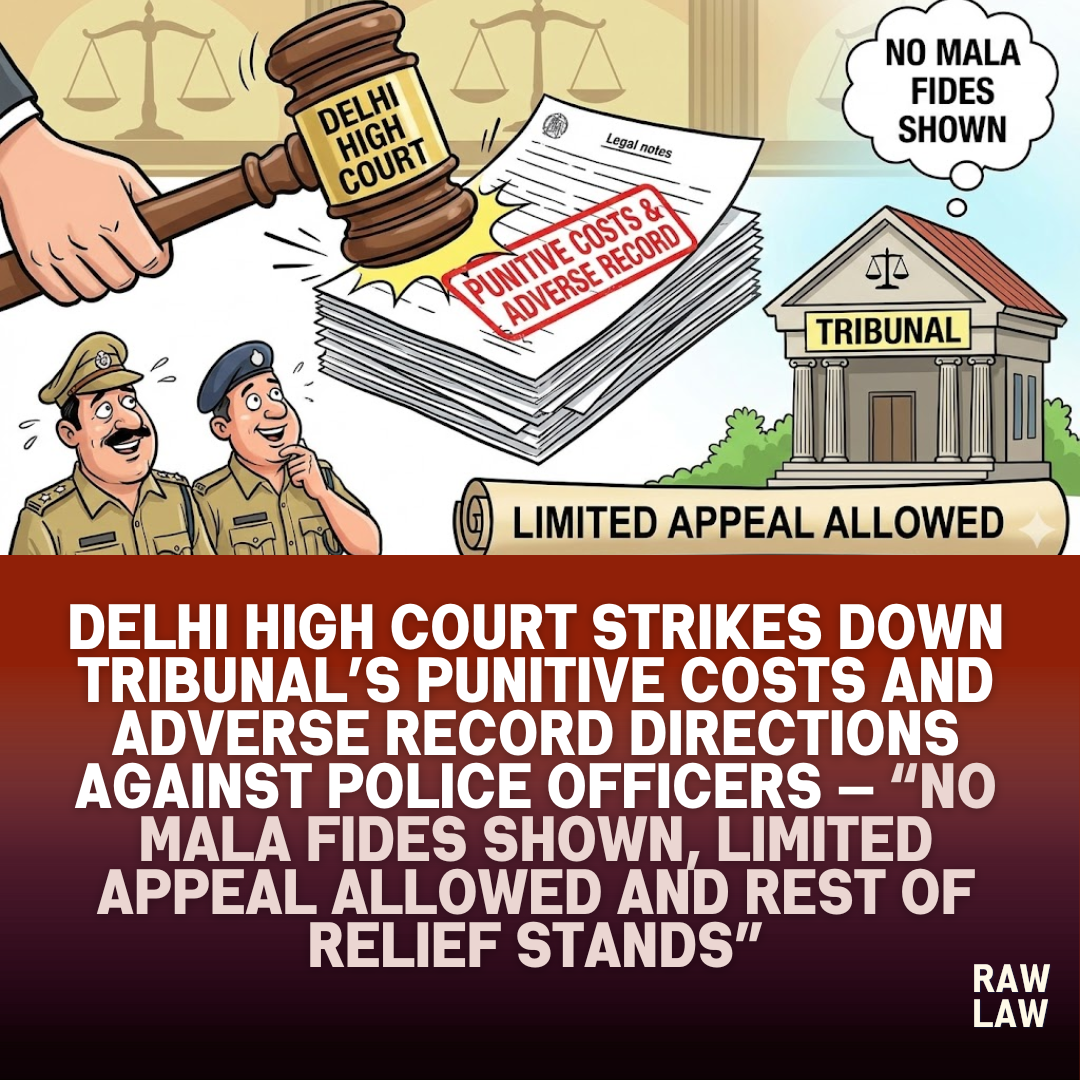
Delhi High Court strikes down tribunal’s punitive costs and adverse record directions against police officers — “No mala fides shown”, limited appeal allowed and rest of relief stands

1. Court’s decision
The Delhi High Court partly allowed a writ petition filed by the Commissioner of Police and others, but only to a narrow extent. While the Central Administrative Tribunal had quashed the disciplinary and appellate orders against the respondent-constable, granted consequential benefits, allowed fresh disciplinary proceedings, and imposed punitive directions in paragraph 34(v), the High Court set aside only the paragraph 34(v) directions. The Court held that, on the record before it, no mala fides could be attributed to the concerned officers against whom costs and adverse recording in their annual performance appraisal reports had been ordered, and therefore the tribunal’s punitive directions could not stand. The rest of the tribunal’s directions remained complied with and undisturbed.
2. Facts
The Commissioner of Police and other petitioners approached the Delhi High Court challenging a tribunal order dated 16 April 2025 passed in an original application filed by the respondent. The tribunal had partly allowed the original application by quashing the disciplinary authority’s order dated 22 July 2023 and the appellate authority’s order dated 18 March 2024, making absolute an interim relief earlier granted, and directing consequential benefits with implementation within eight weeks. The tribunal also granted liberty to initiate disciplinary proceedings afresh in accordance with law. Separately, in paragraph 34(v), the tribunal imposed costs of ₹50,000 each on two officers (respondents 2 and 3 before the tribunal), directed payment to the Prime Minister’s Relief Fund, and further directed the Commissioner of Police to record their “inaction” in their APAR for 2025–26.
3. Issues
The High Court’s inquiry was tightly framed: whether the tribunal’s punitive directions in paragraph 34(v)—imposition of personal costs on officers and a direction to record “inaction” in their annual performance appraisal—were sustainable in law on the facts of the case. Since the petitioners expressly confined their challenge to paragraph 34(v), the High Court did not re-open the tribunal’s merits findings quashing the disciplinary and appellate orders, nor did it revisit the grant of consequential benefits or liberty for fresh proceedings. The core legal issue thus became whether such personal punitive directions can be sustained absent a foundation of mala fides or other compelling justification.
4. Petitioner’s arguments
The petitioners, through counsel, limited their prayer to challenging the tribunal’s paragraph 34(v). They submitted that the tribunal’s decision to impose costs personally on specific officers and to direct adverse entry in their APARs was unwarranted. The petitioners contended that the record did not justify attributing mala fides or deliberate misconduct to those officers, and therefore the tribunal exceeded the appropriate bounds by issuing punitive directions affecting individual officials’ service records and imposing monetary consequences payable to a public fund.
5. Respondent’s arguments
The respondent appeared in person. The order records that the respondent confirmed that the remaining directions of the tribunal—other than paragraph 34(v)—had been complied with. The respondent did not, in the High Court’s limited adjudication as captured in the order, successfully establish a factual basis to sustain a finding of mala fides against the concerned officers. The dispute therefore narrowed to whether the tribunal’s punitive directions could stand when compliance with the core relief had already been achieved and mala fides were not demonstrable on the record placed before the High Court.
6. Analysis of the law
Service law adjudication permits tribunals and courts to grant consequential relief when disciplinary action is found legally unsustainable, and to permit fresh proceedings where the law allows. However, personal costs against individual officers and directions affecting APAR entries are serious measures because they carry reputational, career, and financial consequences. Such directions typically require a clear basis—such as demonstrable mala fides, deliberate disregard of law, or egregious and blameworthy conduct—rather than mere institutional error or procedural lapse. In this order, the High Court applied a restraint-based standard: absent a record-supported attribution of mala fides, the tribunal’s punitive measures could not be sustained, even if the tribunal was dissatisfied with departmental functioning generally.
7. Precedent analysis
The tribunal’s paragraph 34(v) had referred to an earlier Delhi High Court judgment dated 14 August 2024 in a different matter concerning police working, using it to comment that it saw no improvement and therefore imposed costs and APAR directions. The High Court, however, did not rely on any external precedent in the short oral order. Instead, it decided the case on the immediate principle that mala fides must be shown before penal consequences are fastened personally on officers through costs and adverse performance recording. By explicitly recording that “no mala fides can be attributed,” the Court treated that absence as determinative of the limited challenge.
8. Court’s reasoning
The High Court noted at the outset that the petitioners were restricting their challenge solely to paragraph 34(v). It recorded that the remaining directions had already been complied with, and this was confirmed by the respondent appearing in person. After hearing counsel, the Court held that it found no basis to attribute mala fides to the concerned petitioners (the officers targeted by the tribunal’s punitive directions). On that short but decisive finding, the Court allowed the limited prayer, and set aside only the direction contained in paragraph 34(v) of the tribunal’s order dated 16 April 2025. The writ petition and pending application were disposed of accordingly.
9. Conclusion
The Delhi High Court did not disturb the tribunal’s substantive relief to the respondent—quashing of disciplinary and appellate orders, confirmation of interim relief, consequential benefits, and liberty for fresh proceedings—particularly because those directions had already been complied with. But it removed the punitive layer added by the tribunal in paragraph 34(v), holding that costs and adverse APAR recording could not be sustained when mala fides were not made out against the specific officers. The case is a reminder that judicial and tribunal displeasure at systemic delay or inaction cannot automatically translate into personal penalties without a clear evidentiary foundation.
10. Implications
For police disciplinary litigation and broader service jurisprudence, this order reinforces an important boundary: tribunals may correct unlawful disciplinary action and grant consequential benefits, but personal costs and APAR-related directions are exceptional and must be grounded in specific findings, not general dissatisfaction. For departments, the decision is protective of individual officers where mala fides are not established, while still leaving the administration accountable to implement substantive tribunal directions. For litigants, it shows that even when a tribunal grants strong relief, appellate courts may prune punitive directions that overreach, especially where compliance has already occurred and the record does not justify attributing bad faith to particular officials.
Case law references
1) Delhi High Court judgment dated 14 August 2024 in a police matter (referred to by the tribunal)
- What it was used for by the tribunal: To express dissatisfaction with the respondents’ functioning and to justify imposing costs and APAR directions.
- How treated here: The High Court did not adopt that approach; it set aside the punitive directions because mala fides could not be attributed to the officers targeted.
FAQs
1) Can a tribunal impose personal costs on government officers in service matters?
It can, but such directions are exceptional. This order shows that where mala fides cannot be attributed to the officers, personal cost directions may be set aside on judicial review.
2) Can a tribunal direct adverse remarks in an officer’s APAR as a punishment for “inaction”?
Such directions have serious service consequences and require strong justification. The Delhi High Court set aside an APAR direction when it found no mala fides against the officers concerned.
3) If the High Court sets aside only the punitive part of a tribunal order, do the main reliefs still survive?
Yes. Here, the High Court interfered only with paragraph 34(v) and left the rest of the tribunal’s directions intact, recording that they were already complied with.