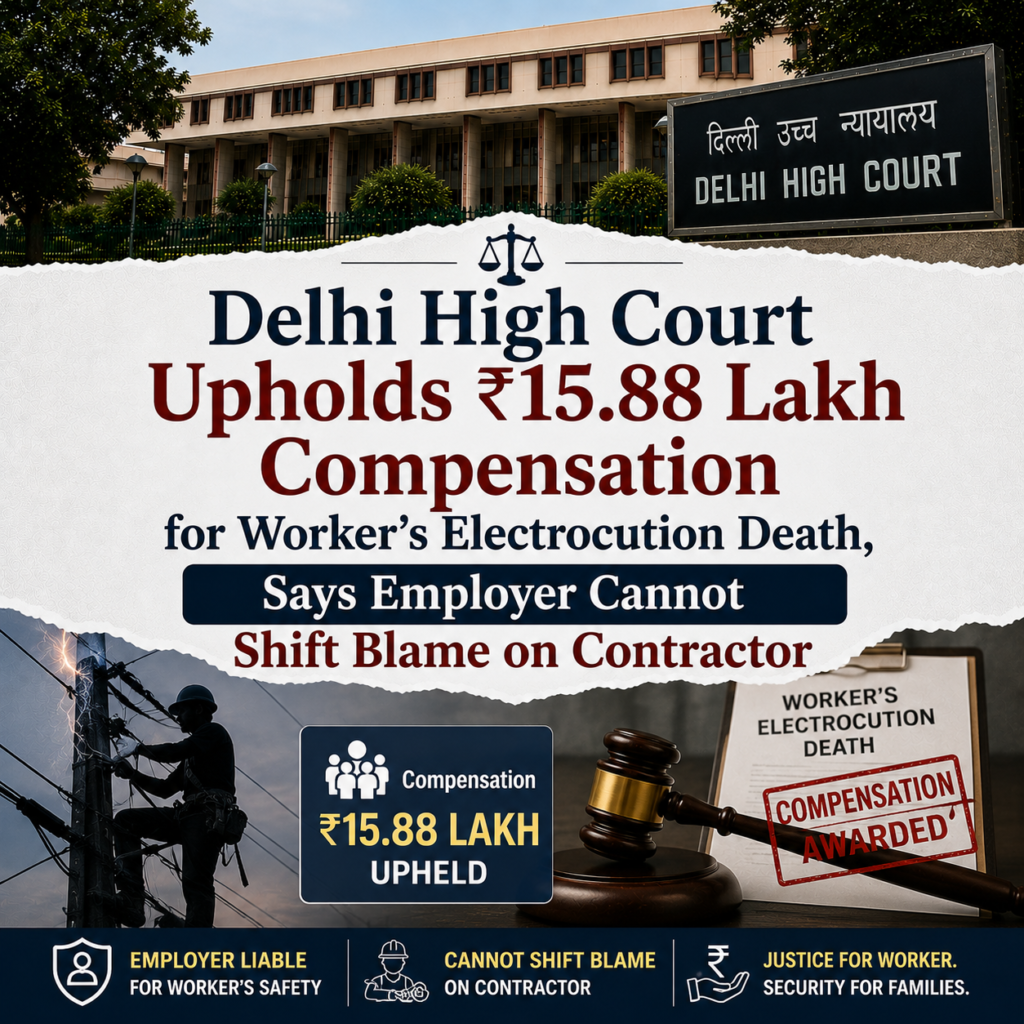
Delhi High Court Upholds ₹15.88 Lakh Compensation for Worker’s Electrocution Death, Says Employer Cannot Shift Blame on Contractor

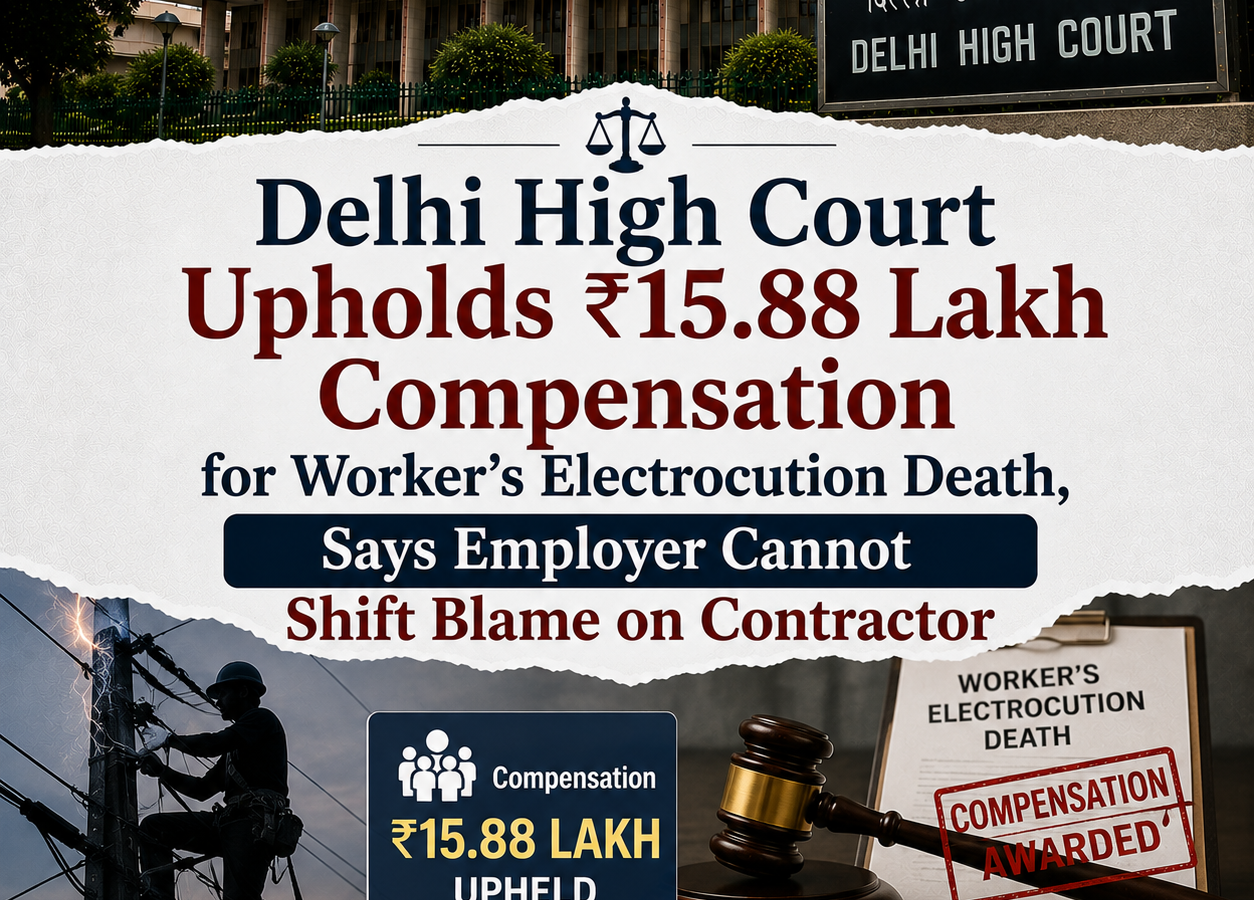
Delhi High Court Upholds ₹15.88 Lakh Compensation for Worker’s Electrocution Death, Says Employer Cannot Rely on Unproved Contractor Agreement
Facts
The appeal was filed by Anil Kumar Goel under Section 30 of the Employees’ Compensation Act, 1923, challenging the order dated 09.06.2023 passed by the Commissioner under the Act. The Commissioner had allowed the claim filed by the legal heirs of late Sanoj Kumar and directed the appellant to pay compensation of ₹15,88,425, funeral expenses of ₹5,000, and interest at 12% per annum from 08.04.2022 till realisation.
The respondents’ case was that Sanoj Kumar was employed by the appellant and, on 08.04.2022, while carrying out flooring work at the appellant’s premises, suffered electrocution due to unsafe electrical fittings and died during the course of employment.
The appellant disputed the employer-employee relationship and claimed that he had entered into an agreement dated 06.04.2022 with one Shyam Kumar, who was allegedly responsible for arranging labour and safety equipment. However, after filing his written statement before the Commissioner, the appellant stopped participating in the proceedings and was proceeded against ex parte.
Issues
- Whether the Commissioner erred in holding that an employer-employee relationship existed between the appellant and the deceased.
- Whether the alleged agreement with Shyam Kumar could absolve the appellant from liability under the Employees’ Compensation Act.
- Whether the appeal raised any substantial question of law under Section 30 of the Employees’ Compensation Act.
Petitioner’s Arguments
The appellant argued that the deceased was not his employee and that he had no liability to pay compensation.
He submitted that the repair and flooring work had been assigned to Shyam Kumar under an agreement dated 06.04.2022. According to the appellant, Shyam Kumar had undertaken to execute the work, arrange labour and provide safety equipment.
The appellant also argued that there was a discrepancy regarding the timing of the incident, as the claim application mentioned the accident time as around 6:00 p.m., while the FIR recorded it as 11:00 p.m.
Respondent’s Arguments
The respondents contended that Sanoj Kumar died while performing flooring work at the appellant’s premises and that the accident arose out of and in the course of employment.
They relied upon the FIR lodged by a fellow workman, the death certificate and the post-mortem report to establish the accident and death. Since the appellant failed to prove the alleged agreement with Shyam Kumar and did not participate in the proceedings after filing his written statement, the respondents argued that the Commissioner rightly awarded compensation.
Analysis of the Law
The Court held that an appeal under Section 30 of the Employees’ Compensation Act is limited in scope and can be entertained only if it involves a substantial question of law. The Commissioner is the final authority on facts under the statutory scheme.
The Court found that the appellant’s entire defence was based on the alleged agreement dated 06.04.2022 with Shyam Kumar. However, the agreement was not proved before the Commissioner. It was an unregistered document, apparently executed on a plain sheet of paper, and no material was placed on record to prove either its execution or its contents.
The Court also noted that Shyam Kumar, on whom the appellant’s defence was based, was not examined as a witness. Therefore, the alleged agreement could not be relied upon to disturb the factual findings recorded by the Commissioner.
Precedent Analysis
The Court relied on Golla Rajanna & Ors. v. Divisional Manager & Anr., (2017) 1 SCC 45, where the Supreme Court held that the scope of appeal under Section 30 of the Employees’ Compensation Act is restricted to substantial questions of law, and the Commissioner is the last authority on facts.
Applying this principle, the Court held that the appellant was attempting to reopen factual findings regarding employment, accident and liability, which is impermissible in an appeal under Section 30 unless perversity or a substantial question of law is shown.
Court’s Reasoning
The Court observed that the appellant had pleaded the existence of the agreement with Shyam Kumar before the Commissioner but failed to produce or prove it during evidence. He also stopped appearing before the Commissioner after filing the written statement, resulting in ex parte proceedings.
The Court rejected the appellant’s attempt to rely on the agreement at the appellate stage, holding that an unproved document cannot dislodge factual findings recorded by the Commissioner.
The alleged discrepancy in the timing of the accident was also held to be immaterial. The Court noted that there was no dispute regarding the date of the incident, the occurrence of the accident, the fact that work was going on under the appellant’s instructions, and that the death occurred at the appellant’s premises.
Since the appellant failed to show that the Commissioner’s findings were perverse, unsupported by record or legally infirm, the Court held that no substantial question of law arose.
Conclusion
The Delhi High Court dismissed the appeal and upheld the Commissioner’s award directing payment of compensation to the legal heirs of the deceased worker.
The Court held that the appellant could not avoid liability by relying on an unproved contractor agreement, especially when the Employees’ Compensation Act is a welfare legislation and the factual findings of the Commissioner did not suffer from any perversity or legal infirmity.
Case Details
Case: Anil Kumar Goel v. Roshani Devi and Ors.
Court: Delhi High Court
Case Number: FAO 265/2023
Judge: Justice Manoj Kumar Ohri
Date: 8 July 2026
Result: Appeal dismissed; compensation award upheld.