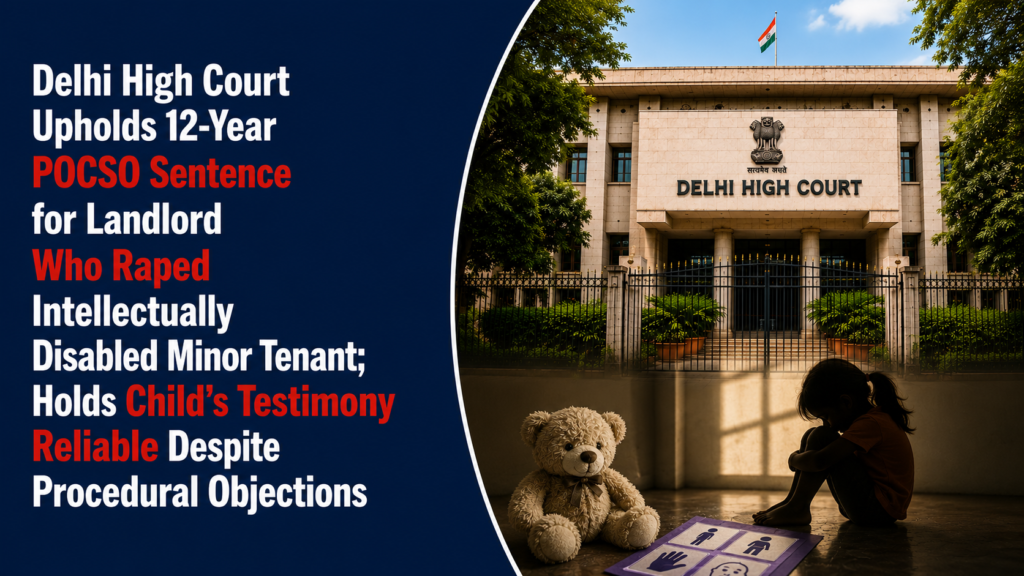
Delhi High Court Upholds 12-Year POCSO Sentence for Landlord Who Raped Intellectually Disabled Minor Tenant; Holds Child’s Testimony Reliable Despite Procedural Objections


Delhi High Court Upholds Landlord’s Conviction for Raping Intellectually Disabled Minor Tenant; Says Lack of Fresh Injuries Does Not Discredit Penetrative Assault
Facts
The appellant, Shankar Singh, was the sole accused in Sessions Case No. 155/2017 before the Additional Sessions Judge-07 (POCSO), West District, Tis Hazari Courts. He challenged his conviction under Sections 342 and 376(2)(i), (l) IPC and Section 6 of the POCSO Act.
The prosecution alleged that on 27 June 2017, and on earlier occasions, the appellant wrongfully confined an intellectually disabled minor girl and committed aggravated penetrative sexual assault upon her in his jhuggi at Nangloi, Delhi. The girl was described as about 11 years old at the time.
The victim’s family lived as tenants in a jhuggi owned by the appellant. The defence case was that the prosecution was fabricated because of disputes concerning non-payment of rent and the appellant’s demand that the family vacate the premises.
The Trial Court convicted the appellant and sentenced him to 12 years’ rigorous imprisonment with ₹12,000 fine under Section 6 POCSO, along with six months’ rigorous imprisonment under Section 342 IPC. The sentences were ordered to run concurrently.
Issues
The principal issues before the Delhi High Court were:
- Whether the testimony of PW1, an intellectually disabled child with a mental age assessed at around five years, was competent and reliable.
- Whether her Section 164 CrPC statement was compromised because her mother translated two expressions spoken by her in Maithili.
- Whether the absence of fresh hymenal injury or other external injuries undermined the allegation of penetrative sexual assault.
- Whether the assistance of the clinical psychologist and other persons during the victim’s deposition complied with the POCSO Act.
- Whether the testimony of PW3, the victim’s younger brother, sufficiently corroborated the prosecution case.
- Whether the false implication defence based upon an alleged rent dispute created reasonable doubt.
- Whether the Trial Court erred in disallowing defence suggestions during cross-examination of the child witness.
Appellant’s Arguments
The appellant argued that the medical examination did not support the prosecution case because the MLC disclosed no fresh hymen tear or external injury.
He contended that the victim’s mother had actively assisted in recording the Section 164 statement and that this made the statement unreliable, particularly because the mother was an interested witness.
The appellant also challenged the competence of the clinical psychologist, contending that she was neither a special educator nor a person previously familiar with the victim and that the psychological assessment had allegedly been conducted by a trainee rather than by the expert herself.
It was further argued that the victim’s brother merely stated that the appellant did “ganda kaam” and did not describe penetration. According to the defence, the case therefore could at best amount to aggravated sexual assault rather than aggravated penetrative sexual assault.
Finally, the appellant relied on the alleged rent dispute to contend that the family had falsely implicated him.
Respondent’s Arguments
The State supported the conviction and argued that the victim had consistently described the sexual assault through both words and gestures.
It contended that the absence of fresh injuries or semen did not negate the prosecution case, particularly because the assault might have been interrupted and because the MLC showed an old hymenal tear.
Counsel appearing for the prosecutrix further argued that Section 26(3) POCSO did not make assistance of a special educator mandatory in every case and that the presence of the victim’s mother in court was permissible to create a child-friendly environment under Section 33(4) POCSO.
Analysis of the Law
The Court first addressed the reliability of the victim’s Section 164 statement.
It reiterated that a Section 164 CrPC statement is not substantive evidence and can only be used to corroborate or contradict its maker.
The Court distinguished State of Rajasthan v. Darshan Singh, where an interested relative had interpreted sign language of a speech and hearing impaired witness. In the present case, the mother had merely translated two Maithili words, rather than interpreting gestures or the substance of the victim’s account.
The Court also held that failure to administer oath did not automatically invalidate the testimony. Competency is governed by Section 118 of the Evidence Act, while omission of oath primarily goes to credibility.
The Trial Court had conducted voir dire and found that the victim could understand questions and give rational answers. Her mental age alone did not render her incompetent.
Precedent Analysis
The Court considered Darshan Singh but found it factually distinguishable because the interested father there had interpreted signs of a witness who could independently read and write. Here, PW1 could communicate orally to a meaningful extent and the mother had translated only limited expressions.
The Court relied upon Rameswar v. State of Rajasthan on the principle that absence of oath does not by itself render a competent witness’s testimony inadmissible.
On medical evidence, the Court relied upon Solanki Chimanbhai Ukabhai v. State of Gujarat and Rangnath Shamrao Dhas v. State of Maharashtra for the proposition that medical evidence is ordinarily corroborative, not determinative. Ocular evidence cannot be discarded unless medical evidence completely rules out the prosecution version.
Court’s Reasoning
The Court found the victim’s evidence credible when read as a whole.
PW1 stated that the appellant took her to his house, removed her salwar, removed his own clothes and committed “ganda kaam”. She demonstrated the act through to-and-fro gestures and affirmatively stated that the appellant inserted his private part into hers.
The Court acknowledged that some questions put to PW1 were leading, but held that the conviction did not rest upon those answers alone. Her earlier answers, gestures and Section 164 statement independently corroborated the overt acts attributed to the appellant.
PW3’s evidence also corroborated the occurrence. He had seen the appellant and his sister partly undressed, with the appellant lying on top of her and covering her mouth. The Court held that the expression “ganda kaam” could not be read in isolation from these surrounding circumstances.
The Court rejected the medical-evidence objection. It held that penetration to any extent is sufficient and need not be complete. It also reasoned that the incident may have been interrupted when PW3 pushed open the door, which could explain the lack of fresh hymenal injury.
The Court further held that Section 26(3) POCSO contemplates assistance from a special educator, a person familiar with the child’s communication, or an expert. A clinical psychologist could therefore validly assist, and the fact that a trainee helped collect background information did not invalidate the assessment.
The defence plea of false implication due to rent disputes was also rejected as unsubstantiated.
The Court ultimately held that the prosecution had proved wrongful confinement and penetrative sexual assault beyond reasonable doubt.
Significantly, however, the High Court found one procedural error in the Trial Court’s handling of cross-examination. The Trial Judge had disallowed certain defence suggestions on the ground that the child, whose mental age was five years, could not understand them. The High Court held that this was incorrect. Section 33 POCSO protects a child from aggressive questioning and character assassination, but does not eliminate the defence’s right to put relevant questions. The proper procedure was for counsel to communicate the questions to the Special Court, which should then put them to the child.
That procedural error, however, did not affect the ultimate conviction.
Conclusion
The Delhi High Court held that the prosecution had successfully established the offences under Sections 342 and 376(2)(i), (l) IPC and Section 6 POCSO.
It rejected the challenges based on lack of fresh injuries, alleged improper interpretation, competency of the child witness, assistance of the psychologist, absence of independent witnesses and the alleged rent dispute.
The Court therefore found no infirmity in the conviction or sentence warranting interference.
The appeal was accordingly dismissed as being without merit.
Case Details
Case: Shankar Singh v. State of NCT of Delhi
Court: High Court of Delhi at New Delhi
Case Number: CRL.A. 662/2025
CNR Number: DLHC010296582025
Judge: Justice Chandrasekharan Sudha
Date: 17 August 2026; judgment reserved on 11 August 2026
Result: Appeal dismissed; conviction and 12-year sentence under Section 6 POCSO upheld, along with conviction under Sections 342 and 376(2)(i), (l) IPC.