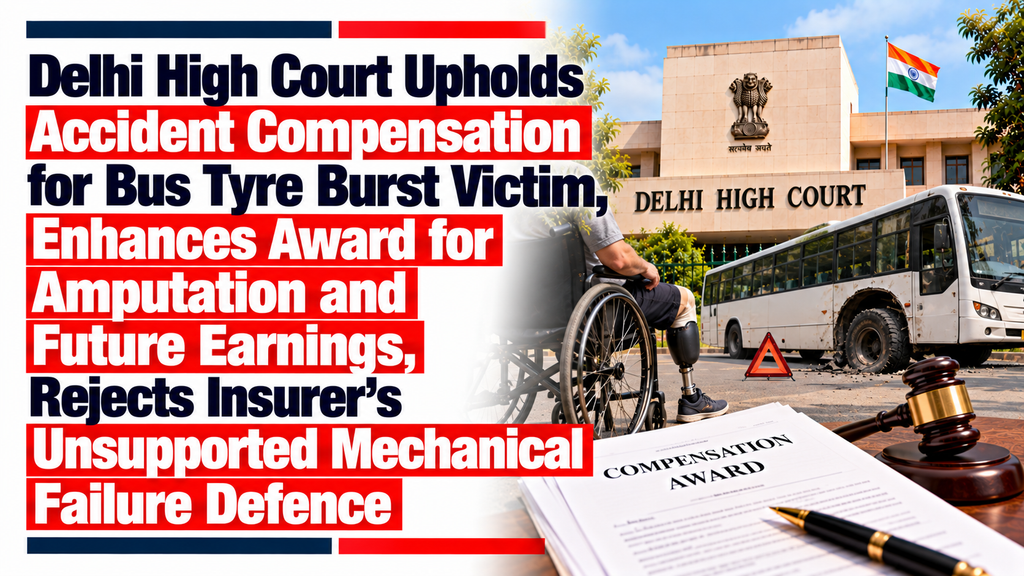
Delhi High Court Upholds Accident Compensation for Bus Tyre Burst Victim, Enhances Award for Amputation and Future Earnings, Rejects Insurer’s Unsupported Mechanical Failure Defence

Delhi High Court Significantly Raises Injured Passenger’s Compensation to ₹33.44 Lakh, Awards Separate Lifetime Prosthetic Support, Rules Tyre Bursts Do Not Automatically Defeat Insurance Claims
Facts
On 15 May 2011, seventeen-year-old Krishan Kumar was travelling in a bus when its rear tyre burst after striking a stone, and a torn metal sheet struck his right leg. Subsequent complications necessitated below-knee amputation, leaving 70% permanent disability. The Motor Accident Claims Tribunal (MACT), Dwarka, awarded ₹10,18,655 with 7.5% interest on 3 January 2015. United India Insurance appealed against liability, asserting that a falling cooler caused the injury or, alternatively, that mechanical failure excluded negligence. The injured passenger cross-appealed for enhanced damages, loss of earning capacity and lifelong prosthetic expenses.
Issues
Whether evidence established a motor-vehicle accident despite a seven-month delay in registering the FIR and contradictory hospital history; whether a tyre burst or mechanical defect excluded compensation under Sections 165 and 166, Motor Vehicles Act, 1988; and what compensation was appropriate for a 17-year-old amputee, particularly functional disability, future income and prosthetic replacement and maintenance.
Petitioner’s Arguments
The insurer argued that Sir Ganga Ram Hospital’s LAMA summary described a cooler falling on the claimant’s leg at home; its panel doctor supported this account, the FIR was delayed, and no repair or damage report proved the alleged tyre burst. In the alternative, a tyre burst was mechanical failure rather than negligent driving, defeating a Section 166 claim. The claimant relied on consistent bus-passenger testimony, an early DD entry, the owner’s acknowledgement of the tyre burst, and Medanta’s road-accident history. He sought future earning loss and prosthetic costs, asserting significant occupational impairment.
Respondent’s Arguments
The claimant explained that his father supplied the misleading hospital history to avoid police formalities and expedite urgent treatment. DD Entry 38B was recorded on 20 May 2011, and the 2 December 2011 FIR followed prolonged medical treatment. The owner identified his son as driver; witnesses described the rear tyre bursting and metal sheeting striking the passenger. The insurer disputed the causal narrative and quantum, relying on its reviewing panel doctor, who had not examined the patient personally.
Analysis of the Law
Sections 165(1) and 166 of the Motor Vehicles Act cover bodily injury arising out of the use of a motor vehicle; mechanical breakdown does not automatically sever causation. The court applied the civil standard of preponderance of probabilities and principles of strict liability recognised for motor accidents. To escape responsibility on a mechanical-defect theory, the owner must prove a latent defect undiscoverable despite reasonable precautions. Rule 94 of the Central Motor Vehicles Rules requires sound, properly inflated tyres. Future earning loss turns on functional, not merely certified medical, disability; prosthetic expense is a distinct long-term head.
Precedent Analysis
Kaushnuma Begum v. New India Assurance Co. Ltd., (2001) 2 SCC 9, recognises compensation for accidents arising from vehicle use and discusses strict liability despite absent driver fault. Minu B. Mehta v. Balkrishna, (1977) 2 SCC 441, places the burden of establishing a latent, unavoidable mechanical defect on the owner. New India Assurance v. Mrunal Makarand Patwardhan, 2023 SCC OnLine Bom 669, rejects treating tyre bursts as acts of God without proof. Raj Kumar v. Ajay Kumar, (2011) 1 SCC 343, governs functional disability. Prahlad Sahai v. Haryana Roadways, 2026 SCC OnLine SC 651, supplies five-year prosthetic-replacement and maintenance guidance.
Court’s Reasoning
Justice Anish Dayal preferred the claimant’s and other passengers’ consistent testimony, early police diary record, owner’s admission and Medanta medical history over the insurer’s contradictory cooler theory. The father’s explanation for the misleading initial history and the delayed FIR was accepted. No one proved that the bus was roadworthy or the burst tyre suffered an unavoidable latent defect. Assessing 75% functional disability, the Court used skilled-worker wages of ₹7,410 monthly, 40% future prospects and multiplier 18 to allow ₹16,80,588 for future earnings. Medical expenses were fixed at ₹9,71,035, pain and suffering at ₹5 lakh, and loss of amenities at ₹1.5 lakh. Paragraph 77 calculates prosthetic support at ₹40.95 lakh, but operative paragraph 83 orders ₹45.95 lakh: an apparent discrepancy.
Conclusion
The insurance appeal failed; the claimant’s appeal succeeded on enhancement. Core compensation rose to ₹33,44,623 (an increase of ₹23,25,968), with 7.5% interest; the enhanced sum must be deposited before MACT within four weeks, subject to release/FDR directions. Operative paragraph 83 separately directs ₹45,95,000 for prosthetic limbs within six weeks, held in an interest-bearing FDR and released against verified original invoices; unspent lifetime balance returns to the insurer. The reasoned calculation in paragraph 77 instead states ₹40,95,000, warranting clarification before implementation. Both appeals were disposed of.
Case: United India Insurance Co. Ltd. v. Krishan Kumar & Ors. (connected cross-appeal by Krishan Kumar @ Kinu)
Court: High Court of Delhi at New Delhi
Case Number: MAC.APP. 244/2015 and MAC.APP. 367/2015 (MACT MACP 351/12/14)
Judge: Justice Anish Dayal
Date: 29 October 2026 (reserved 15 September 2026; uploaded 30 October 2026)
Result: Insurer’s liability challenge rejected; claimant’s compensation enhanced to ₹33,44,623 plus separately directed prosthetic provision, with inconsistent figures in paragraphs 77 and 83.