Delhi High Court Upholds Builders Association’s Impleadment in Cement Cartel Probe; Holds Interested Consumer Body Can Assist CCI Without Prejudicing Manufacturers’ Rights or Accessing Confidential Records

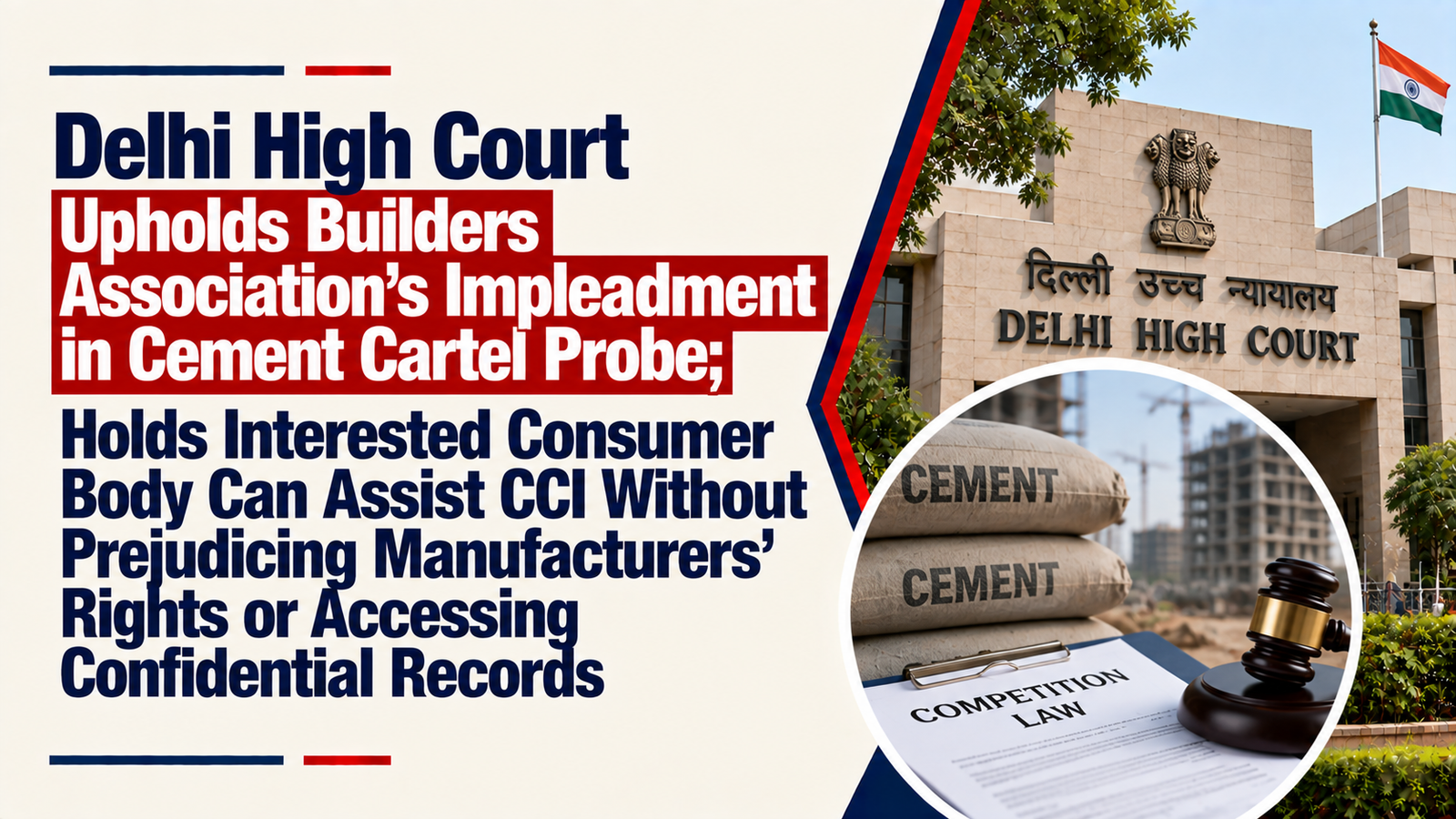
Delhi High Court Dismisses UltraTech Appeal Against Builders Association’s Participation in CCI Cement Cartel Inquiry; Finds Association Has Substantial Interest
Facts
The appeal was filed by UltraTech Cement Ltd. against the judgment dated 18 December 2023 of a Single Judge of the Delhi High Court dismissing its challenge to a Competition Commission of India (CCI) order dated 5 July 2023. The CCI had permitted the Builders’ Association of India (BAI) to participate in Suo Moto Case No. 2/2019, inspect non-confidential records and submit its opinion on the Director General’s investigation report.
The underlying competition proceedings arose from multiple complaints received between December 2018 and May 2019 alleging anti-competitive conduct by grey cement manufacturers. BAI itself had written to the CCI on 8 February 2019, alleging cartelisation by cement manufacturers resulting in an abnormal increase in cement prices. The CCI thereafter ordered a DG investigation under Section 26(1) of the Competition Act on 1 July 2019.
BAI initially sought impleadment in December 2021, while the DG investigation was still underway. That application was rejected because the investigation was already at an advanced stage.
The procedural position later changed. The DG completed its investigation and submitted its report on 1 July 2022. In an earlier writ petition, the Delhi High Court gave BAI liberty to approach the CCI afresh under Regulation 25 after completion of the investigation. BAI accordingly filed a fresh application on 27 September 2022.
The CCI allowed that application on 5 July 2023, finding that BAI had a substantial interest in the outcome and that permitting it to present its opinion was necessary for a meaningful inquiry.
Issues
The Division Bench principally considered:
- Whether the CCI’s order permitting BAI’s impleadment was a non-speaking and unreasoned order.
- Whether allowing BAI’s second impleadment application amounted to an impermissible review of the CCI’s earlier rejection.
- Whether the CCI violated principles of natural justice by allowing BAI’s application without first granting UltraTech a separate hearing.
- Whether BAI possessed the requisite “substantial interest” and whether its participation served the public interest under Regulation 25(1).
- Whether impleadment prejudiced UltraTech by potentially giving BAI access to confidential commercial information.
- What effect the Supreme Court’s order dated 26 February 2024 in Dalmia Cement (Bharat) Ltd. v. CCI had upon the controversy.
Appellant – UltraTech’s Arguments
UltraTech argued that the CCI’s order dated 5 July 2023 was unreasoned and ex parte. According to it, the CCI neither adequately explained why BAI was a necessary participant nor gave UltraTech an opportunity to oppose the impleadment application.
It contended that the earlier BAI impleadment application had already been rejected and therefore allowing a fresh application effectively amounted to an impermissible review or recall of the earlier order.
UltraTech relied upon the amendment to Section 36 of the Competition Act, arguing that the earlier express power to decide applications ex parte had been removed and therefore BAI’s application could not have been determined without hearing it.
It also contended that BAI was a hostile body and that allowing it to participate could expose UltraTech’s confidential and non-confidential material. The company relied on decisions including Ujjam Bai, Shukla & Brothers, Mohan Lal Capoor, Eaton Power Quality and CCI v. SAIL in support of its arguments concerning natural justice, reasoned orders and review powers.
Respondent – Builders’ Association of India’s Arguments
BAI argued that it was not a hostile adversary seeking determination of private rights but a body seeking to assist the CCI in reaching the correct conclusion.
It described itself as the largest consumer of grey cement in the country and therefore claimed a direct and substantial interest in proceedings concerning alleged cartelisation and abnormal cement prices.
BAI relied upon Regulation 25, which permits the CCI to allow a person or enterprise having substantial interest in the outcome to participate where doing so is necessary in the public interest.
It further argued that ordinary Order I Rule 10 CPC / dominus litis principles do not govern CCI proceedings because competition proceedings have a fundamentally different public-interest character.
BAI also relied upon the Supreme Court’s order dated 26 February 2024, in which its statement was recorded that it would not seek inspection of documents marked confidential.
CCI’s Arguments
The CCI supported BAI’s position and contended that both its own order and the Single Judge’s judgment contained sufficient reasons.
It further submitted that any concern about confidentiality had effectively been addressed by the statement recorded before the Supreme Court that BAI would not seek access to confidential documents.
Analysis of the Law
1. Regulation 25 permits participation based on substantial interest and public interest
The Court examined Regulation 25(1) of the Competition Commission of India (General) Regulations, 2009.
The provision empowers the CCI, upon a written application, to permit a person or enterprise to participate where:
- the person or enterprise has substantial interest in the outcome; and
- allowing participation is necessary in the public interest.
The Court found that these conditions were satisfied.
BAI is an all-India association of builders whose members are major consumers of grey cement. Any alleged cartelisation by cement manufacturers would therefore have a direct bearing upon its members.
The Court consequently held that BAI plainly possessed sufficient interest and that receiving its opinion could serve the public interest.
2. CCI’s order was not non-speaking
UltraTech argued that the CCI had merely recorded a conclusion without giving reasons.
The Division Bench disagreed.
The CCI had expressly recorded that, after considering BAI’s application, it was satisfied that BAI had substantial interest in the outcome and that its participation was necessary for a meaningful inquiry.
The CCI had also taken into account BAI’s status as a major consumer of cement and the direct impact upon builders when cement manufacturers allegedly engage in anti-competitive practices.
Accordingly, the High Court rejected the contention that the order lacked reasons.
Precedent Analysis
Dalmia Cement (Bharat) Ltd. v. CCI
Other cement manufacturers had challenged the same CCI impleadment order dated 5 July 2023 before the Madras High Court.
The resulting proceedings reached the Supreme Court in SLP(C) No. 4100/2024. On 26 February 2024, the Supreme Court dismissed the SLP while keeping the question of law open and recording BAI’s statement that it would not seek inspection of confidential documents.
The Delhi High Court therefore accepted that it could still determine the legal questions raised by UltraTech because the Supreme Court had left them open.
However, it observed that its ultimate result could not run contrary to the Supreme Court order, under which BAI’s participation and access to non-confidential material had remained intact.
Kunhayammed, Yogendra Narayan Chowdhury, Davinder Pal Singh Bhullar, Experion Developers and Indian Oil
UltraTech relied upon these authorities to argue that dismissal of an SLP without reasons does not create binding precedent or operate as res judicata.
The Division Bench stated that there was “no quarrel” with these propositions. The significance of the Dalmia Cement order was instead that the Supreme Court had expressly left the question of law open while recording BAI’s confidentiality undertaking.
Ujjam Bai, Shukla & Brothers and Mohan Lal Capoor
These authorities were relied upon by UltraTech for the general principles that quasi-judicial proceedings must comply with natural justice and that reasoned decisions should disclose the rational link between the material considered and the conclusion reached.
The High Court did not dispute those principles, but found on the facts that UltraTech had prior knowledge of BAI’s participation and that the CCI had adequately recorded its satisfaction under Regulation 25.
Eaton Power Quality
UltraTech invoked Eaton Power Quality to contend that the CCI could not unilaterally review or recall its earlier rejection of BAI’s impleadment application.
The Court rejected the premise that there had been any review at all: the two applications were considered at materially different procedural stages.
Court’s Reasoning
Earlier rejection did not bar the fresh application
The Court regarded the procedural distinction between the two applications as critical.
When BAI’s first application was rejected on 29 December 2021, the DG investigation was still pending.
By contrast, when BAI was granted liberty to apply afresh and did so on 27 September 2022, the investigation had already concluded and the DG report had been submitted.
The earlier Single Judge had expressly granted BAI liberty to invoke Regulation 25 in this changed procedural setting. Consequently, the CCI’s later order did not constitute review of its earlier rejection.
No violation of natural justice
The Court also rejected UltraTech’s contention that it lacked notice.
On 6 October 2022, the CCI had directed that BAI be supplied with the Section 26(1) order and the non-confidential DG report and permitted it to submit its opinion. That order was directed to be forwarded to all opposite parties, including UltraTech.
The formal impleadment order of 5 July 2023 therefore did not come as an unknown development. UltraTech had knowledge that BAI had been permitted access to the non-confidential DG report and invited to submit its opinion.
The Division Bench agreed with the Single Judge that, in these circumstances, there was no actionable violation of natural justice.
Competition proceedings are fundamentally public-interest proceedings
This is the broader legal significance of the judgment.
The Court emphasised that the Competition Act exists to prevent practices adversely affecting competition, sustain competitive markets, protect consumers and ensure freedom of trade.
CCI proceedings concerning alleged anti-competitive conduct therefore serve a larger public purpose, rather than merely adjudicating a private lis between adversarial parties.
Accordingly, where a person, body or enterprise possesses sufficient interest, its participation may assist the CCI in reaching a correct and just conclusion.
The investigated enterprise therefore cannot insist upon ordinary civil-suit notions of dominus litis, under which it alone determines who may participate in the proceeding.
Impleadment does not determine substantive rights
The Court stressed that allowing BAI to participate did not determine any right of UltraTech or BAI.
Its purpose was merely to assist the CCI in reaching an informed conclusion concerning the alleged anti-competitive practices.
This significantly weakened UltraTech’s natural-justice and prejudice objections because the impleadment itself did not impose liability or conclusively adjudicate its rights.
Confidentiality remained protected
The Supreme Court had recorded BAI’s statement that it would not seek access to material marked confidential.
Accordingly, BAI’s participation was effectively confined to furnishing its opinion upon the non-confidential portion of the DG’s investigation report.
The Delhi High Court therefore found no prejudice to UltraTech arising from BAI’s continued participation.
Conclusion
The Delhi High Court dismissed UltraTech Cement Ltd.’s Letters Patent Appeal and upheld BAI’s participation in the CCI’s cement cartel proceedings.
The Court held that BAI, being an all-India builders’ association and a major consumer of grey cement, had sufficient and substantial interest in an inquiry concerning alleged anti-competitive practices by cement manufacturers.
Its participation under Regulation 25 served the public-interest character of competition proceedings and would assist the CCI in reaching a correct conclusion. UltraTech could not invoke ordinary dominus litis principles to control who participates in such regulatory proceedings.
The Court further rejected UltraTech’s objections based on absence of reasons, review of the earlier rejection and natural justice. Since BAI was restricted to non-confidential material and had undertaken before the Supreme Court not to seek confidential records, the Court found no prejudice to UltraTech.
The appeal was accordingly dismissed with no order as to costs.
Case Details
Case: UltraTech Cement Ltd. v. Competition Commission of India & Anr.
Court: Delhi High Court
Case Number: LPA 8/2024 with CM APPL. 440/2024 and CM APPL. 25142/2024
CNR: DLHC010575912023
Bench: Chief Justice Devendra Kumar Upadhyaya and Justice Tejas Karia
Judgment By: Chief Justice Devendra Kumar Upadhyaya
Reserved On: 25 August 2026
Delivered On: 8 September 2026
Underlying Proceeding: CCI Suo Moto Case No. 2/2019 concerning alleged anti-competitive conduct/cartelisation by grey cement manufacturers.
Result: Appeal dismissed; CCI’s decision permitting Builders’ Association of India to participate, inspect non-confidential records and submit its opinion on the DG report upheld; no order as to costs