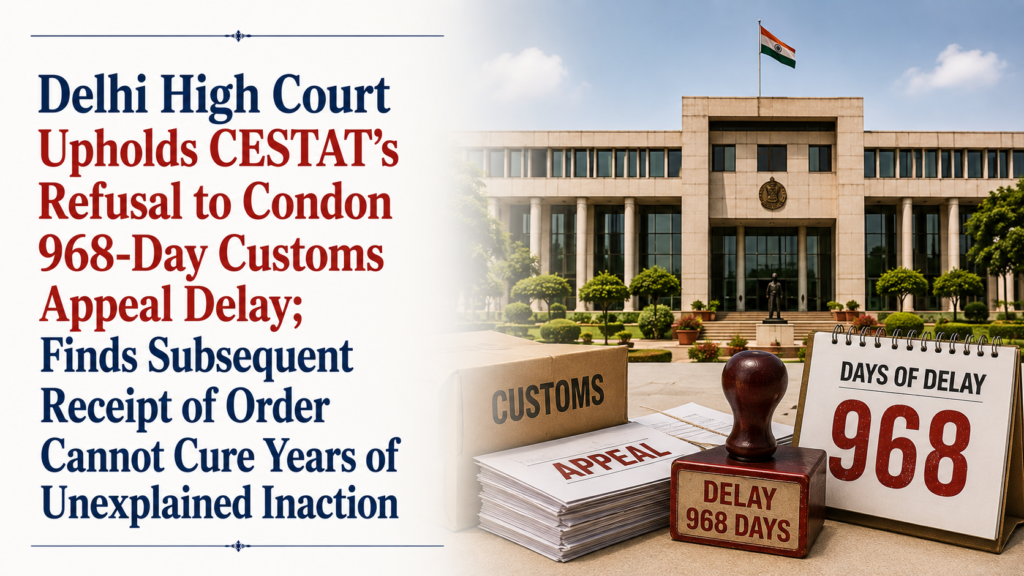
Delhi High Court Upholds CESTAT’s Refusal to Condon 968-Day Customs Appeal Delay; Finds Subsequent Receipt of Order Cannot Cure Years of Unexplained Inaction

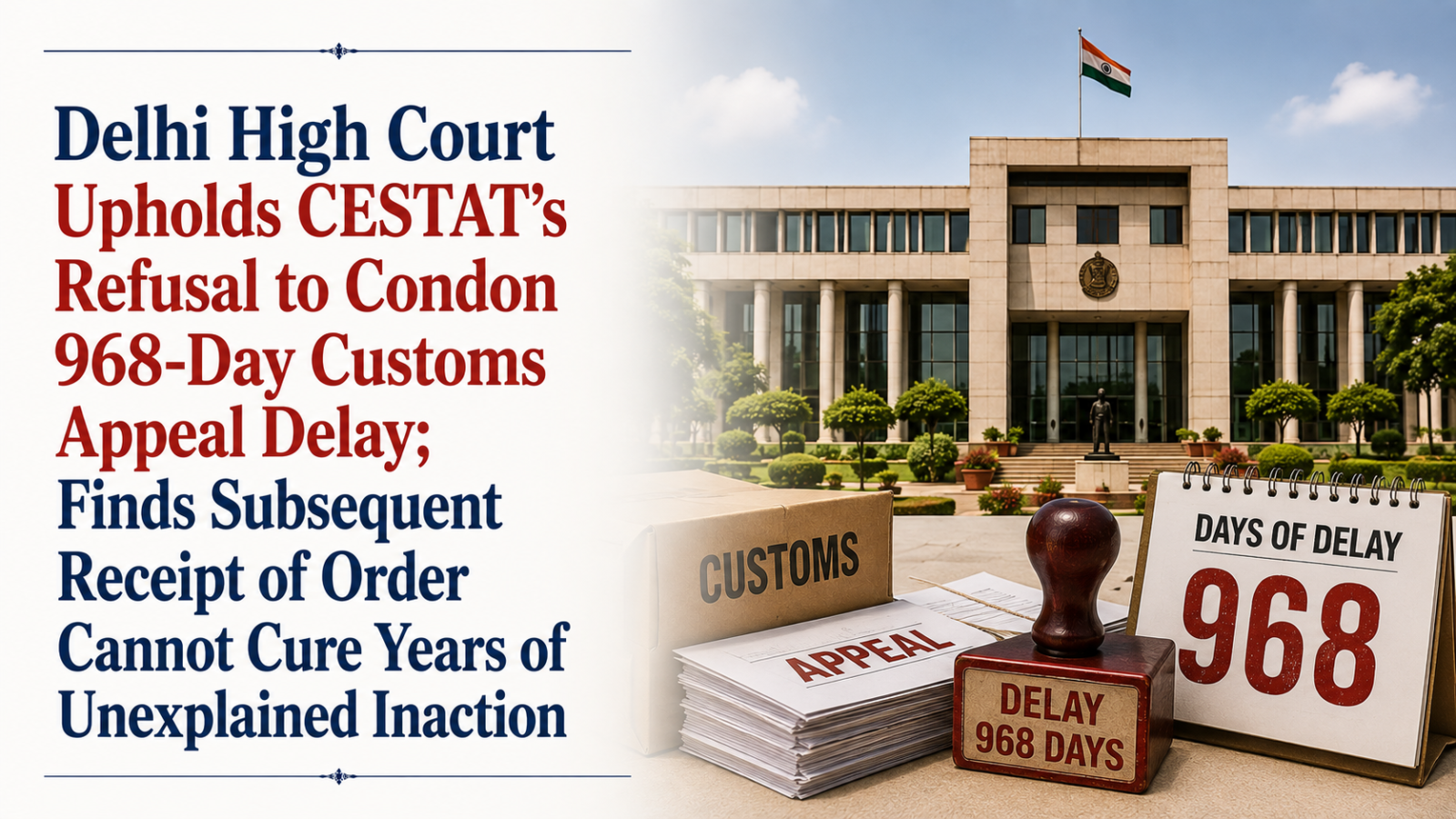
Delhi High Court Rejects Plea That 2024 Receipt Restarted Customs Appeal Limitation; Says Earlier Prolonged Inaction Remained Unexplained
Facts
The batch comprised three Customs Appeals filed by M/s Radhey Shyam Rishipal Factory, its partner Deepak Kumar and Radhey Shyam under Section 130 of the Customs Act, 1962. They challenged a common CESTAT order dated 7 January 2026 rejecting their applications for condonation of delay and consequently dismissing their appeals.
The dispute arose from a Show Cause Notice dated 22 December 2020 concerning certain imports made by the appellant-firm. The Principal Commissioner of Customs (Import), ICD Tughlakabad, ultimately passed an Order-in-Original dated 7 December 2021, re-determining the declared value of imported goods, directing recovery of differential customs duty and imposing penalties.
According to the Department, the Order-in-Original was dispatched to the address available on record and was also e-mailed on 14 December 2021 to the counsel who had represented the appellants during adjudication. A corrigendum was similarly sent on 22 December 2021.
The appellants contended that the order was never served upon them personally and that they first became aware of it only when the Department initiated proceedings for freezing their bank accounts on 27 February 2024.
They claimed that a copy of the Order-in-Original was finally supplied to them on 2 July 2024, after which they filed appeals before CESTAT on 1 August 2024.
Because the appeals were far beyond the prescribed limitation period, CESTAT required applications for condonation of delay. Those applications were filed only on 20 December 2024, seeking condonation of approximately 968 days.
CESTAT rejected the applications and dismissed the appeals.
Issues
The principal issues before the Delhi High Court were:
- Whether CESTAT had erred in refusing to condone the approximately 968-day delay.
- Whether the appellants had shown “sufficient cause” within Section 129A(5) of the Customs Act.
- Whether communication of the Order-in-Original to the counsel who had represented the appellants was relevant to the question of diligence and delay.
- Whether the appellants could rely on alleged non-communication by their counsel to explain the entire period of delay.
- Whether CESTAT’s findings were perverse or legally erroneous so as to give rise to a substantial question of law under Section 130 of the Customs Act.
Petitioner’s Arguments
The appellants argued that limitation under Section 129A begins from the date on which the adjudication order is communicated to the aggrieved person.
They contended that neither the Order-in-Original nor any communication concerning it was served upon them at their registered address or personal e-mail addresses.
According to them, they first acquired actual knowledge only when their bank accounts were frozen in February 2024. After obtaining a copy of the order on 2 July 2024, they filed their appeals within approximately one month.
They argued that the December 2021 e-mail sent to their erstwhile counsel could not be treated as sufficient communication because there was no evidence showing that the counsel had forwarded or communicated the order to them.
The appellants further contended that they should not suffer because of their counsel’s failure to communicate the order.
Reliance was placed on Rafiq v. Munshilal, for the principle that a diligent litigant should ordinarily not be prejudiced by a lawyer’s default.
Respondent’s Arguments
The Customs Department argued that there was no justification for interference with CESTAT’s discretion.
It pointed out that the appellants had participated in the adjudication proceedings through the very same counsel to whom the Order-in-Original was sent by e-mail on 14 December 2021.
The order had also been dispatched to the address available on record and displayed on the Department’s notice board.
More importantly, despite being fully aware that adjudication proceedings had concluded, the appellants made no enquiry whatsoever for nearly three years regarding their outcome.
The Department also stressed that the same counsel who had represented the appellants in adjudication later filed the CESTAT appeals and condonation applications.
When CESTAT specifically directed him to explain why his receipt of the 2021 e-mails had not been disclosed and whether he had informed the appellants, no explanation was furnished.
Analysis of the Law
The Delhi High Court first emphasised the limited nature of appellate jurisdiction under Section 130 of the Customs Act.
An appeal lies to the High Court only where a substantial question of law arises.
The High Court is not entitled to simply substitute its view for that of CESTAT on factual matters merely because another conclusion may also have been possible. A factual finding can justify intervention only if it is perverse, unsupported by evidence, ignores material evidence or rests upon an erroneous legal standard.
The Court then considered Sections 129A(3) and 129A(5).
An appeal is ordinarily required to be filed within three months from communication of the order. CESTAT may admit a delayed appeal where “sufficient cause” is established.
While “sufficient cause” receives a liberal and justice-oriented interpretation, such liberality does not dispense with the requirements of bona fides, diligence and satisfactory explanation.
Precedent Analysis
Santosh Hazari v. Purushottam Tiwari
The Court relied on Santosh Hazari v. Purushottam Tiwari, (2001) 3 SCC 179 in explaining what constitutes a substantial question of law.
A mere invitation to reassess evidence or substitute one factual view for another is insufficient.
Esha Bhattacharjee v. Managing Committee of Raghunathpur Nafar Academy
The High Court referred to Esha Bhattacharjee, (2013) 12 SCC 649, which recognises a liberal approach to condonation where a bona fide explanation exists but cautions against condonation in cases of gross negligence or lack of due diligence.
Basawaraj v. Special Land Acquisition Officer
The Court also relied upon Basawaraj v. Special Land Acquisition Officer, (2013) 14 SCC 81.
The principle applied was that limitation provisions must be enforced even where their operation may cause hardship. Equity cannot substitute for a legally sufficient explanation where prolonged negligence or inaction is established.
Rafiq v. Munshilal
The appellants relied on Rafiq v. Munshilal, (1981) 2 SCC 788, where the Supreme Court protected a diligent litigant from prejudice caused solely by counsel’s default.
The Delhi High Court distinguished that precedent.
Here, the appellants themselves had remained inactive for nearly three years despite being aware that adjudication proceedings had taken place and concluded. Therefore, the matter was not one where the entire delay resulted exclusively from counsel’s lapse.
Court’s Reasoning
The Court attached considerable importance to the appellants’ own conduct.
They were admittedly aware of the adjudication proceedings and had actively participated through counsel. Nevertheless, after hearings had concluded, they made no enquiry between December 2021 and February 2024 about whether an adjudication order had been passed.
Even if the Court assumed in their favour that they personally did not receive the Order-in-Original in December 2021, this did not explain why they remained completely inactive for nearly three years.
The Court also held that CESTAT had not relied exclusively on service by e-mail to counsel.
Its decision rested on the cumulative circumstances:
- the appellants knew about the adjudication;
- counsel represented them throughout;
- the Department attempted postal service;
- the order was e-mailed to counsel;
- it was displayed on the notice board; and
- the appellants made no enquiry for nearly three years.
Another important factor was that the same counsel who received the Order-in-Original by e-mail in 2021 later filed the delayed appeals and condonation applications.
Despite CESTAT specifically calling upon him to explain why receipt of the e-mails had not been disclosed, no response was filed.
The High Court further observed that knowledge acquired by a duly appointed counsel is at least a relevant circumstance when testing diligence and sufficient cause, even if the question whether such service amounts to formal statutory communication is kept separate.
The subsequent receipt of a fresh copy on 2 July 2024 and prompt filing thereafter could not erase the earlier unexplained period of inactivity.
Conclusion
The Delhi High Court held that CESTAT had considered all relevant material and applied the correct statutory test of “sufficient cause”.
Its refusal to condone the approximately 968-day delay was neither arbitrary nor perverse.
No material evidence had been ignored, no erroneous legal principle had been applied and the appellants’ challenge essentially sought re-appreciation of factual circumstances, which was outside the limited scope of Section 130.
The Court therefore held that no substantial question of law arose.
It further concluded that the appellants had failed to satisfactorily explain their prolonged inaction before allegedly receiving the Order-in-Original on 2 July 2024.
Accordingly, all three customs appeals were dismissed and the pending applications were disposed of.
Case Details
Case: M/s Radhey Shyam Rishipal Factory v. Principal Commissioner of Customs (Import) with Deepak Kumar v. Principal Commissioner of Customs (Import) and Radhey Shyam v. Principal Commissioner of Customs (Import)
Court: High Court of Delhi at New Delhi
Case Number: CUSAA Nos. 89/2026, 90/2026 and 92/2026 with connected applications
Judge: Justice Anil Kshetarpal and Justice Shail Jain; judgment authored by Justice Shail Jain
Date: 18 August 2026; reserved on 6 August 2026
Result: Appeals dismissed. CESTAT’s refusal to condone approximately 968 days’ delay upheld; no substantial question of law found under Section 130 Customs Act.