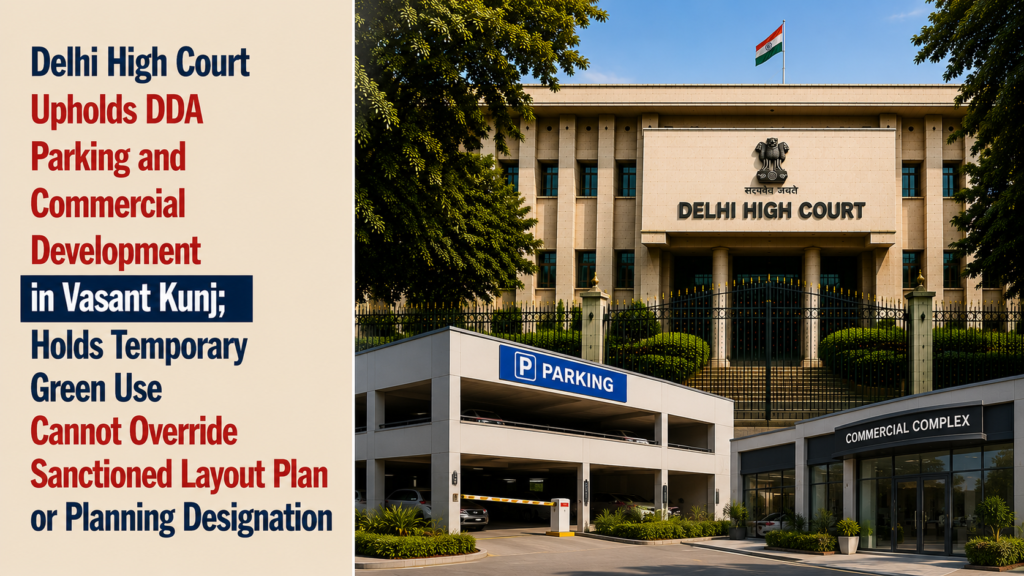
Delhi High Court Upholds DDA Parking and Commercial Development in Vasant Kunj; Holds Temporary Green Use Cannot Override Sanctioned Layout Plan or Planning Designation

Delhi High Court Upholds DDA Tender for Vasant Kunj Development; Says Temporary Open Gym and Biodiversity Park Cannot Freeze Sanctioned Commercial and Parking Use
Facts
The connected writ petitions were filed by Residents’ Welfare Associations representing Saraswati Apartments, Narmada Apartments, Yamuna Apartments and Ganga Apartments in the DDA Mega Housing Complex at Vasant Kunj. They challenged DDA’s Notice Inviting Tender dated 27 June 2025 and the consequential allotment dated 18 October 2025 for development works, including construction of a two-level deck parking facility and local commercial amenities.
The RWAs contended that the proposed works would consume land which residents had been using as a biodiversity park, open gym and recreational area. According to them, converting this land for parking and commercial development violated the Master Plan for Delhi and constitutional environmental protections under Articles 21 and 48-A.
The Mega Housing Scheme had been introduced around 2010. Its approved layout plan provided for Local Shopping Centres, community facilities, circulation roads, underground parking and land earmarked for multi-level parking. Certain parcels remained vacant and, over time, some portions began to be used as an open gym and biodiversity park.
DDA maintained that these temporary uses did not alter the original sanctioned land use. It proceeded with the tender and awarded the work to M/s Bansal Construction Co. on 18 October 2025.
Issues
The principal issue was whether DDA could proceed with the proposed parking and commercial development in accordance with the sanctioned layout plan, even though residents had for years been using the land as a green and recreational area.
The Court also considered:
- Whether temporary community use could create an enforceable right to preserve the land permanently as green space.
- Whether the proposed development violated the MPD or any statutory planning instrument.
- Whether environmental principles, including the Public Trust Doctrine, could prevent development of land not legally designated as a park.
- Whether additional parking and commercial infrastructure was arbitrary because other parking spaces or shops allegedly remained unused.
- To what extent the High Court could interfere with decisions involving urban planning and infrastructure policy.
Petitioners’ Arguments
The RWAs argued that the existing biodiversity park and open recreational space constituted an important ecological amenity for residents.
They contended that removing the green space would deprive the housing complex of its only meaningful recreational and ecological area and would violate planning norms and environmental principles, including the Public Trust Doctrine.
They also argued that existing basement parking facilities remained non-operational, making construction of further parking infrastructure unnecessary, arbitrary and disproportionate.
Further objections were raised concerning population norms for Local Shopping Centres, the availability of existing malls in Vasant Kunj and allegedly vacant commercial premises in the surrounding area.
Respondent’s Arguments
DDA argued that the development strictly followed the originally sanctioned layout plan.
According to DDA, the relevant parcels had always been earmarked for neighbourhood commercial facilities and parking purposes. Their temporary or permissive use as green space could not legally alter their sanctioned planning designation.
DDA therefore maintained that it was implementing an already approved development scheme rather than converting a legally designated park or protected open space.
Analysis of the Law
The High Court emphasised the limited scope of judicial review in matters of urban planning.
Questions concerning zoning, infrastructure, land use and civic planning primarily fall within the competence of specialised statutory authorities. A writ court should interfere only where the planning decision suffers from illegality, arbitrariness or violation of a statutory requirement.
The Court found that the RWAs did not challenge the existence of planning approval itself. Their grievance was essentially that because the land had been used for years as a green area, that use should now prevail over its sanctioned designation.
The sanctioned layout plan, however, showed the relevant parcels as utility plots for neighbourhood commercial facilities and parking infrastructure, not as a park or protected open space under the MPD or another statutory instrument. No material demonstrated that the land had subsequently been legally redesignated.
The Court therefore held that mere passage of time or temporary community use cannot create rights inconsistent with the approved planning framework.
Precedent Analysis
The Court referred to Rohit Dhupar & Ors. v. Lt. Governor & Ors. and Smt. Maya Devi v. Union of India.
These authorities recognise that layout plans are planning instruments capable of administrative adjustment for infrastructure and feasibility requirements, provided statutory planning instruments such as the Master Plan remain unaffected.
The precedents therefore supported judicial restraint in reviewing decisions involving implementation and adjustment of sanctioned urban planning schemes.
Court’s Reasoning
The Court found no legal basis for treating the land as a protected green area merely because residents had been using it as such.
Protection of green spaces undoubtedly forms part of constitutional environmental governance. However, according to the Court, such protection becomes legally decisive where the land is actually designated as ecological, recreational or open space under the applicable statutory planning framework.
Environmental principles could not be invoked to prevent implementation of an approved development scheme on land earmarked for another lawful use.
The Court also rejected the argument based on population norms for Local Shopping Centres. The MPD operates at neighbourhood and zonal levels, rather than merely by reference to the population of one housing cluster. Questions concerning the adequacy of such infrastructure are matters for planning experts.
Similarly, whether Vasant Kunj already had sufficient shopping malls, whether shops were lying vacant, or whether additional parking was actually necessary were matters of urban planning and expert assessment, not questions for judicial determination under Article 226.
The Court further noted that during pendency of the proceedings DDA had granted the residents a public hearing and passed a reasoned speaking order dealing with their concerns. Consequently, the complaint regarding lack of consultation no longer survived.
Ultimately, the Court held that the RWAs were asking it to substitute judicial preference for the assessment of expert planning authorities, which was impermissible in writ jurisdiction.
Conclusion
The Delhi High Court held that DDA’s tender dated 27 June 2025 and allotment dated 18 October 2025 were consistent with the sanctioned planning framework.
It found no illegality, arbitrariness or violation of any statutory planning provision.
The Court held, in substance, that:
- temporary use of vacant land as a biodiversity park, open gym or recreational area does not permanently alter its sanctioned land use;
- residents cannot acquire a permanent planning entitlement merely through long community use;
- environmental principles cannot restrain implementation of an approved scheme where the land is not legally designated as protected green space; and
- courts should not replace expert urban-planning assessments with their own view on the desirability of infrastructure projects.
Accordingly, all writ petitions were dismissed, pending applications were disposed of, all interim orders were vacated, and no costs were imposed.
Case Details
Case: Saraswati Apartments Residents Welfare Association v. Delhi Development Authority & Ors. with connected matters
Court: High Court of Delhi at New Delhi
Case Numbers: W.P.(C) 17333/2025; W.P.(C) 1185/2026; W.P.(C) 2122/2026; W.P.(C) 958/2026
Judge: Justice Anil Kshetarpal and Justice Amit Mahajan
Date: 17 August 2026; judgment reserved on 21 April 2026
Result: Writ petitions dismissed; DDA’s tender and allotment for two-level parking and commercial development upheld, with interim orders vacated and no order as to costs